Choosing a mover safely: how to vet, insure and avoid scams
Regulatory text checked .
A moving company is safe to hire when three things check out together: it holds the operating authority and registration to carry your belongings, it stands behind coverage that would actually pay you back if something is lost or damaged, and it shows none of the warning signs of a scam. Treat those as one decision rather than three separate errands. A company can look polished and still fail one of them, and any single failure is reason enough to pause before you pay a deposit or sign anything.
Before you weigh any of that, settle one question: will your belongings cross a state line? That answer decides which rulebook your three checks are measured against, so it comes first.
This page is the map. The step-by-step license lookups, the coverage math, and the full scam checklist live in the deeper guides it points you to.
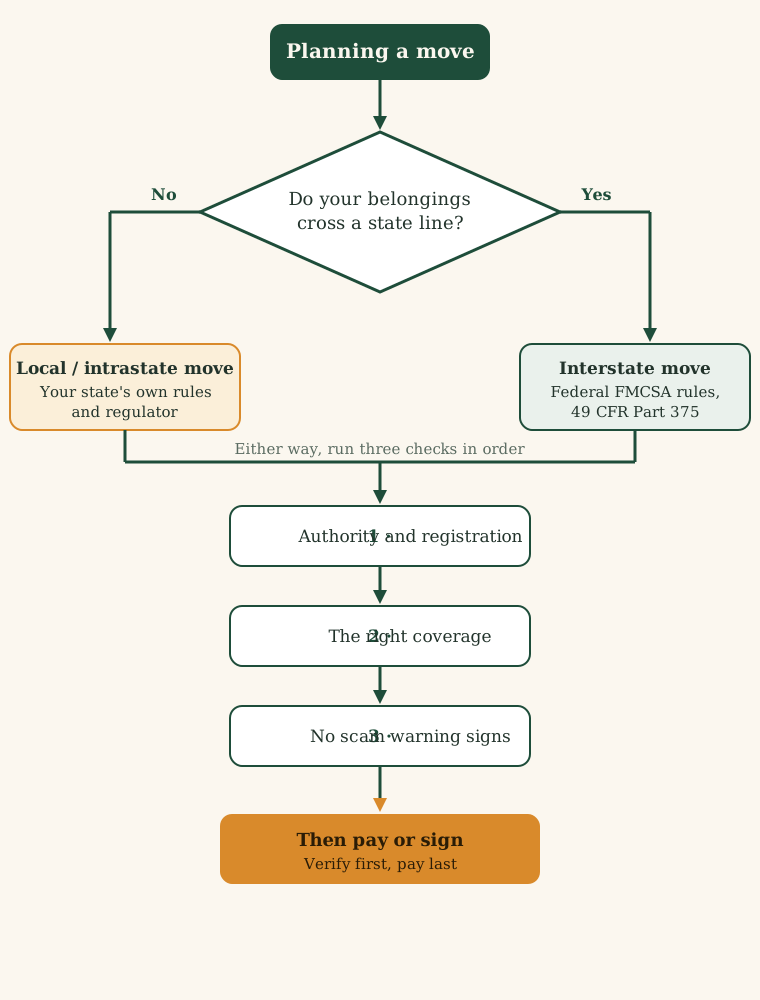
The three checks that make a mover safe to hire
The three checks fit together into a single judgment. Authority and registration tell you the company is real and accountable. Coverage decides what you could recover if a box is crushed or a shipment never arrives. The warning signs catch the operators who skip the first two and count on you not noticing.
Put plainly, you are confirming three things before you commit:
- Authority and registration: is this a real, authorized household-goods carrier, and does its registration number reflect active authority to do your move?
- The right coverage: what would you actually get back if something is lost or damaged?
- Scam warning signs: do the quote, the payment demands, and the reviews show the patterns that give rogue operators away?
None of the three stands alone. A mover that clears all three is worth hiring; one that fails even one is worth walking away from.
Authority and registration: is the company allowed to move you?
Authority comes first because it establishes that you are dealing with a genuine, accountable business before anything else matters. For an interstate move, a legitimate household-goods mover must publish its U.S. DOT number in its advertising, in the exact form “U.S. DOT No. (assigned number),” under 49 CFR § 375.207. We checked this federal text against the official eCFR on October 20, 2026.
A number on an ad, though, is only a starting point. A company can hold a DOT number and still not be authorized to transport household goods across state lines, which is a different thing entirely. In one consumer-report case, a mover displayed a DOT number yet turned out to have no authority to carry household goods interstate, so the number alone gave the customer no real protection. The lesson is narrow and important: check for active household-goods authority behind the number, not just the number itself.
A second, concrete legitimacy signal is what the company hands you up front. Before it executes the bill of lading (the contract that lists what is being moved and on what terms), an interstate mover must give you a written estimate, a notice that its rate tariff is available, short summaries of its arbitration and complaint procedures, and the FMCSA booklet “Your Rights and Responsibilities When You Move” along with the “Ready to Move?” guide, as set out in 49 CFR § 375.213. An outfit that resists putting any of this in writing is telling you something. The actual lookup steps for the DOT number and state license live in the verify guide.
The right coverage: what you could actually recover
Coverage decides the practical question behind the whole decision: if your things are damaged or lost, what can you get back? On an interstate move the mover is, in general, legally liable for loss of or damage to the goods carried on its lawful bill of lading, under 49 CFR § 375.201 (current as of that same October 20, 2026 check). That full-value liability is the default. You can waive it in writing in exchange for a lower released rate, and the mover must disclose the limits of its liability to you.
The phrase to hold onto is waived in writing. The higher, full-value protection stays in place unless you sign it away for the cheaper released rate, so read what you are agreeing to before you initial it. How valuation (the level of liability coverage you choose) compares with buying separate insurance is the job of the coverage guide; here it is enough to know that a default protection exists and that a signature can lower it.
Scam warning signs: the check that catches the rest
The warning-signs check is the safety net for everything the first two miss. Rogue operators skip authority and coverage on purpose, and the patterns surface in three places: the quote, the payment demands, and the reviews. An estimate that comes in far below every other bid, pressure to pay a large sum before any work is done, and a balance that suddenly must be cash or a money order once the truck is loaded are the classic tells.
These are overview cues, not the whole catalog. The full red-flag checklist and the steps for reporting a mover live on the scams guide. What matters here is recognizing enough of the pattern to stop before you pay or sign.
Seen together, the three checks answer one question in three parts. Authority tells you the company is real and accountable, coverage tells you what you would recover, and the warning signs catch the operators who never intended to honor either. A mover is safe to hire only when all three hold at once.
Interstate vs. local moves: which rules apply to you
One test settles which rules govern your move: do your household goods cross a state line on the way to the new home? If they do, it is an interstate move.
An interstate move falls under the federal consumer-protection rules the Federal Motor Carrier Safety Administration (FMCSA) sets out in 49 CFR Part 375. Those rules apply, by their own terms, only when a carrier transports household goods for individual shippers in interstate commerce, under 49 CFR § 375.101, which we confirmed against the current eCFR text on October 20, 2026.
A move that stays entirely within one state is a local or intrastate move, and it follows that state's own moving rules and its own regulator. Those rules differ from state to state, so confirm what your own state requires rather than assuming that a rule you read about elsewhere applies to you.
Never generalize one state's rule to all fifty.
| Your move | Which rules apply | Who oversees it |
|---|---|---|
| Interstate (household goods cross a state line) | Federal FMCSA consumer-protection rules in 49 CFR Part 375 | FMCSA (federal) |
| Local or intrastate (move stays within one state) | That state's own moving rules, which vary by state | That state's own regulator |
This fork comes first because it sets the standard the other two checks are measured against. The authority you confirm, the coverage that applies, and the complaint history you look up all depend on whether you are reading federal rules or your state's.
One early federal cue is easy to notice: an interstate household-goods mover must show its U.S. DOT number in all of its advertising, as noted above. Treat a displayed number as a prompt to look the company up, not as proof that it holds active household-goods authority. The number gets you to the right record; it does not vouch for the company. The actual USDOT and state-license lookup steps belong to the verify guide.
When you are ready to run that lookup on a specific company, our guide to checking a mover’s USDOT number and license walks through the FMCSA SAFER and protectyourmove.gov searches and the state regulator step by step.
Quick answers: license, coverage, and scam red flags
How do I know a moving company is legitimate?
Run the three checks before you pay or sign. Confirm the company's authority and registration, confirm the coverage that will apply to your shipment, and watch for the scam signs in the quote and the payment terms. Legitimacy is the sum of all three, not any one of them.
What should I check before I hire?
The three checks, plus a few habits that make them easier. Get several written estimates, commonly three to five, so you have a normal range to judge against. Confirm the company is registered and look at its complaint and standing history. Insist on an in-person or video survey of your home rather than a quote given sight-unseen over the phone, which is how lowball estimates start.
When you read reviews, weigh the critical one-star reviews carefully. Scam operations have been caught padding their ratings with fake five-star praise written by their own staff, so the complaints often tell you more than the applause.
Is a much cheaper quote a warning sign?
A quote that sits far below every other bid you collected is a reason for suspicion, and the payment pattern tells you more than the headline price. A modest deposit can be ordinary. A demand for a large payment before any work happens is not, and a balance that must suddenly be paid in cash or a money order once your belongings are already on the truck is a classic trap.
The danger is in the payment demand, not in a deposit by itself.
What protects my belongings if something breaks?
For an interstate move, check your valuation selection and any written waiver before signing. Our guide to what coverage protects your belongings explains the Full Value Protection default, separate insurance and the questions to ask your existing insurer.
Where do I start if I've never hired a mover?
Decide interstate versus local first, then run the three checks in order, and read every document before you sign it. That sequence keeps you from skipping the step that determines all the others.
Read before you sign, every time.
Could the company I picked be a broker, not the mover?
Possibly, and it is worth confirming early. Enter your details on a quote site, and your phone number and email can be passed to a long list of companies. The one you choose may turn out to be a broker that arranges the move rather than the carrier that actually performs it. That is a distinction to pin down, not proof that every quote site or broker is a scam; plenty of brokers are legitimate. You simply want to know which role the company plays and who will show up at your door.
The full red-flag list and the reporting steps are on the scams guide.
Across all of these answers runs one usable rule: verify first, pay last, and keep everything in writing. Each quick answer is a starting point; open the matching guide when you need the full procedure.
Choose your situation and where to go next
Match your own starting point to the next step and the guide that carries the detail. Find the row that sounds like you.
Before paying or signing, compare the written offer, company roles and pickup documents using the red flags of a moving scam.
| If this is you | Start here, and which guide answers it |
|---|---|
| One online quote looks much cheaper than the rest | Run the three checks before you pay or sign; the scams guide covers the full red-flag list |
| Unsure whether crossing a state line changes the rules | Decide interstate versus local first (federal Part 375 versus your state); the verify guide covers the lookup |
| Worried about what happens if something breaks | The interstate default liability can be kept or waived in writing; the coverage guide explains valuation versus insurance |
| Never hired a mover before | Decide interstate versus local, then run the three checks in order and read every document before signing |
| A mover wants a large deposit and cash at delivery | Treat a large up-front payment or a cash-only balance after loading as a red flag; the scams guide has the full list and what to do |
| You plan to move yourself instead of hiring a company | There is no mover to vet, so these three checks do not apply; this page is for picking a company to hire |
Where each deep guide takes you
Three guides carry the procedures this page only outlines. The verify guide walks through looking up a USDOT number and a state license and confirming active household-goods authority. The coverage guide explains how valuation and separate insurance actually work and how to decide between them. The scams guide lays out the complete red-flag checklist and the steps for reporting a mover that has crossed the line.
Detailed caution about paperwork lives in those guides too. One example worth previewing: do not sign a clean delivery receipt before you have inspected your belongings, because a signature saying everything arrived fine can be used to deny a later damage claim. The guides explain how to note an inspection in progress on the document instead.
Whichever row fits, the next move is to open that guide and follow its steps. Keep the order straight: settle the jurisdiction, run the three checks in order, and only then pay or sign.
Verify first, pay last. When a demand feels off, stop before you hand over money.