Scammed by a Mover or Goods Held Hostage: What to Do
Regulatory text checked .
Open your signed estimate, bill of lading—the transportation contract—and payment receipts. Ask the carrier in writing for your shipment’s location, a delivery appointment and an itemized explanation of any increased demand.
If delivery depends on paying an amount the mover is not entitled to demand, contact FMCSA immediately at 888-368-7238. Do not wait to finish the complaint packet.
Choose your situation
- Late shipment, unknown location: Ask a supervisor for a definite delivery update and a copy of the delay notice. Check the delay branch.
- Higher price after loading: Compare signatures and loading times; request the charge basis and document your applicable payment offer. Check the increase.
- Delivered with missing items, damage or disputed charges: Record delivery discrepancies, keep separate payment and damage evidence, then write to the carrier. Record the delivery and start the dispute.
- Dispute request unanswered: Keep proof of receipt and request the named program’s written status. Follow up on the stalled request.
Contents
If your goods are held hostage: your federal rights
Is this a delay or a refusal to deliver?
Ask whether the carrier is refusing delivery unless you pay more. A missed delivery window or vague location update alone does not establish that condition. Save the actual demand, including any storage or auction threat.
For a delay, ask a supervisor for a definite date or delivery period. Under 49 CFR 375.605, the carrier must notify you at its expense once the delay becomes apparent, advise expected dates and keep written notification records. Request a copy; it must be furnished by first-class mail or in person.
Keep the update beside the original delivery window.
What can the mover collect at delivery?
Part 375 applies to household-goods motor carriers serving individual shippers in interstate commerce. For an intrastate move, check the relevant state’s rules. Find your estimate type and collect-on-delivery terms before comparing amounts.
| Estimate | Starting amount and allowed extras |
|---|---|
| Binding, fixing charges for listed goods and services | The binding estimate amount. Qualifying services you requested after the bill of lading was issued; applicable tariff-defined impracticable operations, capped at 15% of all other charges due at delivery. |
| Non-binding, approximating charges | Up to 110% of the estimate. The same requested-service and tariff-defined impracticable-operation exceptions, with the same 15% cap. |
These delivery collection limits concern obtaining possession. A non-binding shipment’s final tariff charges may be higher. Reconcile previous payments against receipts.
When and why was the estimate changed?
For extra goods or services identified before loading, the carrier can reaffirm the estimate or prepare a new detailed estimate for your signature. A binding estimate can also become non-binding by written agreement. Loading without the required change reaffirms the original, subject to the later-service exceptions in 375.403(a)(6)–(9) and 375.405(b)(7)–(10).
Compare the signature timestamp with the loading time.
Under 375.403(a)(8) and 375.405(b)(9), if the carrier says new services are necessary after the bill of lading is issued, it must explain them before performing them and give you at least one hour to decide. If you agree to pay, it must obtain your signature on an attachment incorporated into the contract, then bill for those services after 30 days from delivery.
If you do not agree to pay, the carrier should perform only extras necessary to complete delivery and bill after 30 days from delivery. Applicable impracticable-operation charges remain separately collectible at delivery within the 15% cap.
Services you request after issuance follow a different branch. For binding estimates, the carrier must disclose charges, obtain your agreement and prepare a new binding estimate for your signature; those extras may be payable at delivery. For non-binding estimates, 375.405(b)(10) permits delivery collection for requested extras alongside the applicable estimate component.
What if only part arrives or cash is demanded?
For partial delivery, prorate the binding estimate or applicable non-binding amount up to 110% by delivered weight divided by total shipment weight. Add applicable shipper-requested services after bill-of-lading issuance and tariff-defined impracticable operations, capped at 15% of all other charges due at delivery. Prorate the estimate component, not every extra. See 375.403(a)(11) and 375.407.
For non-binding collect-on-delivery shipments, 375.407(a) tells the carrier, You must accept the form of payment agreed to at the time of estimate
, unless you agree in writing to change it.
Record your payment offer and the carrier’s response.
What should your written delivery request say?
Use your documents to fill this editable request. Any reply-by date is your requested response date, not a statutory deadline.
Subject: Delivery request for [shipment reference]

My shipment from [origin] to [destination] was collected on [date].
The signed [binding/non-binding] estimate dated [date] totals [amount].
I have paid [amounts, dates, methods; receipts attached].

You now demand [amount]. Please itemize each extra charge,
its service category and tariff basis, and explain when it was agreed.
Please confirm the shipment’s current location and delivery appointment.

Based on [estimate and applicable documented charges], I offer
[remaining amount] by [agreed payment method] for delivery.
Please confirm acceptance or explain any refusal in writing.
Please reply by [optional requested date].
Keep the sent request and proof of receipt.
Refusal after an offer of the applicable payment can constitute failure of reasonable dispatch under 375.403(a)(10) or 375.407(b). Preserve that evidence for FMCSA.
Document everything: estimates, inventory, payments
Which records explain the demand?
Keep original and revised estimates, contract attachments, inventory, receipts, bank records and messages about charges, delivery, storage or auction.
| Find | Compare with |
|---|---|
| Estimate type, goods/services, amount, signatures and timestamps | Revised estimate and loading time. |
| Bill of lading’s payment form, delivery maximum, dates, charge terms and attachments | Estimate, new demand and signed changes. |
| Carrier legal/trade name, participating carriers and identifiers | Payment recipient, date, method and receipt/bank proof. Separate broker from carrier payments. |
| Inventory identifiers | Delivered cartons and uncartoned items; missing/damage notations. |
Use the bill-of-lading payment field to test a cash demand against the agreed method and any signed change. Compare the delivery maximum with the estimate and applicable extras.
How do you reconstruct what changed?
Order signatures, loading, payments, increased demands, delay notices and refusals by date and time. Distinguish written evidence, telephone statements and unknowns. After a call, request written confirmation; attach the delivery request and payment offer to the relevant event.
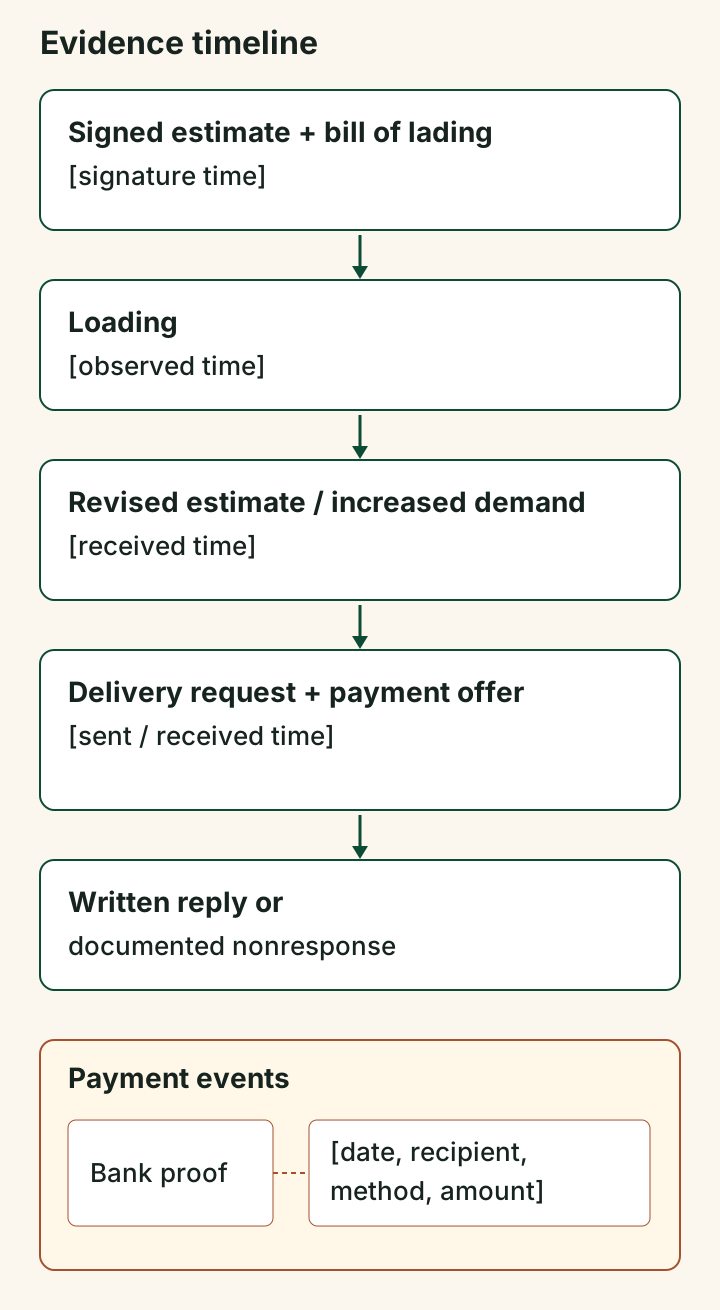
Put each event at its actual time. A revised estimate received before loading belongs before that step.
What should you record when the goods arrive?
Match cartons and uncartoned items to inventory identifiers. Under 375.503, you must have the opportunity to verify articles and condition, note missing or damaged items and receive copies. Photograph discrepancies. Keep damage evidence separate from the payment dispute.
A receipt may record apparent condition except as noted; 375.701 prohibits language releasing carrier or agent liability.
For a future booking, retain these records alongside how to verify a mover before the next move.
How to file an FMCSA and state complaint
Choose the recipient by the action you need.
| Route | Send and retain |
|---|---|
| FMCSA | Report alleged violations with your factual packet; retain the complaint copy, case number and agency status notice. |
| Relevant state agency | Follow its own instructions; retain its acknowledgment or status where provided. |
| Carrier dispute | Request individual resolution with evidence; retain the response and applicable arbitration information. |
Keep the carrier’s written position separately from the agency’s complaint record.
What should you include in the complaint?
Describe what happened, when and where. Include your and the mover’s or broker’s contact details, origin/destination and USDOT/MC numbers if available. Attach the estimate, contract, inventory, payment proof, demands and delivery request/refusal following FMCSA’s packet guidance.
How do you file and keep proof?
Follow the FMCSA Complaint Center instructions:
- Select General Public and the relevant company type. Enter incident details and the matching allegation category.
- Provide first/last name and phone; add email for email notification, otherwise notification comes by mail. Choose whether to share contact information with the company. Mark the on-behalf checkbox when applicable.
- Search by company name or USDOT number; enter company details manually if absent.
- Describe and upload evidence. If you have no uploads, enter N/A in the documentation box.
- Review and certify. Save or print the complaint page before selecting Submit Complaint. Save the resulting case number.
FMCSA reviews whether a complaint is actionable and notifies you. Reports inform enforcement decisions; investigation is not assured. FMCSA cannot settle your individual loss, damage or charge dispute.
Which state agency should you contact?
Choose the relevant state in FMCSA’s State-Level Enforcement Resources, then follow that agency’s instructions. Reuse the factual packet and federal case number where relevant. Save any acknowledgment.
In an emergency, call 911.
Dispute resolution and arbitration options
How do you start a carrier dispute?
Separately write to the carrier identifying the shipment, disputed amounts or missing/damaged items, requested resolution and evidence. Request claim instructions, the arbitration summary, initiation forms, costs and legal effects. Keep proof of receipt.
Does the federal arbitration program cover your dispute?
The 375.211 carrier program covers property loss/damage and whether charges beyond those collected at delivery must be paid. Check applicability for broker/deposit disputes. It requires an independent arbitrator, program notice before signing the contract and initiation information on request. The carrier cannot require advance agreement before a dispute arises.
- $10,000 or less: At your request, the carrier must agree to binding arbitration.
- Above $10,000: Binding arbitration also requires carrier agreement.
You cannot be charged more than half the total cost of instituting proceedings; the arbitrator may allocate costs in the decision.
The decision is due within 60 days of receipt of written dispute notification. A reasonable extension is possible when a party supplies reasonably required information late. That is a decision timetable, not a payment promise.
What if the carrier or administrator does not respond?
Check the program named in your documents and whether it received a complete request. Ask the responsible carrier or administrator for written status and outstanding information or fee issues. Preserve unanswered correspondence.
Report suspected failure to meet federal arbitration duties to FMCSA. For individual recovery, consider civil action in a court of appropriate jurisdiction as an alternative.
What experience should you ask a lawyer about?
Ask about interstate household-goods carrier disputes. Bring the estimate, contract, payment/delivery chronology, correspondence and separate damage records for an assessment of your options.