Moving Insurance and Valuation: What Actually Protects Your Belongings
Before choosing moving protection, match the belongings and losses you want covered to the document that makes a mover or insurer responsible.
Regulatory text checked .
Moving protection can come from the mover’s valuation liability, a separate insurance policy, or your existing homeowners or renters policy. Compare the responsible party, covered loss, limits, deductible and dates before paying for additional protection.
Choose your situation
- The mover says it is insured. That does not identify your household’s protection. Request the valuation selection and any separate policy.
- You are signing for an interstate move. Full Value Protection applies unless you waive it in writing. Read the valuation line and waiver before signing.
- You packed boxes or have valuable items. Packing conditions and item declarations affect protection. Get the written packing terms and identify articles needing a declaration.
- Your belongings will go into storage. Transit protection may not cover every storage arrangement. Confirm each provider, location and coverage period.
- You already have homeowners or renters insurance. It may cover certain events without covering handling damage. Ask your insurer about causes of loss, limits and dates.
Moving insurance vs. valuation: what the words really mean
Valuation sets the mover’s legal and contractual liability for your shipment. A separate moving insurance policy creates coverage under an insurance contract. Your existing homeowners or renters policy is another contract, with its own insurer and conditions.
Start by identifying which document answers your question. The company selling protection and the company responsible under it may be different.
| Protection | Who to identify | What to obtain |
|---|---|---|
| Mover valuation | The mover responsible for the shipment | Valuation selection in the estimate and bill of lading, with applicable conditions |
| Separate insurance | The insurer named in the contract | Issued policy or written purchase record, plus coverage terms |
| Homeowners or renters policy | Your existing insurer | Actual policy, relevant endorsements and confirmation for the planned move |
For the separate-insurance row, follow the insurer’s name through to the policy and reporting instructions. A line on a moving quote saying “insurance included” leaves the actual insured goods, losses and period unanswered.
What does an insured mover establish?
A mover’s registration and business insurance records do not select your valuation level or establish coverage for a particular household loss. Keep the check of the mover’s license and USDOT records alongside this separate document review.
Keep your valuation selection and any insurance policy together.
The mover’s liability: Full Value vs. Released Value overview
The federal rules below apply to interstate household-goods moves. For a move within one state, check that state’s applicable requirements before assuming the same choices or limits.
What applies before you sign a waiver?
For an interstate move, the initial estimate must include Full Value Protection, and that liability level applies unless you waive it. The Full Value Protection provision in Appendix A explains this starting point. Its cost is included in that estimate; it is not free comprehensive insurance.
Read the written waiver before accepting it.
Under 49 CFR 375.201(b), the general obligation uses replacement value. The rule states, “The maximum amount is the declared value of the shipment.” That declaration remains subject to Surface Transportation Board rules and applicable tariffs. A shipment total therefore needs to reflect the goods actually moving.
The mover chooses the remedy. For loss or damage while goods are in the mover’s custody, allowable tariff exceptions still matter. Under Appendix A, the mover chooses whether to restore the item or pay repair costs, or replace it with one of like kind and quality or pay replacement costs. You cannot assume a choice of cash or a brand-new replacement.
Ask for the protection charge and available deductible levels. The deductible is the portion of a covered loss you retain under the selected terms.
To weigh the replacement gap against the mover’s actual charge and deductible, compare Full Value and Released Value Protection in detail before recording your choice.
Released Value follows a written waiver. A written waiver changes the liability framework. Appendix A’s Released Value option carries no additional charge and limits liability to no more than $0.60 per pound per article.
For the rule’s example, a lost 10-pound stereo component worth $1,000 produces a liability ceiling of $6. The item’s weight drives that calculation; the shipment’s declared total is a different figure.
Which valuation fields should you check?
Find the selection in both your estimate and your bill of lading, the shipment’s receipt and transportation contract. Compare the selected protection with what the mover offered.
- Protection selected and any written waiver of Full Value Protection.
- Declared shipment value, checked against your inventory.
- Deductible and the charge for the selected protection.
- Item declarations and conditions, including the applicable tariff reference.
Resolve a mismatch before signing.
What changes when you pack the cartons?
For cartons you pack, record the contents and their condition before sealing, and keep photographs of the packing and carton exterior. At delivery, photograph visible carton damage before opening and keep the packaging available. Ask what the mover and any insurer require you to record on delivery paperwork. Documentation helps establish what was shipped and its condition; the applicable terms still determine how a loss is evaluated.
Humboldt’s valuation explanation, for example, distinguishes externally damaged self-packed cartons from intact cartons with damaged contents. That is a reason to obtain your mover’s own written conditions and preserve photographs of the cartons and goods, rather than assume another carrier uses identical terms.
Which valuable items need a declaration?
Under the interstate extraordinary-value provision, items worth more than $100 per pound need specific identification on shipping documents to avoid the permitted liability limitation. Ask the mover for its declaration requirements before the move.
The shipment total does not identify those articles individually. A separate insurer may use a different definition of high value, so complete its required schedule as well.
Third-party moving insurance: when it makes sense
Start with the loss you still want covered. Test one damaged item, one missing carton and loss of the entire shipment separately. Identify the insured party, named insurer and where to report a loss under the offered contract.
Does the offered policy cover that loss?
Obtain the policy wording before relying on a product name. Match covered goods and causes of loss, packing conditions, declarations, locations and effective dates to your plan. Then compare individual-item limits, overall limits, deductible and exclusions.
The MovingInsurance.com FAQ shows why this matters. Its Total Loss Only form excludes individual items damaged or lost; its All Risk form retains exclusions; its Named Perils form covers listed events. Those are distinctions in that provider’s offerings.
A total-loss-only form would not solve a concern about one broken item. Follow each loss branch below against the offered contract before comparing price.
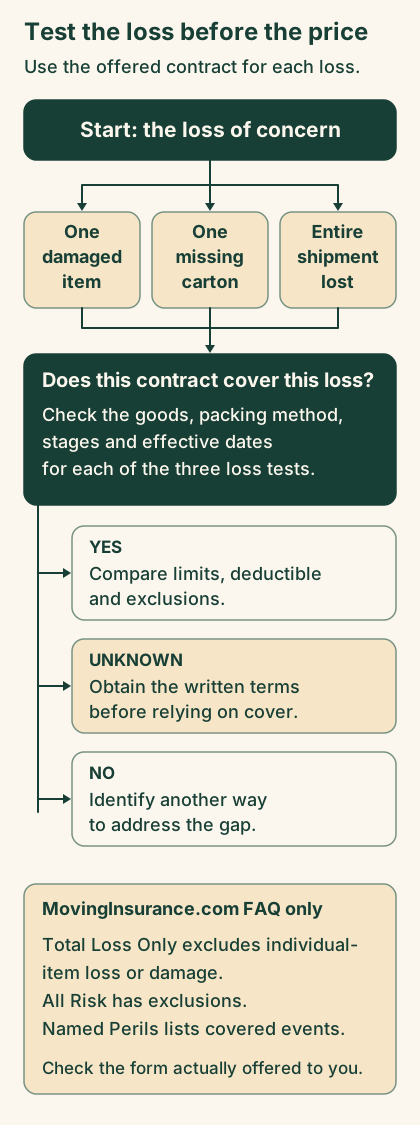
The UNKNOWN branch calls for the written terms before relying on coverage. A NO answer means the offered form leaves that concern unresolved; ask what other protection or arrangement addresses it. Keep each answer with the contract.
Electronics and matching sets deserve their own questions. In the same provider’s FAQ, internal electrical or mechanical damage without visible exterior damage is addressed by an optional addition to its All Risk offering. Compensation based on an entire pair or set is another optional addition with specific eligibility. Ask whether the proposed contract includes either feature and which items must be listed. Do not infer them from a broad coverage label.
What if the mover sells the policy?
A mover may offer separate third-party insurance. For an interstate move, when you buy it through the mover, Appendix A’s Third Party Insurance provision requires the mover to issue a policy or other written purchase record and give you a copy at purchase.
The insurer’s contract remains separate from mover valuation even when the same seller arranges both. Check its owner-packed and storage terms against the gap you identified. An additional policy can have its own restrictions on those arrangements.
What your homeowners or renters policy may already cover
Ask your existing insurer about the move before buying more protection. Describe the professional mover, packing method, storage facility if any, and planned dates.
Which cause of loss is covered?
Ask separately about fire or theft and accidental handling damage. Liberty Mutual’s renters explanation distinguishes covered perils from a mover dropping a box or scratching furniture. Progressive’s moving guidance makes the same general distinction for personal-property policies.
“My belongings are insured” does not answer whether a dropped television is covered. Request the relevant provision or endorsement for that specific event. A policy that responds to theft in transit may give a different answer for handling damage.
Which limits and dates apply away from home?
Find the actual off-premises and storage limits, item limits, deductible and exclusions. Compare those figures with the belongings at that location. The total personal-property limit on your declarations page does not by itself establish the amount available during storage.
Compare the deductible with what you would retain under the mover’s protection or a separate policy.
Confirm coverage dates for loading, transit, storage and onward delivery, including the transition from the old-home policy to the new-home policy. Ask when to change or end the old policy before canceling it. A covered cause of loss and continuous effective dates are separate requirements to check.
Obtain a written answer tied to the relevant wording. Use it in the comparison below rather than treating a general insurer webpage as confirmation of your own coverage.
How to choose the coverage you actually need
Make an inventory using the current cost of comparable replacements. Include photographs showing condition, model details where useful, receipts or appraisals you have, and articles needing declarations. Ask each provider how goods must be listed.
For each important item, keep its description, replacement basis and supporting record together. A purchase receipt can show ownership and the original purchase; a current comparable replacement listing helps explain today’s replacement estimate. An appraisal can be useful for an unusual article. Ask which evidence the mover or insurer accepts, and submit required declarations through its specified process rather than assuming that a personal spreadsheet completes the application.
Compare that inventory with the declared shipment value, any item limits and the deductible. Resale value alone can understate what replacing the belongings would require.
Which loss can you retain?
Who covers each storage handoff?
Use the worksheet to record the answer for each stage. Leave an unanswered field visible and ask the responsible provider to confirm the handoff marked by each arrow.
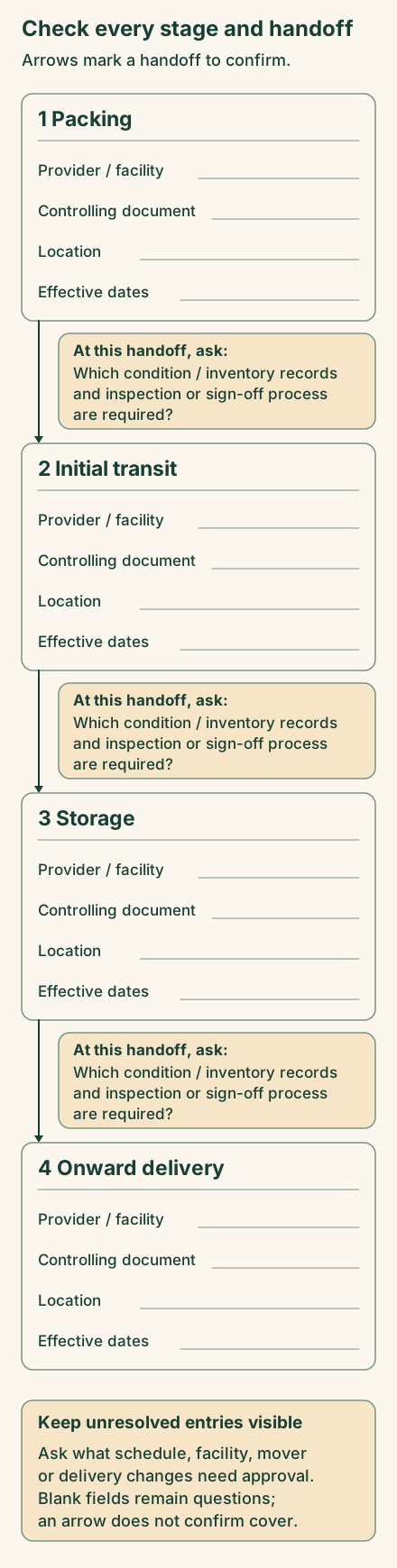
Check the last arrow, from storage to onward delivery, as carefully as the first trip. Confirmation for a storage period does not answer who covers the next move. Ask what happens if the facility, schedule or delivery provider changes and obtain any required approval.
If packed goods cannot be fully inspected at transfer, get that issue answered in writing before relying on the arrangement. Request the provider’s required documentation and how later-discovered damage is handled under its terms. Keep any unanswered point visible in your comparison.
What should the written comparison settle?
Put the actual documents side by side. Compare responsible party, goods and loss, packing and declarations, stages and locations, effective dates, per-item and total limits, deductible and exclusions. Compare price only after checking those differences.
Where two documents might respond to the same event, ask how their payments would be coordinated and what information each provider needs about the other protection. Do not add their headline limits together as if both will pay the same loss in full. Also confirm whether the deductible applies to an item, a claim or another defined unit. Those details can change the amount you retain even when the quoted protection costs look similar.
Send the unresolved question with your move details:
Subject: Written confirmation of moving protection

Move dates: [move dates]
Packing: [packing method]
Storage: [storage facility and dates, or none]
Articles needing a declaration: [goods needing a declaration]
Concern: [loss or gap of concern]

Please identify the responsible mover or insurer and controlling
valuation document or policy. Confirm covered goods, causes of loss
and packing conditions; transit, storage and onward-delivery dates
and locations; per-item and total limits; deductible; exclusions;
and declaration requirements.

Please explain required condition records and inspection or sign-off
at each handoff, and which changes need approval. Send the relevant
policy or tariff wording and tell me where to report a loss.
Check the reply against the document it names. If a sales promise and the wording conflict, obtain clarification before relying on the protection. Choose additional coverage where its checked terms address the remaining loss or stage you want covered.