How to Check a Moving Company's License and USDOT Registration
This guide walks you through confirming that one specific moving company is legally registered and authorized before you sign. A few minutes in two federal lookups, plus your state regulator for an in-state move, settle whether the company holds a real USDOT registration with active authority, whether it is an actual carrier or only a broker, and which record even applies to your move.
Regulatory text checked .
USDOT and MC numbers: what they are and how to look them up
A USDOT number is the identifier the Federal Motor Carrier Safety Administration (FMCSA) assigns to a commercial carrier. It ties the company to its federal registration and safety record, and any mover that transports goods across state lines is required to have one. When you hear a mover called federally registered, the USDOT number is the registration being referred to.
An MC number (motor carrier number) is the operating authority that lets a for-hire company legally move household goods across state lines. Where the USDOT number is about identity and safety monitoring, the MC number is about permission to haul other people's goods for pay between states.
An interstate for-hire mover holds both.
Get the number first
Ask the company for its USDOT number before you discuss anything else.
A compliant mover gives it to you without hesitation. Stalling, changing the subject, or answering that the company "works with licensed partners" is itself a signal worth noticing.
Often you will not have to ask at all. A household-goods carrier must include its name and USDOT number in its advertising (49 CFR 375.207), so the number is usually printed on the written quote, in the website footer and on the side of the truck. When a company that advertises interstate moving shows no USDOT number anywhere, treat the absence as a question to resolve, not a detail to overlook.
Look the number up
Open the FMCSA SAFER Company Snapshot.
Enter the USDOT number. If you only have a company name, you can search SAFER by name instead, though a number pulls the exact record.
Read the entity type first: it will say carrier or broker.
Then read the power units, which tell you how many trucks the company actually operates. A company that markets itself as a major mover but shows zero power units is running a sales office, not a fleet.
Check that the operating-authority status reads active. A revoked, inactive or pending authority means the company cannot legally perform an interstate household-goods move right now, whatever the sales call promises.
Cross-check the same company at protectyourmove.gov. The FMCSA mover search there shows the company's registration status, whether it is a carrier or a broker, and its complaint history, so you see both the authority and the track record in one place.
In a snapshot, these are the fields worth reading at a glance:
- Entity type — carrier or broker
- Operating authority / registration status — active and authorized for household goods
- Power units — the number of trucks the company operates
- Insurance on file — whether the required coverage is shown as filed
- Complaint history — complaints recorded against the company
Read what the record means
A clean snapshot proves three concrete things: the company is registered, it holds operating authority, and it has the required insurance on file.
What the record cannot tell you is whether the crew will pack carefully, arrive on the agreed day or quote you honestly. None of that lives in the database.
It is also worth knowing the limit of the complaint record. FMCSA states that it does not have the authority to resolve a claim against a mover for you, so a clean history is not a promise that help is waiting if something goes wrong. Filing a complaint still matters: it is recorded against the company for the next person who runs the same search.
Interstate vs. intrastate: FMCSA vs. state licensing
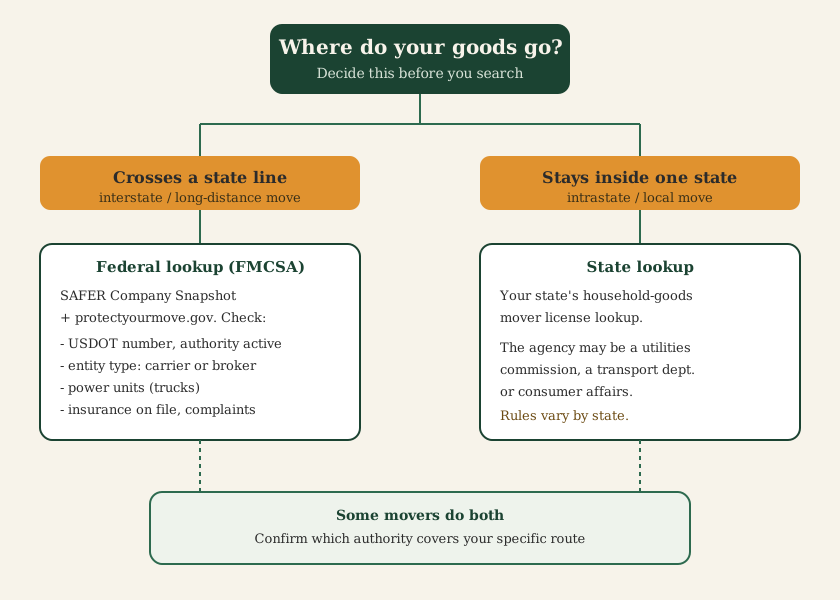
Which record you should trust depends on where your goods are going. An interstate or long-distance move is regulated federally, because a carrier transporting household goods for individual shippers in interstate commerce is subject to FMCSA's consumer-protection rules in 49 CFR part 375. That is why the FMCSA lookups fit a move that crosses a state line.
A move that stays inside one state, an intrastate move, follows that state's own rules instead, and those rules vary from state to state.
Some movers do both interstate and in-state work under the same name, so confirm which authority covers your particular route before relying on either record.
When the federal lookup comes back empty
If SAFER returns nothing for a mover that only works inside your state, that blank result is not by itself proof of a scam.
Check your state's own regulator instead. And ask the mover directly what it is licensed to do and for which kind of move, so you know which record should even exist.
Go to the household-goods (HHG) license lookup for the state your move happens in. Depending on where you live, the moving-licensing program may sit in the utilities commission, the department of transportation or a consumer-affairs agency, so state licensing is not found in one nationwide place.
Read any state example as true only for that state. A licensing detail that applies where a neighbor moved is not a nationwide rule.
Settle interstate versus intrastate before you search. That single decision determines which record actually counts.
What 'licensed, bonded and insured' means and how to confirm it
"Licensed, bonded and insured" is one of the most common lines in moving advertising, and on its own it proves very little.
Most households ask "are you licensed, bonded and insured?" without a clear idea of what each word should mean, which lets a weak company answer yes to all three and move on.
Confirm each of the three words separately rather than accepting them as a single package.
'Licensed'
Licensed means registered and authorized to operate.
Federally, that is a USDOT number plus active operating authority; for an in-state move, it is a license from the state regulator.
Confirm it in SAFER, at protectyourmove.gov, or with the state regulator, not on the company's word.
'Insured'
Insured means the coverage the law requires is actually on file.
A for-hire motor carrier may not operate until it has the minimum public-liability financial responsibility, covering bodily injury and property damage, in effect (49 CFR 387.7). That is a precondition to running at all, not an upgrade.
For household goods specifically, a carrier must also carry cargo-liability security to compensate individual shippers: at least $5,000 for loss or damage on any one vehicle and $10,000 for loss or damage at any one time and place (49 CFR 387.303T).
In practice, confirm that insurance shows as on file in the FMCSA or SAFER record, or in the state record for an in-state mover.
Note the limit in that phrase "on file": it means the regulatory minimum is met, not that the coverage is enough to replace your shipment. What the mover's coverage actually pays you, and the difference between released-value and full-value protection, is a separate question we cover in the moving-coverage guide.
'Bonded'
Bonded means a surety bond stands behind the company. A property broker must keep a $75,000 surety bond or trust fund in effect, and FMCSA will not register the broker until that bond or fund exists (49 CFR 387.307).
That is a broker requirement, not something a household-goods carrier is obliged to carry. A carrier that leans hard on being "bonded" is usually offering a reassuring phrase rather than protection for your belongings, so ask what the bond is for and who it actually covers.
And keep in mind that coverage being on file is a different question from what it pays out if something breaks, which the coverage guide handles, not this page.
| Term | What it means | Who it applies to | How to confirm |
|---|---|---|---|
| Licensed | Registered and authorized to operate | Interstate carriers (USDOT number plus operating authority) and in-state movers (state license) | SAFER, protectyourmove.gov, or the state regulator |
| Insured | Required coverage on file: public liability (49 CFR 387.7) and household-goods cargo liability of at least $5,000 per vehicle and $10,000 per occurrence (49 CFR 387.303T) | Every for-hire household-goods carrier | "Insurance on file" in the FMCSA/SAFER record or the state record |
| Bonded | A $75,000 surety bond or trust fund in effect (49 CFR 387.307) | Household-goods brokers, not carriers | The FMCSA broker record; not expected of a carrier |
Carrier or broker? How to tell and why it matters
In federal terms, a broker is a person who, for compensation, arranges or offers to arrange the transportation of property by an authorized motor carrier; a carrier arranging a shipment it is itself authorized and legally bound to transport is not acting as a broker (49 CFR 371.2).
Put concretely: a carrier runs its own trucks; a broker runs none.
The carrier employs the crew and assumes liability for your shipment. The broker takes your booking and then sells or assigns the job to a carrier that does the actual work.
Why it changes your move
The common trap is signing with what you believe is the moving crew and later discovering you hired a broker, which hands your job to a different company you never researched.
Price follows the same path. A low "binding" estimate from a broker binds the broker, not the carrier that shows up; that carrier can re-price the job on its own tariff when it arrives and writes the bill of lading. The attractive number you agreed to is not the number the truck is bound by.
Check each one
Read the entity type in SAFER. Entity type together with power units tells you quickly whether you are looking at a carrier or a broker.
The distinction also carries a duty you can use. A household-goods broker may arrange a move only for a carrier that holds a valid, active USDOT number and FMCSA operating authority (49 CFR 371.105), so a broker standing in for an unauthorized carrier is already a problem.
A broker must also give each prospective shipper a list of the carriers it uses, with their USDOT and MC numbers, along with a written statement that the broker itself is not a motor carrier authorized to transport your household goods (49 CFR 371.109). Ask for that list and use it to look up the carrier that will really arrive.
Compare the legal name and USDOT number on your paperwork with the record you looked up. A mismatch means a different company will handle the move, and that company is the one to verify.
Verify the carrier that will actually arrive, not just the name on the quote.
If the seller and pickup company differ, reconcile their identities and written terms before loading. Our guide explains how rogue movers and brokers operate and which discrepancies to resolve.
| Feature | Carrier | Broker |
|---|---|---|
| Owns trucks | Yes, operates its own fleet | None of its own |
| Who transports your goods | Its own crew | A separate carrier it assigns the job to |
| Liability for the shipment | Assumes it | Arranges only; not the authorized transporter |
| Shows in SAFER as | Entity type carrier, with power units | Entity type broker, typically zero power units |
| Key disclosure you can demand | Its USDOT number and active authority | Its carrier list with USDOT/MC numbers and a written statement it is not your carrier (49 CFR 371.109) |
A pre-signing verification checklist
Here the earlier steps come together into a short set of checks you can run on one named company before you sign.
Three linked checks do most of the work: confirm the USDOT number and that its operating authority is active; confirm the entity type is carrier, not only a broker; and, for an in-state move, confirm the right state household-goods license. Then read what the record shows, not merely that it exists.
Run every check on the exact legal name and USDOT number the company gave you, not a similar-sounding one. Rogue operators rely on names that look almost right.
- Ask for the USDOT number, the MC number for an interstate move, and the company's exact legal name.
- Look the USDOT number up in the FMCSA SAFER Company Snapshot and confirm the operating authority is active.
- Confirm the entity type is carrier, not only a broker, and check the power units.
- Cross-check registration and complaint history at protectyourmove.gov.
- For an in-state move, confirm the household-goods license with your state's regulator.
- If you booked through a broker, get its carrier list and verify the carrier that will actually arrive.
- Match the name and USDOT number on your paperwork to the record you looked up.
When a household-goods carrier gives you a written estimate, it must also hand you FMCSA's booklet "Your Rights and Responsibilities When You Move" and the "Ready to Move?" guide (49 CFR 375.213). Receiving those documents is itself a confirmation signal; a company that skips them is skipping a federal requirement.
A few signing terms come up as you go. A binding estimate fixes the price in advance; a non-binding estimate is only an approximation that the final charges can exceed; the bill of lading is the contract of carriage you sign on moving day; and the order for service lists the services and dates you have agreed to.
Reader questions
Does a broker actually move my things?
No. A broker arranges and sells your job to a carrier that does the work, so confirm which company you are actually signing with before you commit.
If something goes wrong, will FMCSA get my money or goods back?
FMCSA states it does not have the authority to resolve a claim for you. Filing a complaint still matters, because it records the company for the next person who runs the same search.
What about a move that stays inside one state?
Intrastate moves follow state rules that vary from state to state, so the federal lookup may show nothing; you check the state regulator instead.
Scam red flags, how to report a bad actor, and what a mover's coverage actually pays are each handled in their own guides; this page stops at confirming authority. If keeping these lookup results, numbers and booklets in one place is your next step, your private move workspace sits conveniently alongside the quotes you are comparing.