How to Recognize and Avoid Moving Scams and Rogue Movers
Check who will carry your belongings and what the written price covers before you commit to a full-service interstate move.
Regulatory text checked .
Pause payment or loading when the promises and paperwork disagree. Before proceeding, reconcile the transporting carrier, inventory, services, estimate type, payment terms and dated documents. A low price or reassuring review cannot settle those questions.
Choose your situation
- Low quote or large deposit? Compare the same written scope and obtain the payee and cancellation terms before paying.
- An unexpected broker or carrier? Identify who arranges the move and who transports it; reconcile the names before accepting.
- Changed price or papers at pickup? Leave loading unauthorized while the carrier and shipper resolve and document the discrepancy.
- Reviews conflict with complaints? Match the businesses, dates and recurring details before relying on a rating.
How moving scams work: the hostage-goods playbook
A moving scam can begin with an attractive or unclear booking offer. Once belongings are loaded, the mover claims the shipment needs more space, demands more money and threatens to withhold the goods.
Before loading is the useful decision point. Follow the upper branch to resolve the paperwork; the lower sequence shows the reported pressure after loading.
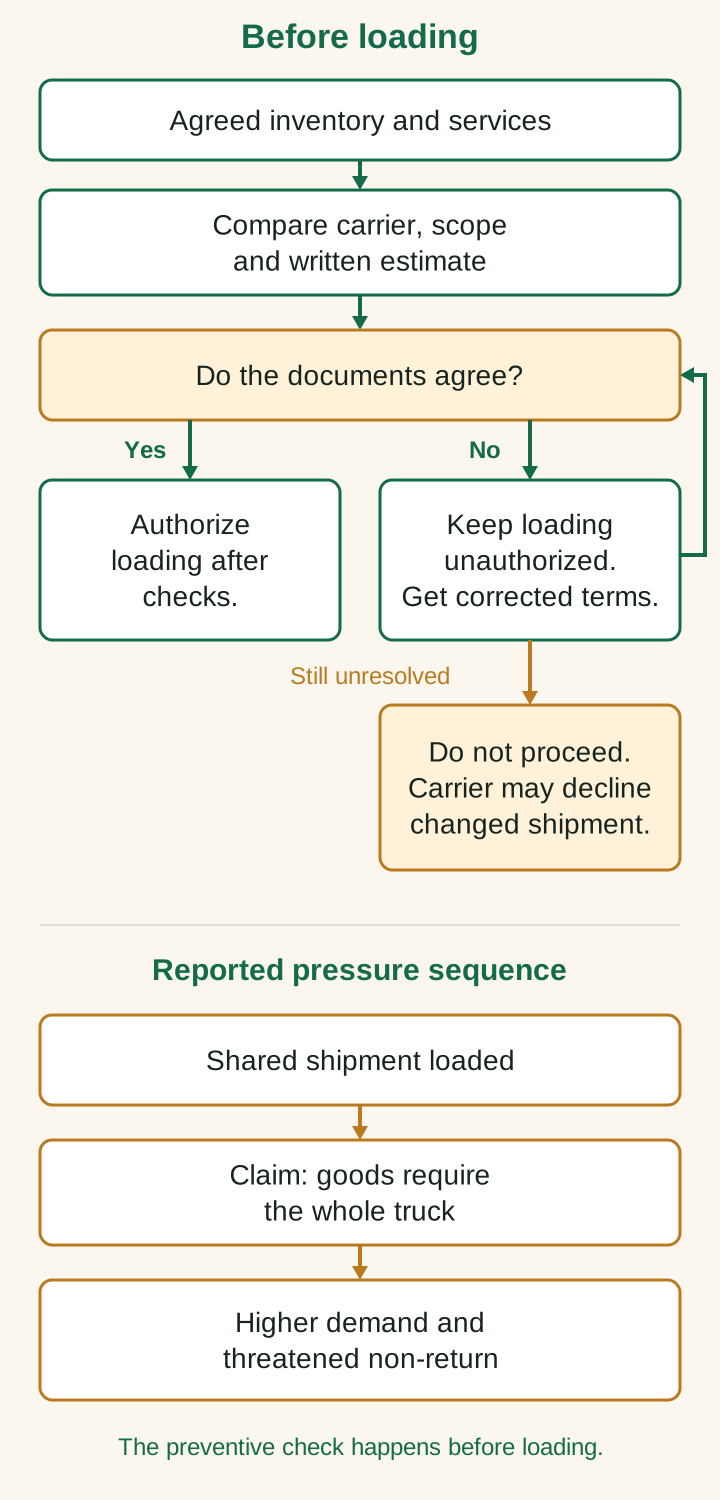
The “No” branch keeps loading unauthorized while you seek corrected terms. If additional goods or services remain unresolved, the carrier may decline the changed shipment; a pause does not require it to complete the move.
Check the new demand against the accepted inventory, services, estimate type and timing. Rogue movers use misleading or coercive conduct; a rental truck, cubic-foot reference, higher price or complaint by itself does not establish fraud. A delayed delivery also differs from a threat to withhold goods for a surprise payment.
If a mover is already holding your goods, follow what to do if it is already happening to document the demand, request delivery and choose the appropriate complaint or dispute route.
For interstate household-goods estimates, 49 CFR 375.401(i) allows mutually agreed amendments before loading and states: “You may not amend the estimate after loading the shipment.” Separate rules govern later additional services. Ask for corrected written terms while your belongings are still available for you to keep.
Red-flag checklist before you book
Compare several written offers using the same inventory, packing, access conditions and dates. An unusually low total needs an explanation of what differs. Choosing the middle price does not replace checking the agreement.
| Warning sign | Check before proceeding |
|---|---|
| No written estimate or an implausibly low quote | Get the complete inventory, services, estimate type and dates in writing. Compare omissions across offers. |
| Large advance payment or pressure to pay immediately | Identify the payee, what the payment buys, and the deposit, cancellation and refund terms. |
| Missing or unverifiable company identity or USDOT | Match the legal or trade name, address, contact details and registration to the company's actual role. |
| Hidden broker or unexplained carrier | Ask who arranges transportation and which carrier will perform this shipment. |
| Advertisement and booking describe different services | Have the seller reconcile the service promised with the agreement before accepting payment. |
A cheaper offer that omits packing or access work is not yet a like-for-like comparison. Obtain a corrected scope first.
Put the offers beside the inventory you supplied. Check whether each includes the same boxes, furniture and packing work, then compare the pickup and delivery commitments. Ask the estimator to explain each difference in writing. A verbal assurance that everything is included leaves you without a clear description to compare at pickup.
What does the deposit buy?
Ask whether the payment covers arranging the move or transportation, who receives it, and what happens if pickup changes. Keep the written terms and any cancellation deadline.
Household-goods brokers must prominently disclose deposit, cancellation and pre-pickup cancellation-refund policies on their websites and in agreements. That requirement creates neither a universal deposit percentage nor an automatic refund entitlement.
Does the written offer match the service you searched for?
Obtain the company's legal or trade name and physical location, then look up its USDOT and license. A number alone does not resolve the service or the company's role. If identity, scope or payment terms remain unresolved, pause the booking.
Rogue movers and broker red flags
The seller may be a broker or a carrier. Compare its role with the company named to transport your shipment.
| Role | What to establish |
|---|---|
| Broker | Arranges transportation. Identify the carrier on whose behalf it provides the estimate. |
| Carrier | Transports your belongings. Match its identity and shipment terms across the estimate and bill of lading. |
Using a disclosed broker can be a legitimate choice. Concealed roles and unexplained differences between the seller and carrier need investigation.
Who stands behind the estimate?
Under the broker advertising disclosure rule, household-goods brokers must prominently display their business locations, USDOT and MC information, broker status and role arranging authorized-carrier transportation. Compare those disclosures with the agreement; request the transporting carrier's identity and contact details.
A broker-provided estimate must be written, based on the authorized carrier's survey and published tariff, and prepared under the required signed agreement. A shipper may waive the survey in writing before loading under 49 CFR 371.113. Broker involvement does not automatically make the estimate non-binding.
Ask the broker to identify the carrier on whose behalf it prepared the estimate and explain the connection between that estimate and your booking. Keep that answer with the agreement and payment record. If the carrier later presents different terms, you can compare the actual promises rather than relying on the salesperson's name.
If another company arrives at pickup, ask the seller and carrier to reconcile its identity and terms with the estimate and bill of lading before loading. Participating carriers belong on that contract when known. Carry both seller and carrier identities into complaint searches.
How to protect yourself at the estimate and on moving day
What goods and services does the estimate cover?
The interstate carrier normally surveys the goods and provides a written estimate marked binding or non-binding. You and the carrier sign it, and you receive a dated copy under 49 CFR 375.401(a), (b) and (h). Include packing, stairs, elevators and other access conditions relevant to the price.
A physical survey may use live or prerecorded video that clearly identifies the goods. Show storage areas as well as rooms. A phone-only quote needs investigation, although you may choose a written survey waiver signed before loading; the carrier retains it with the bill of lading.
Is the estimate binding or non-binding?
A binding estimate guarantees charges for the listed quantities and services. A non-binding estimate approximates costs; final charges follow actual shipment weight and applicable tariff provisions and may exceed the estimate. A tariff sets the carrier's rates and service terms.
If a volume estimate will be converted to a weight-based rate, request the written conversion formula. Cubic feet alone are not a fraud test.
Which promises belong on the bill of lading?
The bill of lading is the receipt and transportation contract. An estimate or booking form alone does not replace it.
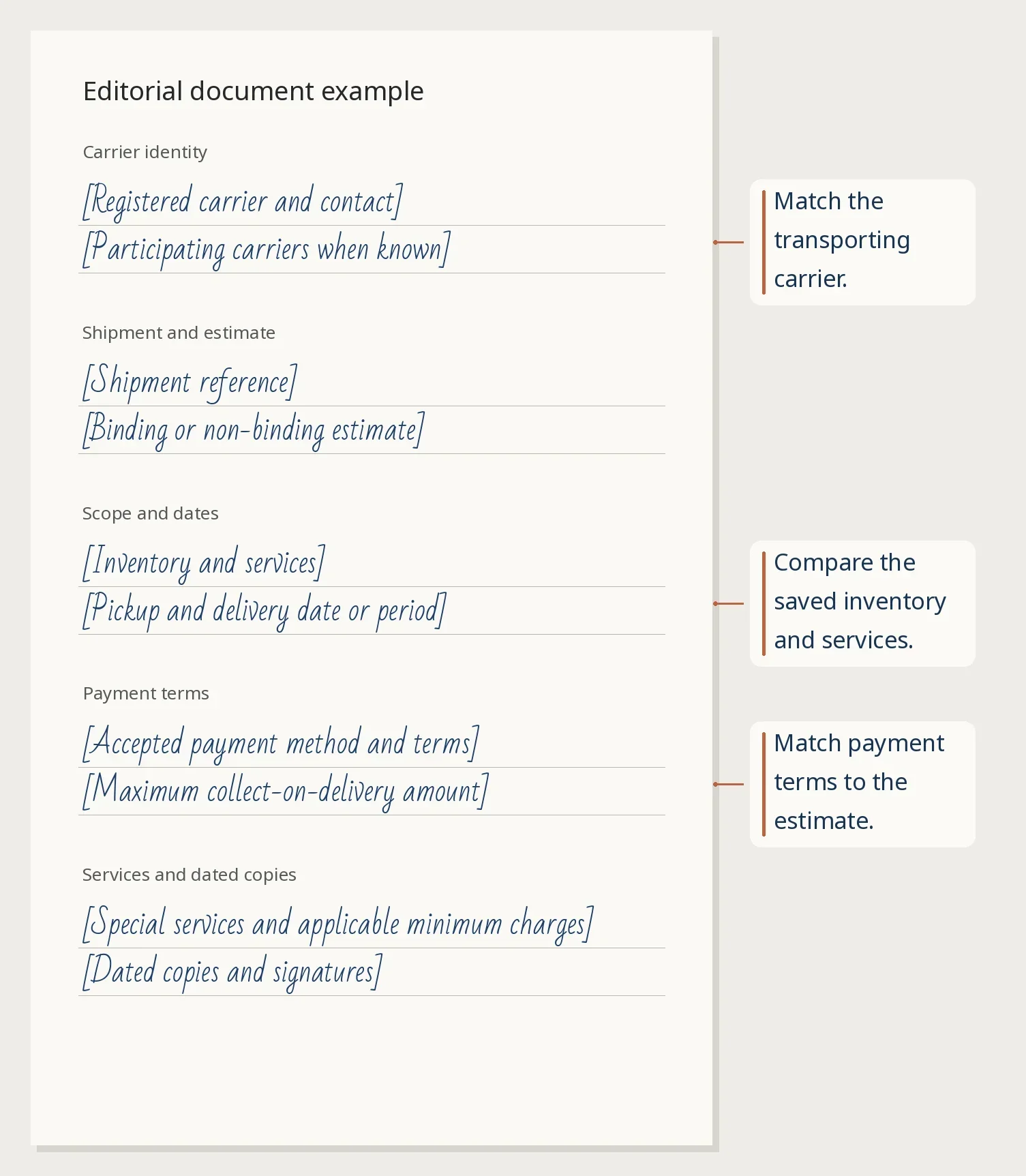
Compare these required bill-of-lading details with your estimate and inventory:
- Registered carrier identity and contact details; participating carriers when known.
- Shipment reference, inventory, estimate and included services.
- Pickup and delivery dates or agreed periods.
- Payment method and terms, special services, applicable minimum charges and maximum collect-on-delivery amount.
This editorial document example groups the fields to compare across your own estimate, inventory and bill of lading.
The payment method must match the estimate. Resolve an unexplained switch; cash itself is not universally prohibited. Keep dated copies before the goods leave.
Read the dates as written: an agreed delivery period and a specific guaranteed date are different commitments. Check that the document reflects the arrangement you accepted. For collect-on-delivery service, locate the maximum amount required to obtain possession and ask the carrier to explain any inconsistency with the estimate and payment terms.
When should you receive and sign the documents?
Under 49 CFR 375.505(h), the bill of lading must be provided, signed and dated at least three days before scheduled loading, with a three-day penalty-free rescission opportunity after signing. Corresponding changes from moving-day additions of goods or services that produce a new estimate under 375.403(a)(6)(ii) or 375.405(b)(7)(ii) do not restart that period. This is not a general broker-deposit cancellation rule.
Do not sign a blank document.
The rule permits leaving undetermined only information unknowable before loading, such as actual weight for a non-binding shipment or unforeseen transit charges. Carrier, shipment and agreed-service information must be present. Carrier and shipper sign before loading, with a dated copy supplied; the bill is also signed at destination.
With the estimate, check receipt of Ready to Move? and Your Rights and Responsibilities When You Move. Copies or qualifying website links are permitted; internet access requires your agreement and a signed, dated receipt. Before the bill of lading, obtain the charge estimate, tariff-availability notice, arbitration summary and complaint/inquiry summary.
What changes before the first item is loaded?
Identify precisely which goods or services differ from the saved scope. If the carrier serves the changed shipment, the preloading options depend on the estimate:
- Binding: reaffirm it, issue a new detailed binding estimate signed by the shipper, or agree in writing to treat the original as non-binding.
- Non-binding: reaffirm it or issue a new detailed non-binding estimate signed by the shipper.
The new estimate must accurately list the additional goods or services. Under 375.403(a)(6) and 375.405(b)(7), the carrier need not serve an unresolved changed shipment. Loading without the required new estimate reaffirms the original, subject to separate later-service rules.
Send this request to the carrier to obtain an explanation and corrected documents before loading. Replace the bracketed fields with your shipment details.
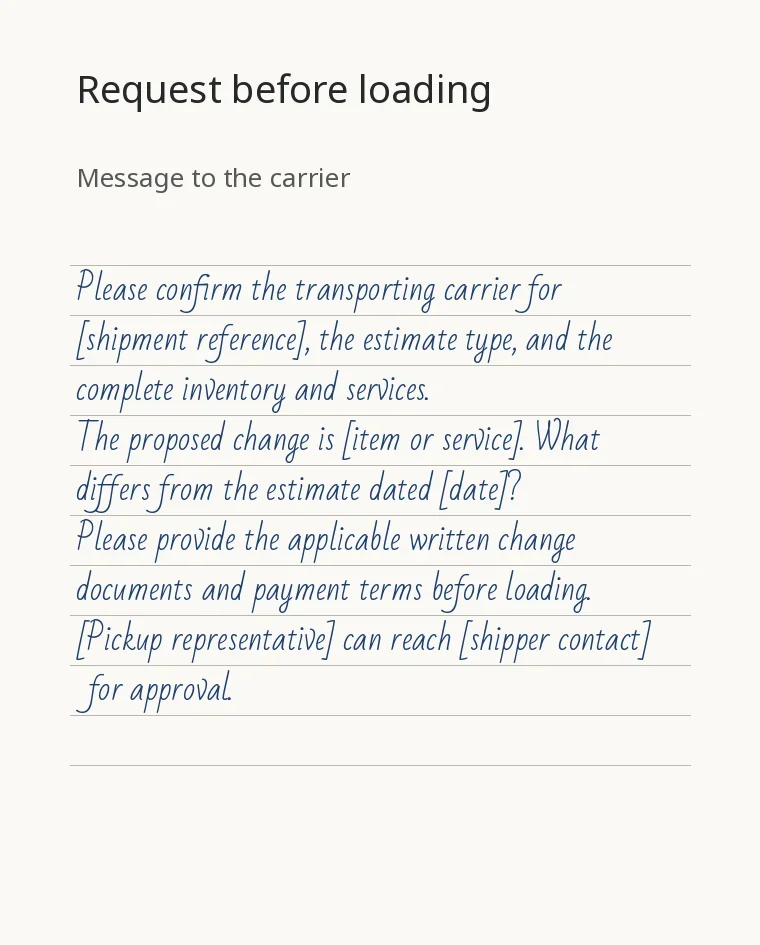
Please confirm the transporting carrier for [shipment reference], the estimate type, and the complete inventory and services.
The proposed change is [item or service]. What differs from the estimate dated [date]?
Please provide the applicable written change documents and payment terms before loading.
[Pickup representative] can reach [shipper contact] for approval.
Compare the reply with the saved inventory and estimate. A later higher amount may reflect final non-binding tariff charges or separately regulated additional services. Ask the carrier to identify the specific work and written or tariff basis; a higher demand alone does not establish fraud.
Our practical pause rule is to reconcile carrier, scope, estimate type, agreed changes, payment terms and dated documents before authorizing loading. If a material discrepancy remains, keep loading unauthorized.
Where to check complaints and scam alerts (FMCSA, BBB)
Use FMCSA interstate mover records and consumer complaint or alert resources, plus BBB business complaints, reviews and scam reports. Match legal or trade names, addresses and registration details to both the seller and transporting carrier.
Read more than one source. Keep a short comparison record using these checks:
| Record | Compare with your booking |
|---|---|
| Business identity | Separate the arranging broker from the transporting carrier. Match legal or trade names and identifying details. |
| Date and described conduct | Look for recurring specifics, such as a different carrier, missing papers or pressure for new terms after loading. |
| Business response | Check whether it answers the actual discrepancy, rather than another aspect of the move. |
A report about a different service or entity may not apply to your booking. Match the details before asking for an explanation.
A reply about punctuality does not resolve a complaint about an unexplained carrier change. Individual complaints, reviews and alerts warrant investigation; they are not automatically official findings of fraud or proof of current authority.
Request a specific written explanation for conflicting information and compare it with the booking. An empty complaint search offers no guarantee. Before signing the bill of lading, obtain the carrier's complaint and inquiry handling summary, including its main phone number and who pays for calls.
Proceed when the material questions have answers you can check against the documents. If identity, scope or terms still conflict, pause the booking and retain what you compared.