Full Value Protection vs. Released Value Protection Explained
Compare the replacement gap with your mover’s written valuation charge and deductible before signing away Full Value Protection.
Regulatory text checked .
For a federally regulated full-service interstate household-goods move, Full Value Protection (FVP) applies unless you waive it in writing. Released Value Protection has no additional valuation charge, but limits liability to $0.60 per pound per article. These are mover-liability options. Before choosing, obtain the actual FVP charge, declared shipment value and deductible. Appendix A to Part 375 sets out these liability levels.
What does Released Value Protection actually pay?
Released Value removes the additional valuation charge when you waive FVP in writing. The initial estimate must include FVP; its additional cost does not make Released Value the default.
The Released Value provision in Appendix A limits liability to “no more than 60 cents per pound, per article.” Multiply that article’s weight in pounds by $0.60. Its purchase price does not determine the limit. For one missing item, you do not multiply the entire shipment’s weight.
The rule’s example uses a 10-pound stereo component valued at $1,000:
10 pounds × $0.60 per pound = no more than $6.
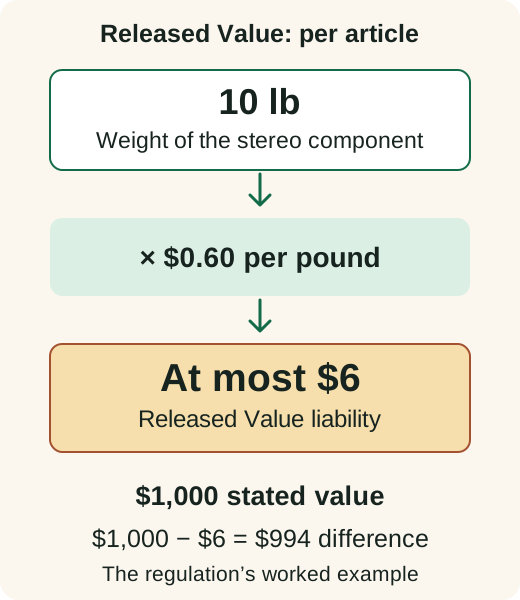
That leaves a $994 difference from the stated value even at the maximum. The calculation establishes a limit, rather than a guaranteed payment.
What could you have to replace yourself?
Use a few actual possessions for your own comparison. Record each item’s weight, what replacing it would cost and the Released Value maximum. Include items whose loss would materially affect your budget, even if they take little space.
Keep a separate line for each article. Combining several valuable items into one household total hides which belongings have the widest gaps. Use documented weights where available, and identify an uncertain weight before relying on the resulting amount.
The useful result is the possible replacement shortfall you would have to fund. Carry that amount into the FVP comparison.
What does Full Value Protection cover and how is it priced?
FVP addresses articles lost, destroyed or damaged while in the mover’s custody, subject to allowable exceptions in its tariff.
The mover chooses the remedy.
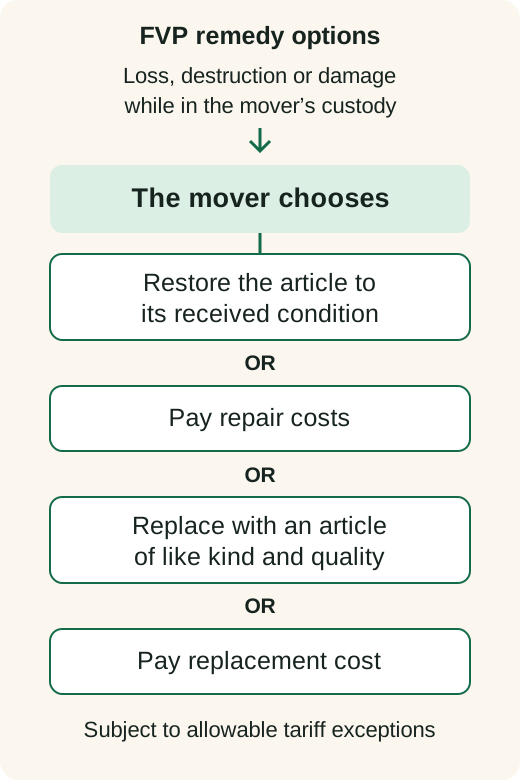
The FVP provision allows restoration to the condition in which the mover received the article, or payment of repair costs. Alternatively, the mover may provide a replacement of like kind and quality, or pay its replacement cost. A repairable item can therefore be repaired; FVP does not automatically produce cash for a brand-new upgrade.
FVP increases the cost above basic transportation, even though it belongs in the initial estimate. Its charge comes from the mover’s tariff—the published rates and terms governing its service. Request the applicable program details.
Which amount is the shipment value?
The minimum shipment valuation used to determine FVP cost is $6 multiplied by the shipment’s total weight in pounds. The mover may use a higher minimum, and you may declare a higher value at additional cost. This establishes a shipment-level amount; it neither prices FVP itself nor pays $6 for each pound of an individual damaged item.
For a 10,000-pound shipment, that minimum calculation produces $60,000. If the goods’ value exceeds that amount, discuss a higher declaration rather than treating the calculated minimum as an appraisal of everything you own. Ask how the mover will document the selected shipment value and its corresponding charge.
There is also a separate article-level requirement: items exceeding $100 per pound need specific written listing on shipping documents to address permitted extraordinary-value limitations. Keep that declaration with your election.
FVP describes the carrying mover’s liability. Separate third-party insurance is a different product, with its own policy terms.
How do settlement, cost and deductibles compare?
Compare the same shipment and declared value.
| Decision detail | Released Value | Full Value Protection |
|---|---|---|
| Settlement | At most $0.60 per pound per article | Mover chooses repair, repair-cost payment, like-kind-and-quality replacement or replacement-cost payment; allowable tariff exceptions apply |
| Valuation charge | No additional charge | Shipment-specific tariff charge; value and deductible affect the quote |
| Value basis | Article weight determines the limit | Declared shipment value; the $6-per-pound shipment minimum is a pricing basis |
| Election | Written waiver of FVP | Applies unless waived; included in the initial estimate |
For the stereo above, the key comparison is a $6 liability ceiling against FVP’s possible repair or equivalent replacement, subject to its terms.
Ask the carrying mover for a written FVP charge at your stated shipment value for each offered deductible. Keep the shipment and value constant across options. Otherwise, a lower charge could reflect a different declaration or deductible rather than a better price for equivalent protection.
Use one column for each actual written FVP offer. Copy the amounts from the quote and leave an unanswered field visible; a deductible number alone does not explain how it applies.
| Check | First offer | Second offer |
|---|---|---|
| Declared shipment value | [goods value] | [goods value] |
| Valuation charge | [quoted charge] | [quoted charge] |
| Deductible amount | [amount] | [amount] |
| Deductible applies to | [unit or event in tariff] | [unit or event in tariff] |
| Applicable limitations | [tariff provision] | [tariff provision] |
| Total moving price | [total; valuation charge included?] | [total; valuation charge included?] |
Start with the declared-value row. If the amounts differ, obtain options at the same value before comparing charges. Then check the deductible’s application against the tariff reference. Confirm whether each moving-price total already includes its valuation charge, so you neither add it twice nor omit it from your budget.
How does the deductible apply?
Obtain both the deductible amount and its application rule. Does it apply per claim, per occurrence or another way? Ask the mover to identify the relevant tariff terms, including limits and exceptions, in writing.
Compare the upfront charge alongside what you could bear after a loss. A cheaper valuation charge alone does not settle that decision.
What if the FVP price is zero or missing?
A form displaying $0.00 at every deductible level needs clarification. Request an actual written option and charge instead of interpreting those entries as free FVP. If a website calculator is unavailable, request the same information directly.
As a decision aid, compare your possible Released Value shortfall with the quoted FVP charge, deductible, shipment declaration and restrictions. Consider whether you could absorb that uncovered loss. There is no single price threshold that answers the question for every household.
How do you select and document your choice before loading?
Find the liability election notice on the written estimate. Section 375.401(g)–(h) requires that notice, both parties’ signatures and a dated copy for you. Check the intended option and quoted terms.
The bill of lading is your shipment receipt and transportation contract. Compare its valuation statement selecting FVP or waiving it in writing for released rates with the estimate. The option and applicable shipment value, charge and deductible should reflect your choice. Obtain your signed, dated copy from the carrying mover.
When must the bill of lading be ready?
Under section 375.505(h), it must be provided to you and signed and dated by you at least three days before scheduled loading. You must have a three-day penalty-free opportunity to rescind after signing.
If additional goods or services on moving day produce a new estimate under section 375.403(a)(6)(ii) or 375.405(b)(7)(ii), corresponding bill-of-lading changes do not start another three-day period. This timing rule does not establish a universal 72-hour FVP-request cutoff or resolve a separate broker-deposit dispute.
How do you record high-value articles?
Ask for the mover’s declaration process and explanation of its extraordinary-value limitation. Specifically list articles worth more than $100 per pound on the shipping documents before the shipment. Increasing the total shipment declaration alone does not identify those articles.
Keep one complete record:
- The signed, dated estimate and its liability election.
- The signed, dated bill of lading with the matching valuation statement.
- The written FVP charge, declared shipment value and deductible terms, if selected.
- The completed written declaration identifying applicable high-value articles.
For separate insurance and homeowners or renters coverage, review the full moving coverage picture alongside your chosen mover-liability option.