Building access for a move: certificate of insurance, elevator and parking
Regulatory text checked .
Get written moving requirements from both buildings and forward them to your mover. Resolve required insurance evidence with its issuer, then confirm elevator and dock bookings, permitted times, payment conditions and the local truck parking arrangement.
Choose your situation
- The building wants a COI. Send its requirements to your mover for the insurer or agent, then obtain management’s acceptance.
- You need an elevator or dock. Confirm start/end times, separate bookings and finalization conditions before fixing the crew’s arrival.
- You are moving yourself, one item or between floors. Ask management which procedure applies before arranging help.
- The truck needs street space. Check the local authority’s process and keep its contact plus a lawful fallback.
What building access rules to check first
Request the written moving policy from management at both addresses while you are arranging the date. Ask about permitted days and hours, insurance paperwork, elevator reservations, the moving entrance, any loading dock, required protection and the day-of contact. Send both sets of requirements unchanged to your mover so the arrival plan accounts for each building.
Keep the origin and destination requirements separate when their conditions differ. Tell the mover which office must receive each document and which building controls each reservation. A requirement accepted at the pickup address still needs a separate answer from destination management.
Do small and internal moves need approval?
Describe how the items will move: a professional crew, hired helpers, your own labor, a single delivery or a transfer between floors. Ask which rules apply before hiring help. A short journey can still involve controlled common areas.
At 35 South Racine, for example, repeated same-day elevator trips that limit other residents’ use trigger a reservation requirement. Use your own building’s policy to identify its trigger.
Who confirms access?
Identify the management representative authorized to accept documents and bookings, and obtain the submission channel. Ask whether insurance acceptance, payment or another step must come first. Keep a tentative slot marked provisional until that representative confirms the remaining conditions are satisfied.
Certificate of insurance: what it is and how to request one
A certificate of insurance, or COI, describes insurance coverage. For a building’s request, have your mover coordinate the evidence with its insurer or agent. Keep the certificate, the underlying policy and any executed endorsement distinct when discussing what coverage exists.
Once the building signs off, file the COI and the building’s moving forms with the rest of your move papers; our guide to the moving document folder and home inventory shows where each document belongs.
What should you request from management?
Get management’s actual requirements or sample rather than reconstructing them from a phone conversation. Check that the request specifies:
- Exact legal names of the entities to be listed and their requested status.
- Required insurance evidence, coverage limits and any endorsement documentation.
- Resident name, move address and date fields, where requested.
- The recipient, submission deadline and acceptance procedure.
Forward the complete request to the mover. Ask whether it can meet those requirements before relying on the booking.
Check whose insurance evidence management is requesting when you use hired helpers or a delivery service. Give that provider the request before committing to it. If the available document cannot satisfy a requested field, ask management and the issuer to address that specific mismatch rather than assuming another provider’s certificate will work.
Who issues and accepts the document?
The mover coordinates issuance with its insurer or agent. Compare the returned evidence with management’s request, then obtain management’s acceptance. Follow the diagram’s return path when management rejects a field or the issuer needs to resolve requested coverage.
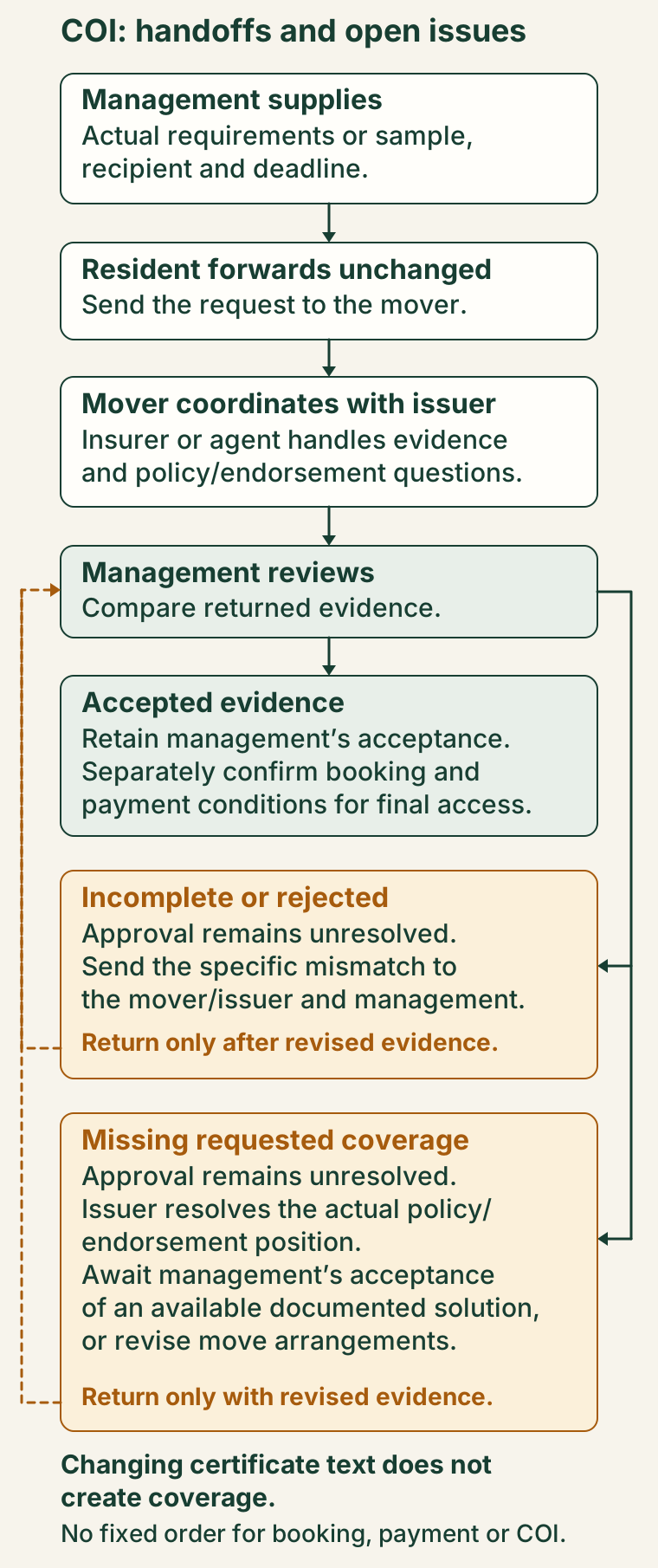
The amber branches keep approval unresolved. A corrected field goes back through management’s review; a coverage question first needs the issuer’s policy or endorsement answer. On the accepted branch, retain management’s acceptance and separately check any booking or payment condition still outstanding.
What if coverage or additional-insured status is missing?
Ask the insurer or agent whether the issue is missing evidence, incorrect information or coverage that the policy does not provide. For an additional-insured request, ask it to identify the relevant policy or endorsement provisions. Do not edit the certificate yourself.
Texas provides a precise legal example. Section 1811.001(3) defines the relevant COI as an insurer- or agent-issued property/casualty coverage summary. Under §1811.152, it “does not amend, extend, or alter the coverage afforded by the referenced insurance policy.” Ask the issuer to resolve the policy position; §1811.153 prevents the certificate from adding rights beyond the policy or an executed endorsement.
This Texas chapter covers property/casualty operations or risks in Texas regardless of the parties’ locations, subject to §1811.002’s exclusions. The SB 425 transition applies its changes to certificates issued on or after January 1, 2012.
If management and the issuer disagree, share the exact objection with both. Keep approval unresolved while they address acceptable documentation or you revise the move arrangements.
Reserving the elevator or loading dock
Ask how to reserve the service or freight elevator and what finalizes the booking. Obtain written start/end times, including any paperwork or payment conditions, before fixing the mover’s arrival.
Does the booking include the loading route?
If a dock or staging area exists, check whether it needs a separate reservation. Confirm the designated entrance, truck size, arrival sequence and unloading route. An elevator confirmation can leave the dock unresolved.
Will the furniture fit, and who prepares the elevator?
Give the mover measurements of restricted doorways, hallway turns and the elevator interior alongside the largest pieces. Check each restriction separately.
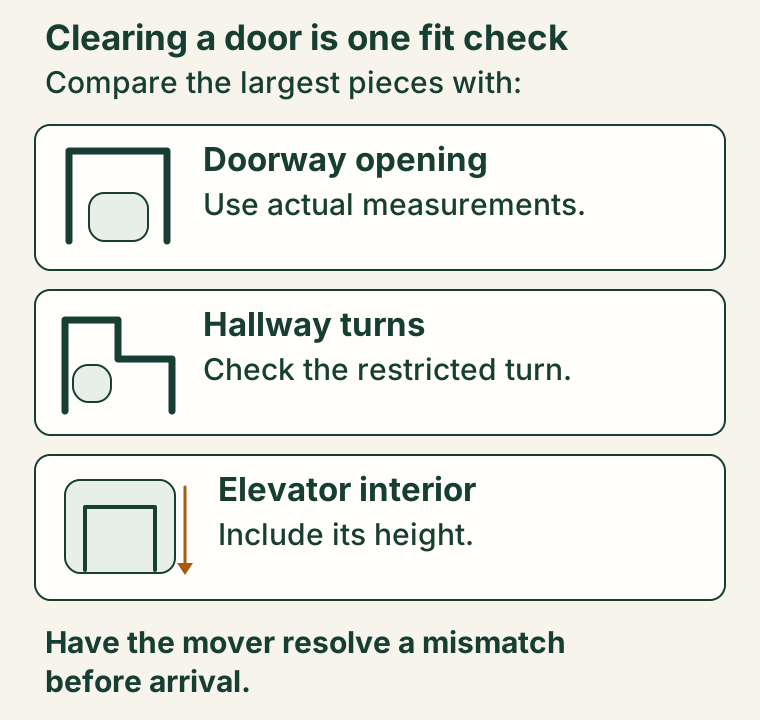
The elevator panel adds a vertical check. A sofa clearing the doorway still needs room inside the car, including enough interior height if the mover plans to stand it on end. Ask the mover to resolve a mismatch before arrival.
Confirm who supplies the required floor and elevator protection and who is authorized to prepare or operate the elevator. Tell the crew that arrangement.
If availability or the route fails, contact management and the mover for a confirmed alternative. Ask the mover to assess the workload against the actual window; a reservation alone does not establish that everything will fit within it.
Move-in and move-out windows, fees and deposits
Align both buildings’ permitted days and start/end times with your mover. Include noise restrictions, cleanup and late-arrival or overrun handling. Check these against the lease-end date before committing to a schedule.
Have the mover plan backward from the destination’s closing time, allowing for the origin window and travel between addresses. Ask whether check-in, installing protection and removing debris must occur within the reserved period. If the proposed schedule conflicts with either building, resolve the date or window before confirming arrival.
Which payments and completion terms apply?
Ask management to separate each fee from any damage deposit. Use the distinction to resolve what secures access and what happens afterward.
| Payment | Questions to resolve |
|---|---|
| Move or reservation fee | Is it nonrefundable? Who receives it, by which method and when? Is a receipt needed to finalize access? |
| Damage deposit | What amount and payment method apply? What inspection, protection and cleanup conditions govern review? Who handles the refund decision? |
The fee row asks whether a receipt finalizes access. If it does, complete that handoff before treating the reservation as final. The deposit row follows the later review: ask how to document common-area condition, debris removal and cleanup, and how to obtain the inspection or refund-review result. Retain photographs and receipts with the access record.
Parking permits and truck access on moving day
Management confirms its entrance and dock arrangements. Ask the local parking or transportation authority separately whether the actual street address needs a truck permit, temporary no-parking arrangement or both.
Identify who applies, who posts signs, the space dimensions, dates/times and enforcement contact. Assign those tasks explicitly with the mover. Seattle’s Temporary No Parking Zone guidance, for example, distinguishes reserving curb space from commercial-vehicle access through its Restricted Area Parking process.
Can the truck use the planned approach?
Match vehicle height and length, turning access and gate or garage clearance with management and the mover. Share the designated approach; have the mover resolve any mismatch using actual measurements.
Check a proposed double-parking plan against the applicable rule. In Washington, RCW 46.61.570(1)(a)(i) prohibits stopping, standing or parking “On the roadway side of any vehicle stopped or parked at the edge or curb of a street”. Its opening exceptions cover avoiding traffic conflict or complying with law, police directions or official traffic controls. The loading exception in (1)(c) does not extend to that prohibition simply because unloading is underway. Ask the mover to arrange a lawful unloading position.
What if the intended space is occupied?
Check when the restriction begins and use the authority contact supplied with your permit or local instructions. Agree a lawful fallback with the mover and management before arrival; keep those contacts available to the crew.
Questions to ask your building management
Send the authorized contact a request identifying your actual move method and the answers still missing. Adapt these lines for each building.
My move is planned for [date], using [mover/helpers/self-move], from/to [unit].
Please send the written policy and confirm:
1. COI requirements/sample, requested fields, recipient, deadline and acceptance process.
2. Elevator slot and separate dock/staging status, with finalization conditions.
3. Entrance, route dimensions, protection supplier and authorized elevator operator.
4. Allowed start/end times, cleanup and late-arrival/overrun procedure.
5. Fee versus deposit terms, payment/receipt requirements and inspection/refund review.
6. Day-of contact and any different procedure for this move method.
Please identify anything still provisional or awaiting approval.What should a complete reply confirm?
Check the reply against the request’s separate elevator and dock fields. One confirmed slot leaves the other unanswered. Also confirm accepted documents, satisfied payment conditions and both buildings’ times aligned with the mover. Verify street permission through the separate authority process.
Read a reply saying documents are on file for its actual meaning. Ask whether they have been reviewed and accepted, and whether the elevator and dock are confirmed. Record any outstanding condition beside the person responsible for resolving it.
Follow up on missing answers with the responsible party. Share unresolved requirements with management and the mover, and retain written confirmations alongside the day-of contacts.