The complete moving checklist: plan your move step by step
Set the moving window, agree who does the work, and confirm the arrangements that let packing, loading and arrival happen in order.
Regulatory text checked .
Start your moving checklist with the date or window and the people responsible for packing, loading, transport and unloading. Track the written service scope, documents, building access and arrival arrangements alongside the boxes. Each unfinished confirmation needs an owner and a next action.
Renting your next place? The guide to moving into your first apartment covers inspection, utilities, renters insurance and building rules step by step.
Still have an old home to hand back? The checklist for moving out of your current place covers notice, condition records, final services and documented key return.
Just bought a home? The checklist for moving into a new house starts with locks, utilities and HOA before you unpack.
Choose your situation
- Still choosing help? Full-service, labor-only, container and DIY options assign work differently. Identify who handles each stage, then request the included services in writing. Use the service questions to compare the same work.
- Moving through a managed building? The moving date needs compatible building access and mover timing. Request management’s actual requirements and approval, then check the arrival window against the elevator and loading arrangements.
- Hiring an interstate household-goods carrier? Request the signed estimate and dated bill of lading ahead of loading; obtain the signed carrier inventory before or at loading. The document checks explain the three-day bill-of-lading requirement and its specific exception.
- Near moving day or already arriving? Review unfinished confirmations and separate personal essentials and documents from shipment boxes. Tell helpers what stays with you. Start with short-notice priorities or the arrival checks.
What a moving checklist should cover
A complete move connects timing and service scope, budget, sorting and packing, documents and inventory, building access, address updates, loading, delivery and arrival. Work can be finished in one area while another remains unresolved: packed boxes still need an agreed loading arrangement and a destination that can receive them.
Write down the date or usable window. Assign packing, loading, transport and unloading to named people or providers.
Confirm storage and special services separately.
Use the following record as a moving to-do list you can save or print. Replace the bracketed fields with your arrangements. A task stays open until its needed response or work is recorded. In the last column, distinguish a request you sent from the answer you need: a requested moving window still needs confirmation from the responsible party.
| Work or confirmation | Responsible party | Needed by | Status or evidence |
|---|---|---|---|
| Service responsibilities | [person/provider] | [date/window] | [written included scope] |
| Packing and sorting | [person] | [date/window] | [remaining work; move/store/donate/discard] |
| Documents and inventory | [person/carrier] | [applicable document timing] | [accessible copies] |
| Building access | [management/mover] | [moving window] | [approval and compatible arrival] |
| Services and address updates | [provider/management/sender] | [arranged date] | [account, billing or notification response] |
The access row needs both management and mover input. Recording only “mover booked” leaves the building’s permission unanswered. For interstate documents, use the specific timing below rather than a generic moving-day deadline.
Build your moving budget around the chosen service, materials, travel and any storage or temporary accommodation needed. Match those categories to confirmed inclusions. A first move or rental move may require different arrangements; office relocation needs its own workplace coordination.
Your move at a glance: the timeline
Work backward from your date or window. Use the week-by-week moving timeline to sequence early decisions, packing, service confirmations and arrival checks. Open an accessible move folder as soon as confirmations start arriving.
Find the stage that still needs work in the diagram. Follow the green sequence for the overall plan; use the amber short-notice path to return directly to an unfinished stage.
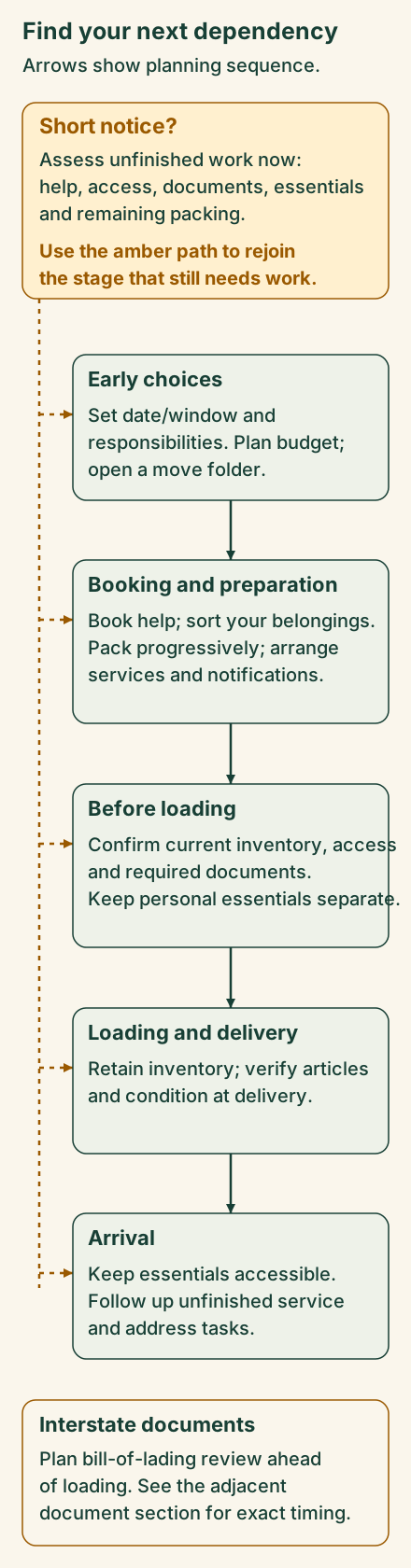
The amber path reaches every stage, including arrival. If you are already packing, return to booking and preparation when help or sorting remains unresolved; check the before-loading stage when access or required documents remain open. Use the unfinished confirmation to choose where to resume.
Readiness for loading depends on decisions made during preparation. Give the mover your current inventory and access information, reconcile changes, and finish the packing assigned to you. Keep personal items and documents reachable while arranging services and direct address notifications.
Schedule interstate document review ahead of loading. Check building arrangements against the mover’s arrival window and identify the items helpers must leave with you. Keep delivery and arrival checks on the plan after departure.
What comes first when time is short?
Eight-, six-, four- and two-week markers, or a month-long plan, are optional planning aids. Use your remaining dependencies to set priorities.
Assign service arrangements and notifications during preparation. Track postal forwarding and direct sender updates separately, then check their status after arrival.
Documents and inventory to keep together
Keep quotes, receipts, contracts, confirmations and relevant personal documents in an accessible paper or digital move folder.
Setting up that folder well is its own small task: our guide to the moving document folder and home inventory shows which papers to keep together and how to record your boxes.
How will people identify boxes and find reassembly details?
Label boxes with readable destination words and brief contents descriptions on visible sides. A numbered index or photos can hold more detail. Keep the index available; helpers still need to see where a box belongs.
What should an interstate carrier provide before loading?
The following federal paperwork duties apply to an interstate household-goods carrier serving an individual shipper under 49 CFR Part 375. Use them when coordinating that covered move; local and DIY arrangements need their own document checks.
Before executing the bill of lading, the carrier must provide a written total-charge estimate identifying it as binding or non-binding. Both parties sign it, and you receive a dated copy when it is signed. Request and retain the estimate required by § 375.401(b) and (h).
A binding estimate commits the parties to charges for the quantities and services shown. A non-binding estimate states expected cost; final charges follow actual shipment weight and applicable tariff provisions. Compare the described work as well as the total.
Use this comparison to identify which record answers the open question. A quoted total belongs with the estimate; the agreed pickup or delivery period belongs with the bill of lading; identifiers and condition notes belong with the carrier inventory.
| Record | What to locate |
|---|---|
| Estimate | Estimate type, quantities, services, total charges and signatures. |
| Bill of lading | Contract terms, pickup/delivery dates or periods, payment, services and attachments. |
| Carrier inventory | Cartons and uncartoned articles, matching identifiers and delivery-condition notes. |
The inventory row connects the articles loaded to the delivery check. An estimate listing the work and a personal box list serve different purposes; keep the carrier’s signed inventory accessible alongside them. Check the timing for each record below before marking the document row in your plan complete.
The bill of lading is the transportation contract. Under § 375.505, review pickup and delivery dates or periods, payment terms and services. Locate the estimate and inventory, which must be attachments if not otherwise provided. A delivery window and guaranteed-date service are different commitments. Retain your dated copy.
The carrier must provide the bill of lading for you to sign and date at least three days before scheduled loading, and give you a three-day penalty-free opportunity to rescind after signing. Request it early enough to review before that handoff.
There is a specific exception: if additional items or services on moving day produce a new estimate under the provisions cited in § 375.505(h), corresponding bill-of-lading changes do not require a new three-day period.
Which blanks need clarification?
Section 375.505(g)(3) says, “You may not require an individual shipper to sign a blank document.” An incomplete document may omit information that cannot be determined before loading, such as actual weight or unforeseen transit charges, while retaining all other relevant shipping information.
Ask the carrier to clarify missing or mismatched information before signing.
What changes between loading and delivery?
For the covered interstate shipment, the carrier must inventory every carton and uncartoned article with corresponding identifiers. Obtain the copy signed by both parties before or at loading, as required by § 375.503(a)–(c). Your personal box index complements this record.
At delivery, the carrier must allow you to verify the articles and their condition, make written missing or damage notations, and receive a copy of those notes. Keep that record; the notations alone do not complete a separate claim or establish recovery.
Building access: COI, elevator and parking
Ask management at the relevant addresses for actual certificate of insurance (COI), elevator, moving-window and parking or loading requirements. Pass those conditions to the mover and request compatible arrival and service arrangements.
For the document handoff and booking steps, see how to arrange a certificate of insurance and reserve the elevator, then confirm the separate truck parking arrangement.
A mover booking and building permission need separate confirmations.
Follow management’s approval and the mover’s timing into the same check. Both must support the planned access; the separate dashed branch concerns a later delivery.
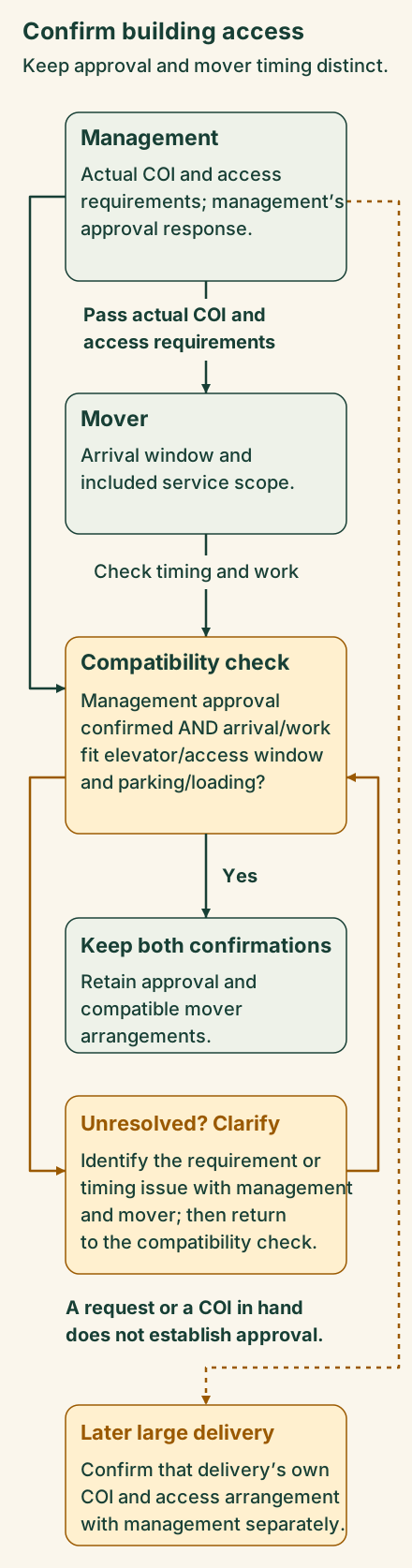
The compatibility box requires management approval and arrival and work that fit the access window. If either remains unanswered, follow the unresolved branch, clarify that specific point with management and the mover, then check compatibility again. A reservation request leaves approval unresolved. Possessing a COI also does not show that management accepted it. Retain both responses before relying on the moving date.
Which access details affect the service scope?
For binding and non-binding estimates on covered interstate household-goods moves, the carrier must determine accessorial charges, such as elevator and long-carry charges, before preparing the bill of lading. Disclose both addresses’ conditions and confirm the priced services under § 375.401(f).
That pricing duty is separate from building COI acceptance and the actual parking or loading permission.
The same household also asked about a later couch delivery. Confirm that delivery’s COI and elevator arrangement separately; the moving reservation does not establish approval for another delivery.
What to do after you move in
Separate the things needed during travel, on arrival and when each room starts functioning:
- Personal suitcase and documents: keep clothes, personal essentials and records with you.
- Arrival supplies bin: keep basic bathroom, cleaning and box-opening items reachable.
- Per-room open-first boxes: identify the last-needed contents you will want first in that room.
Tell helpers which items stay with you. Check that the person carrying the documents and the person keeping reassembly parts know the plan. An open-first label helps only if the relevant box is reachable when that room needs it.
Prepare the sleeping area before spending your remaining energy on other rooms. Keep bedding and any needed reassembly parts accessible.
Furnishing a first apartment? The guide to what to buy for a new place helps you identify missing daily basics and decide which purchases can wait.
During delivery, use the inventory and records to check what arrived and record missing or damaged articles. Retain the copy; the carrier’s verification duties apply to the covered interstate shipment.
Keep address notifications and utility confirmations on your move-in list. The checklist to change your address and transfer utilities covers USPS forwarding, direct account updates and service checks.
Who handles utilities and address follow-through?
USPS explains that its change-of-address order changes your mailing address with the Post Office only. You still need to notify government agencies, companies and other senders directly.
Track forwarding and direct notifications separately. For each unfinished entry, record who needs the update and the response or account change you are waiting for. Keep that entry open until you have checked its status.
Keep first-night setup, the delivery record and unfinished account or notification tasks visible. Unloading finishes one part of the move; each remaining handoff needs its own confirmation.
Questions to ask before you start
Use the same inventory and access description when comparing help. Ask who packs, loads, transports and unloads, who handles agreed storage, and what special preparation is included. “Full-service” alone leaves those details unanswered.
Ask what is included and what is charged separately.
Compare packing and materials, relevant access services and any needed storage against the written scope. A lower total may describe different work. Record the answer before deciding which arrangement fits your budget and available help.
Which items or changes need an explicit answer?
Send changes to inventory, addresses, access or parking before final confirmation. Ask how they affect the written scope and arrival timing.
Copy this request and replace the fields with your known arrangements:
Move date or window: [date/window]
Origin and destination access: [known conditions]
Current inventory and special items: [description]
Changes since the quote: [changes]

Please confirm who handles packing, loading, transport and unloading;
what preparation and any agreed storage are included;
which services and charges are included or separate;
the arrival window; and how the changes affect the written scope.
Check the reply for named responsibilities, acknowledged inventory and access conditions, included and separate charges, and compatible arrival timing. Follow up on the specific unanswered item rather than treating a general acknowledgment as confirmation.
Direct service, pricing and arrival questions to the mover; building conditions and management billing to management; account arrangements to the relevant provider.
Choose the unresolved confirmation that controls your next handoff.
Contact its responsible party and put the response in your move folder and plan, where you can use it during the move.