How to build a moving document folder and a reliable home inventory
Set up the paperwork once, at the start, and every mover, insurer or helper question has a fast answer.
Regulatory text checked .
Build one folder that holds every paper your move depends on, keep two inventories alongside it (a box inventory that tracks what is packed and whether it arrived, and a home inventory that records what your belongings are worth), and keep all three reachable on moving day.
What this guide covers
What belongs in your moving document folder
Keep the move-critical papers together: the written estimate, the order for service, the bill of lading, the mover's itemized inventory, the two FMCSA consumer booklets, and every receipt with the final invoice. These are the documents a mover or insurer refers back to if anything is disputed.
Two names are worth pinning down now. An order for service is the written agreement that lists the services you booked and the agreed dates. A bill of lading is the receipt and the contract for your shipment. You will be told to keep both, so it helps to recognize each one when it arrives.
One folder beats scattered papers: a single place to search means the right document surfaces in seconds, not after a hunt through drawers and three email accounts while the truck waits.
Setting up a binder that protects every page
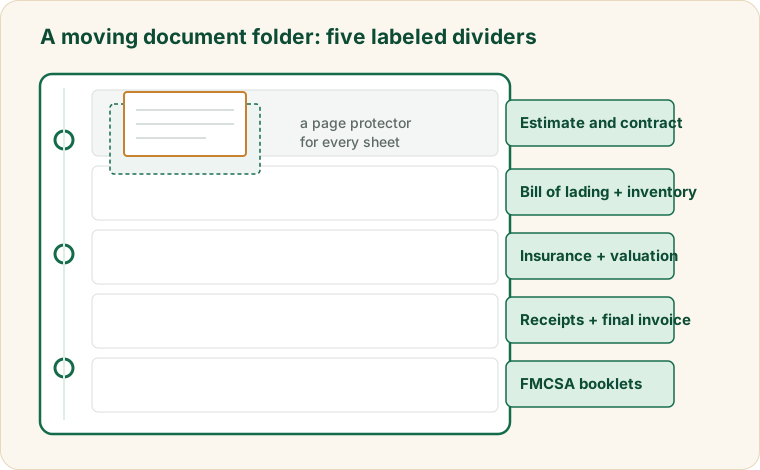
A durable binder does the physical work. Use clear page protectors so nothing gets creased, labeled divider tabs to separate categories, and a sleeve for each document so a single sheet cannot slip out unnoticed. A sheet of cardstock inside a protector keeps thin pages upright.
Build your dividers around the categories you will actually look under:
- Estimate and contract
- Bill of lading and the mover's signed inventory
- Insurance and valuation
- Receipts and the final invoice
- FMCSA consumer booklets
Those sections mirror how you search later: when you think "where is the signed inventory," you reach for the bill of lading tab.
The layout below shows how those five dividers sit in one binder, with a page protector on the top section.
Keep the folder current with one habit: drop every new document into a single inbox spot as it arrives, then file that stack in one sitting.
Building a home and box inventory you can trust
You need two inventories, and they solve different problems. A box inventory tracks what is packed and whether each box reached the new place. A home inventory records what your belongings are and what they are worth.
Your box inventory
For each box, record a box number, the room, a short description of the contents, and status flags for fragile, loaded, arrived and damaged. Write the box number large on at least two sides of the box so you can read it however it is stacked.
| Box number | Room | Contents | Fragile | Loaded | Arrived | Damaged |
|---|---|---|---|---|---|---|
| 1 | Kitchen | Plates and bowls | Yes | Yes | Yes | No |
| 2 | Office | Printer, cables | Yes | No |
The status flags turn the list into a running check. Tick Loaded as a box goes on the truck and Arrived as it comes off, and the gaps show what is still missing. A fragile flag marks what to unpack gently; a damaged flag marks what to inspect and photograph first. At the far end you find a box by its number instead of opening ten.
Group the rows by room, and keep a printable one-page version with checkboxes. A helper can then pack and account for a whole room at a glance.
Your home inventory
The home inventory is about value, so it records more per item: the room, a description, the purchase date, the brand or model, the original cost, and the replacement cost today. Link a photo and a scanned receipt to each valuable item. Keep original and replacement cost in separate columns, because they are rarely the same number, and neither guarantees any claim outcome.
| Room | Item | Purchase date | Brand or model | Original cost | Replacement cost today |
|---|---|---|---|---|---|
| Garage | Upright freezer | 2020 | (model) | price paid | price today |
This record is the evidence of what you owned and what it was worth if something is lost or damaged, so you are not working from memory. A missing item does not prove its value; the inventory, photos and receipts do.
These are your own working records. They are not the mover's itemized inventory, which the mover prepares and signs; that one is explained below with the move papers. Keep both of yours current as you pack, so neither becomes a last-night scramble.
Choosing between a spreadsheet and an app
The decision is narrow: which method will you actually keep up to date? Pick the one you will still be using when you are tired and halfway packed.
For most moves a spreadsheet or ready-made template is enough. Rather than build columns from scratch, start from a home or moving inventory template that already has room and insurance columns, and keep the file in the cloud so it opens on your phone while you stand over a box. A spreadsheet also prints to a single page, which gives you the paper checklist for moving day.
| Dimension | Spreadsheet or template | Dedicated app |
|---|---|---|
| Starting point | Download and edit | Install and set up |
| Editing on a phone | Cloud file opens on the phone | Built for the phone |
| Capturing photos | Paste or link manually | Photo creates the entry |
| Box labels | Print your own | Scannable label per box |
| Cost and learning | Usually free, familiar | May cost money and setup |
A dedicated app can add automation, as an illustration rather than an endorsement: photograph an item and it writes the entry, and print a scannable label that shows each box's contents on moving day. The right choice is the method you will keep current and can open the instant you need it, not the one with the longest feature list.
Estimates, contracts and the bill of lading
Four documents sit at the center of the folder because each governs a different part of the move. What follows applies to interstate household-goods moves regulated by the FMCSA, and the rules below were read against the current official text on November 1, 2026.
The written estimate comes first. The mover must give you a written estimate of the total charges and state whether it is binding or non-binding before executing the bill of lading, under 49 CFR 375.401(b). A binding estimate guarantees the total cost based on the quantities and services shown. A non-binding estimate is the mover's projection, with final charges based on the shipment's actual weight, so it can change.
Noted alongside the estimate is valuation, the level of the mover's liability for loss or damage that you select. It is not the price of the move, and it is not the same as separate insurance; keep that choice where you can find it.
With the written estimate, the mover must also provide two DOT publications, "Ready to Move? Tips for a Successful Interstate Move" and "Your Rights and Responsibilities When You Move," under 49 CFR 375.213(a). They belong in the folder, not the recycling.
The bill of lading is the one to protect above the rest. Before receiving your shipment the mover must prepare and issue it, and it holds the terms and conditions of the contract, under 49 CFR 375.505(a). You both sign it.
Before you sign the bill of lading, check that a handful of fields match what you agreed to.
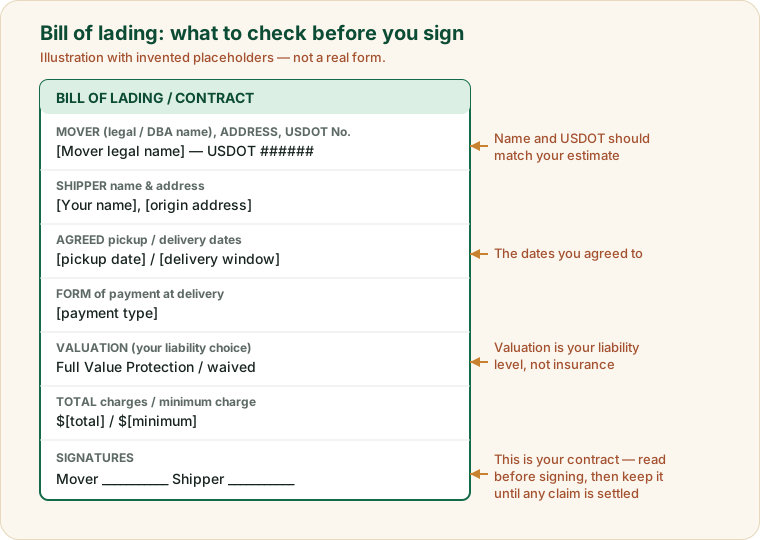
Confirm the mover name and USDOT number match your estimate, the dates and the valuation choice are right, then keep the signed copy until any claim is settled.
The mover's itemized inventory is distinct from your own records. The mover must prepare a written itemized inventory and, before or at loading, give you a copy signed by both of you with a copy of the bill of lading, under 49 CFR 375.503(a) and (c). Check it against the goods as they come off the truck.
| Document | What it is | Rule |
|---|---|---|
| Written estimate | Total charges, marked binding or non-binding, given before the bill of lading | 49 CFR 375.401(b) |
| DOT booklets | Two consumer guides provided with the estimate | 49 CFR 375.213(a) |
| Bill of lading | The receipt and contract, prepared before loading | 49 CFR 375.505(a) |
| Mover's itemized inventory | The mover's signed item record, copied to you at loading | 49 CFR 375.503(a), (c) |
File the estimate and valuation in your estimate-and-contract section, the bill of lading and the signed inventory together, and the booklets in their own spot.
Keeping receipts for taxes and a possible claim
The records that support a loss or damage claim are the bill of lading, the mover's signed itemized inventory, your own home inventory with its photos and values, and receipts for any damaged or lost items. Together they show what shipped, in what condition, and what it was worth.
How long you keep them depends on the paperwork, not a fixed calendar. A written claim for loss or damage must be filed within the time limits specified in the bill of lading or contract of carriage, under 49 CFR 370.3, read on November 1, 2026. Because that window lives in your own documents, read it on the bill of lading and keep the bill of lading and both inventories at least until any claim is resolved.
On taxes, keep the move-related receipts and the final invoice in case they matter for your situation. How long to hold them depends on your tax circumstances, so rather than assume a deduction applies, confirm what is relevant and how long to retain it with current IRS guidance or a tax professional.
Keeping the folder and inventory within reach on moving day
On moving day, keep the folder with you rather than letting it get packed into a sealed box. A bright, easy-to-spot binder is quick to grab when you leave.
Back it up digitally. Scan each document to cloud storage so a copy is reachable even when the paper folder is not in your hands, and keep the inventory in the cloud so it opens on your phone at either end. A private move workspace, such as the one MoversHere provides, is one place to keep those scanned documents and reconcile the final invoice against the estimate.
Keep one caution in mind, because it changes what you do with sensitive papers. A single binder that is lost or stolen is a problem of its own, so store passwords, Social Security cards and passports in a more secure place, such as a home safe, rather than only in the grab-and-go folder.
A small habit prevents quiet losses: label each page protector with its contents. If someone pulls the car title and does not put it back, the empty labeled sleeve shows exactly what is missing. Do both, and you arrive with the folder ready to grab and the inventory ready on your phone.