Moving-out checklist to leave your current home the right way
Regulatory text checked .
Confirm your agreed last day and obligations. Clean and document the empty home, coordinate final services and mail, then keep a record of the keys and access devices handed over.
Choose your situation
- Your rental ends as agreed. Confirm the notice recipient and end date, then follow the cleaning and key-return instructions. Check your lease.
- You are leaving a rental early. Get the agreement-end, service-stop and key-return dates clarified in writing; moving your belongings does not establish that every obligation has ended. Coordinate the dates.
- You sold the home. Confirm possession, items staying and unfinished agreed work with your transaction professional. Prepare the handover.
- Your next home is unavailable. Confirm both access dates and arrange lodging, storage, both transport legs and mail. Plan the gap.
Giving notice and reviewing your lease
Open your rental agreement and move-out instructions. Identify the tenancy type, end date, notice clause, recipient and delivery method. Compare those terms with the applicable state and local rule, and confirm the proposed key-return arrangement.
Physical departure, the agreement ending and acceptance of keys can happen separately. Ask management to clarify unresolved dates and obligations in writing.
Keep the notice and delivery evidence together.
When a reply supplies different instructions, save it alongside the agreement rather than replacing the original record. Identify the disputed date or delivery requirement in your follow-up so the response answers the unresolved point.
Match the notice rule to your tenancy
For an indefinite monthly or periodic tenancy in Washington, RCW 59.18.200(1)(a) requires “written notice of 20 days or more” preceding the end of a rental period. Match both the tenancy type and period-end date before using that number.
Subsection (1)(b) permits shorter notice for qualifying armed-forces members, spouses or dependents when permanent-change-of-station or deployment orders do not allow 20 days. For a fixed term or another early-departure circumstance, check the applicable agreement and rules before choosing dates.
If you are selling, settle what stays
Review the sale agreement, addenda and possession/access arrangements with your transaction professional. Compare your removal list with included appliances and separately agreed furniture. Resolve an ambiguous washer, dryer or other item before movers load it.
Put changed agreements about remaining items in writing.
Cleaning and repairs for your deposit
Use the original condition record and move-out instructions to guide the cleaning. Once furniture leaves, check the exposed floors, walls and storage spaces that were previously hidden.
Clean rooms as they empty. Leave the box-staging area and exit route for the last floor pass.
- Empty and clean appliance interiors; remove stovetop grease and wipe cabinet fronts.
- Clean bathroom residue, sinks, fixtures and the toilet.
- Vacuum or clean floors, baseboards and window sills using methods appropriate to their materials.
- Check light fixtures and remove remaining trash.
Before booking professional cleaning, compare the requested work with the actual instructions and condition.
For a sold home, include outdoor areas in the final check: remove personal debris, pick up after pets and maintain the yard through the agreed handover. Ask before leaving pots, spare materials or other items that the buyer has not agreed to keep.
Check any deduction against the records
Compare each questioned charge with the initial record, final photos, specific statement and supporting documents. Ask the landlord to identify the condition or cleaning work behind an unclear charge and provide readable supporting material.
In Washington, RCW 59.18.280(1)(c) bars withholding a deposit for “wear resulting from ordinary use”. Carpet-cleaning deductions require documented wear beyond ordinary use. Compare the charge with the evidence of that condition.
Under (1)(a)–(b), the specific retention statement, required documents and any refund are due within 30 days after “the termination of the rental agreement and vacation of the premises”. The trigger requires both termination and vacation. For statutory abandonment, the clock starts when the landlord learns of it. Personal delivery or properly addressed, prepaid first-class mailing within the period complies.
Subsection (2) includes exceptions concerning circumstances beyond the landlord's control and abandonment when addressing failures to comply. Subsection (4) excludes non-damage deductions, such as rent, from the checklist/documentation requirements. Keep funds available for cleaning, agreed repairs and final balances while the deposit accounting remains open.
Final utility readings and shut-offs
List accounts in your name and ask each provider to confirm its stop or transfer date against the agreed handover schedule. Keep each confirmation separate when departure and handover dates differ.
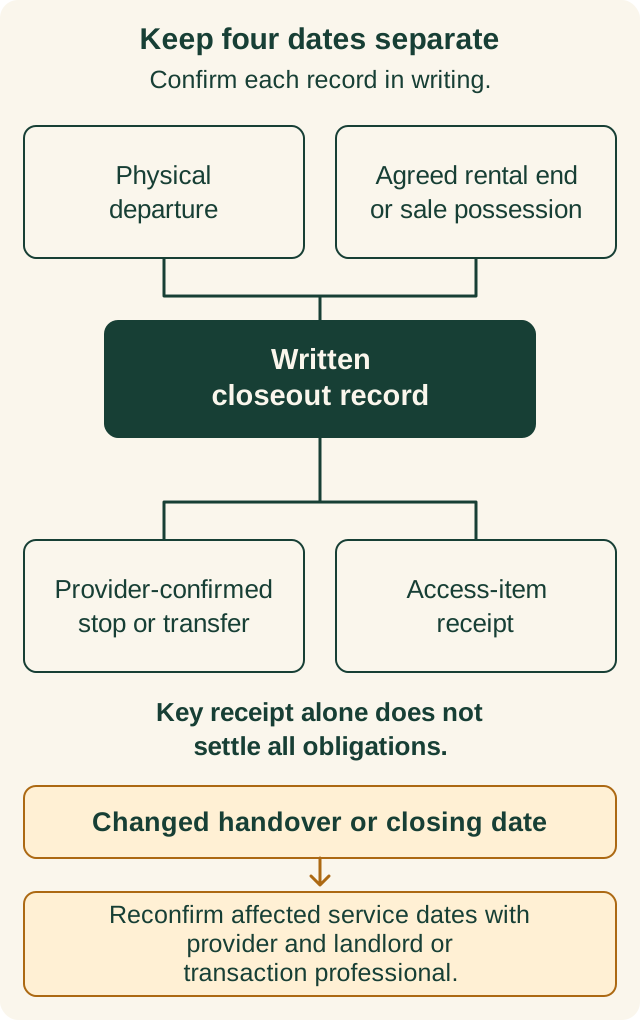
The four boxes feed one written record; their connecting lines do not set a sequence. If the handover or closing date changes, follow the amber branch and reconfirm affected services with the provider and landlord or transaction professional.
For sellers: coordinate service continuity with possession and the walkthrough so agreed checks remain possible. If closing changes, reconfirm dates with the provider and transaction professional before a scheduled stop occurs.
Keep the service record through the final bill
For each account, save the provider, account/service address, confirmed stop date, reference number, any appropriate reading/photo, equipment-return receipt and final-bill status.
Use the record to distinguish a request from a completed account task:
| Account task | What to retain |
|---|---|
| Stop or transfer requested | Provider confirmation of the effective date |
| Customer reading requested | Accessible reading/photo and the provider's instructions |
| Equipment returned | Return receipt identifying the equipment |
| Final bill checked | Compared dates and charges, payment record and any unresolved query |
The first row confirms scheduling; it leaves the final-bill task open. A meter photograph supports your query if figures differ, but does not override the provider's record or determine liability.
Ask whether a customer reading is needed. Record it only where accessible without operating meters or disconnecting gas or electrical equipment; leave that work to the provider or qualified professional.
Return provider-owned equipment using its instructions and obtain a receipt.
Compare the final dates, readings used and charges with your confirmations. Ask about discrepancies and retain the response. A scheduled stop is not a checked final balance.
Forwarding mail and closing accounts
Submit a USPS change of address and separately update government agencies, banks, insurers, stores and other senders. The postal order updates your address with the Post Office only.
Complete identity verification and retain the confirmation code. USPS guidance says to allow at least 7–10 business days after approval for the order to take effect. Forwarding varies by mail class and endorsement.
For sensitive documents, contact the sender directly about restrictions and delivery options.
Returning keys and the final walkthrough
Confirm the agreed walkthrough arrangements. Compare the vacant home and final photos with the initial condition record and agreed work. If the walkthrough cannot happen, retain the request, record condition yourself and send the closeout record.
Record the access handover
Inventory keys, fobs, remotes and other applicable access devices. Agree the secure recipient and return method, then obtain acknowledgment of what was received.
Use this copyable editorial record to keep condition, access and open points together:
Handover date/time: [date and time]
Vacant condition and photo record: [notes/file references]
Agreed items remaining: [items]
Agreed work checked: [work/status]
Unresolved points and requested next step: [details]
Keys/fobs/remotes returned: [types and quantities]
Recipient and return method: [details]
Receipt/acknowledgment: [reference or pending]
Forwarding contact: [contact]
Copy sent to other party: [date/method]
Send a copy and retain the acknowledgment. Keep outstanding points open for landlord or transaction-professional follow-up: a key receipt alone does not release every rental obligation or approve a deposit refund.
After handover, use the apartment move-in checklist to handle the next home's arrival checks.
If there's a gap before your next place
Check each gap arrangement against its own confirmation.
| Gap arrangement | What to confirm or arrange |
|---|---|
| Old and new access | Both dates in writing; obtain agreement to any change before relying on it. |
| Temporary lodging | Price lodging separately from storage and both transport legs. |
| Stored belongings and essentials | Confirm release and delivery; keep documents, medicines and daily necessities accessible. |
| Mail during the gap | Arrange a usable forwarding destination, ask USPS which service fits, and update direct senders. |
The access row stays open while a change is only requested. Keep lodging, storage, transport and mail visible until each has a confirmed next step. Include cleaning, agreed repairs and final bills in the budget without relying on an immediate deposit refund.
Choose a mail destination for the gap
For a permanent departure, arrange a usable forwarding destination and ask USPS which service fits. USPS Hold Mail guidance excludes requests for an address where you no longer live.
Temporary forwarding serves a temporary relocation; a short gap alone does not mean you are returning to the old home. Update direct senders using the mail and account steps above.