Storage between leases: bridging a gap between homes
You handed back the keys on the first, but the new place will not be ready until the fifteenth, and a handful of short-term storage paths can carry your belongings across that gap.
Regulatory text checked .
The storage path that fits comes down to three questions about the gap itself: how long it will last, whether you need to reach your belongings while they are stored, and who handles the goods, you or a crew.
When a gap between leases happens
Move-out and move-in dates rarely line up on their own. A lease ends before the next one starts, a closing or a construction delay pushes the new home back, or an out-of-town or staggered move leaves your things in one place while you are already settling in another. The gap is normal, and it is worth planning for rather than improvising on the last day.
The three questions that decide your path
Three questions sort most of the choice. How long is the gap likely to be, days or months? Will you need to reach your belongings while they are stored? And who do you want doing the handling, you or a crew?
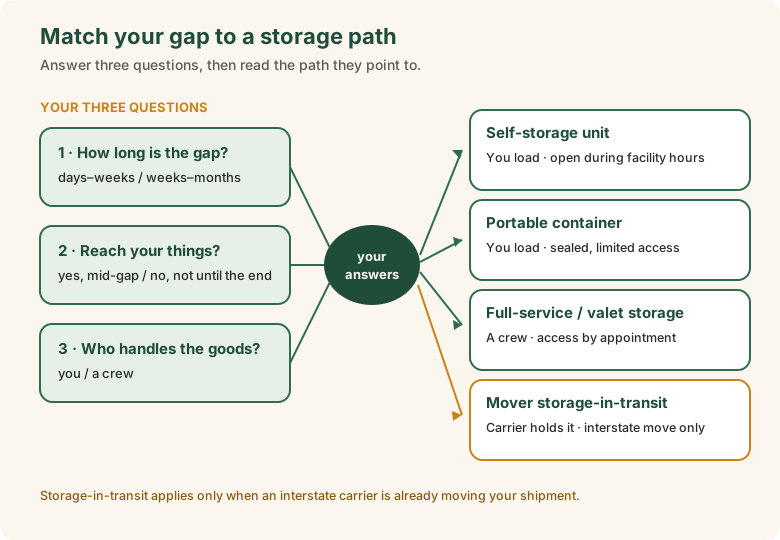
Your answers usually point one way. A short gap of days or weeks where you want to keep loading on your own time suits a unit or a container you control. An interstate move whose delivery date is still uncertain often lands with the carrier itself. And a new home that needs cleaning or repairs before furniture can go in calls for something that can stay sealed and wait.
Your short-term storage options
Four short-term paths are worth knowing before you compare them closely.
The first is a self-storage unit, which you rent and fill yourself at a facility. The second is a portable container, dropped at your home or loaded at the company yard and then stored until it is delivered to the new address. The third is full-service or valet storage, where a moving crew packs, loads and warehouses your goods for you. The fourth appears only on an interstate move: storage-in-transit, where the carrier moving your shipment holds it temporarily between pickup and delivery.
A unit or a container you load yourself keeps you in control and on your own schedule; full-service storage and storage-in-transit hand the lifting, loading and warehousing to a crew.
How the four storage paths compare
Set the paths side by side on the points that decide the choice: who handles the goods, where they sit, how you reach them during the gap, who redelivers them, how cost is structured, and who is liable for the packing.
| Path | Who packs and loads | Where your things sit | Reaching them during the gap | Transport and redelivery | How cost tends to be structured | Liable for packing |
|---|---|---|---|---|---|---|
| Self-storage unit | You | A unit you rent at a facility | Usually open during facility hours | You arrange it | Monthly rent, often by unit size | You |
| Portable container | You | At your home, or stored sealed at the company yard | By arrangement once stored; some yards allow a scheduled visit | Company delivers and redelivers | Pickup, delivery, redelivery, fuel and a monthly storage charge | You |
| Full-service or valet storage | A crew | Wooden vaults stacked at the company warehouse | Not drive-up; contact the company and schedule | Company handles it | Packing and labor plus monthly vault storage | The mover |
| Mover storage-in-transit | The carrier's crew | The carrier's warehouse between pickup and delivery | By arrangement with the carrier | Carrier handles it | Part of the interstate move, plus storage charges | The mover |
With self-storage you rent and manage the unit, load and transport it yourself, usually come and go during facility hours, and own the results of how the items were packed and stacked.
A portable container lets you pack on your own schedule. It is dropped at the home, which needs clear, legal driveway or street space that an HOA, a curvy or tight driveway, or a downtown block can deny, or else it is loaded at the company yard. Once sealed it is stored and later redelivered. Because you loaded it, the container company is generally not liable for damage caused by how the items were stacked. That sealed container can also double as storage while you clean or repair the new home before anything comes inside.
Full-service or valet storage sends a crew to pack and load at the home, then warehouses the goods in wooden vaults stacked at the company's facility. The trade-off against self-storage is access: you cannot drive up and open a unit, so reaching your things means contacting the company and scheduling a visit first.
Mover storage-in-transit is a category of its own. On an interstate move the carrier holds your shipment temporarily between pickup and delivery and arranges the transport and redelivery to the new address. Federal rules govern the written notice you are owed and when the carrier's liability ends; those are covered in the next section.
Read the table against your own move, weighing handling, location, access and cost against how long your gap runs and whether you expect to need your things. No path is best in the abstract; one of them fits this gap.
What to ask about access, insurance and cost
Ask these questions before you commit, and get the answers in writing. They fall into three groups.
Access
Ask exactly how, and how fast, you can reach your belongings once they are stored. Some stored containers and warehoused vaults cannot be opened until they are redelivered, or only with advance notice and a scheduled visit, while a self-storage unit can usually be entered during facility hours.
Confirm the access terms in writing. For a container service, also confirm where the depot is, how far it will deliver, and whether you can get to your own container at the yard if you need something out of it mid-gap.
Insurance and valuation
Before you count on being covered, keep two things that sound alike apart.
Ask what coverage applies and what it excludes, and review a mover's valuation coverage separately from your homeowners or renters insurance. MoversHere explains what to check; it does not give personalized insurance advice.
On an interstate move, the default Full Value Protection makes the mover liable for goods lost or damaged during the transportation and related services, at their replacement value up to the shipment's declared value, unless you waive full value in writing, which drops the mover's liability to the amount set in the Surface Transportation Board's released-rates order; either way the mover must disclose the limits of its liability (49 CFR 375.201, checked November 1, 2026).
Those released-value limits are low. Liability can fall to as little as 60 cents per pound per article, and any article worth more than $100 per pound has to be listed in writing to be eligible for fuller recovery (49 CFR 375.203, checked November 1, 2026).
Storage-in-transit has its own notice rule. Before the storage period converts to permanent storage, the carrier must notify you in writing, generally at least 10 days before it expires, giving the conversion date, telling you that a nine-month window to file loss-or-damage claims then applies, that the carrier's liability is ending, and that the goods become subject to the warehouseman's rules, regulations and charges (49 CFR 375.609, checked November 1, 2026).
Cost
Ask for an all-in, written price and watch the billing cycle. Storage and container services commonly add separate pickup, delivery, redelivery, fuel and monthly storage fees, and storage is billed in monthly periods. Keep this conversation to what you are confirming rather than figures a provider quotes you in passing.
The billing cycle matters when dates move: if a delivery or redelivery slips past the end of a paid month, another full month can be charged. Get the all-in price in writing.
Treat the move and the storage period as one written scope. Confirm the pickup inventory, the storage environment and whether it is climate controlled, the access rules, the monthly charge, the redelivery terms, what happens if the closing date changes, and whether the same company stays accountable through pickup, storage and final delivery.
Preparing and inventorying items for storage
Prepare, inventory, load and lay out your belongings so they survive the gap, and set aside the few things you will keep with you.
Keep an inventory. A written list of what went into storage, clear bins so you can see contents without opening them, and a label on every box turned to face the aisle will save you digging later.
Prepare the items so they last the stay. Find out what the facility prohibits, rent a size that actually fits, and disassemble large furniture. Keep sensitive things such as wood, electronics, instruments or art, and anything staying a long time, in climate control.
Store pieces the way the maker intends rather than only to save space. Some belong flat, others upright. A mattress wedged on its side for a long period, for instance, can let the inner materials settle toward the ground and ruin it, so treat that as a caution rather than a rule for every item.
Load so nothing shifts. Pack tightly, put the heaviest, sturdiest pieces low as a base with lighter items on top, and fill gaps with padding so the tiers stay flush. In a container, use the tie-down rings and build the last load into a wall at the door, so the contents do not slide forward and block it when the container arrives.
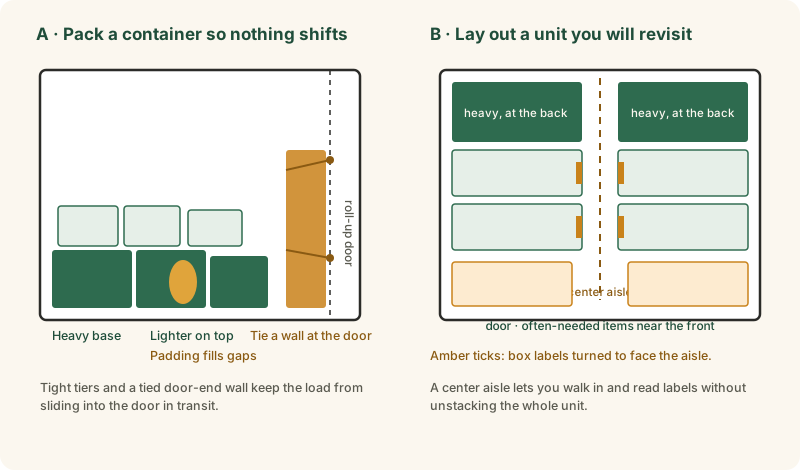
Lay out a unit you expect to revisit. Keep belongings along the walls with a center aisle so you can walk in and read labels, heavy items low and toward the back as a base, and the things you will need often near the front.
Set a few things aside before the load is sealed.
Those travel with you; everything else can wait out the gap.