Moving estimates and contracts: what each document means and what to check
Most people picture a moving contract as a single sheet they sign once. For a household move, especially one that crosses a state line, it is really a small stack of documents that work together, and knowing each one keeps your price and your pickup predictable.
That set is the written estimate, the order for service, and the bill of lading, plus the booklet called Your Rights and Responsibilities When You Move for any move between states. The basic shape is the same whether you move across town or across the country, though the booklet and several of the rules below are interstate-specific, so a local move follows some of them but not all.
By the MoversHere editorial team. Created , updated .
Regulatory text checked .
In short: a moving contract is a set of documents, not one page. The written estimate fixes the price. The bill of lading is both the receipt and the contract for moving your things. The order for service is the authorization step in between. For an interstate move, your mover must also hand you the Your Rights and Responsibilities When You Move booklet when it gives you the estimate.
Choose your situation and jump to a short answer:
- Which paper fixes the price? The estimate sets the price; the bill of lading records and governs the shipment.
- What does my estimate type mean for the bill? Binding is fixed, non-binding follows the weight up to 110 percent at delivery, and not-to-exceed is a ceiling you can come in under.
- What will I sign, and in what order? The estimate first, then usually an order for service, then the bill of lading at pickup.
- What should I check before I sign? Confirm the estimate type and that the services, dates and amounts match, and never sign a blank document.
- I only got an order form and no bill of lading at pickup. An interstate shipment must have a bill of lading, which is the required receipt and contract.
- I am asked for a large upfront deposit. A deposit may be expected, but it should be small, and payment terms belong on the signed documents.
The moving paperwork, start to finish
You are handed these papers at predictable moments, so it helps to know which shows up when and what you are signing.
The four papers always arrive in the same order, and only two of them bind you. This diagram lays out the sequence and marks which paper fixes your price and which one is the contract.
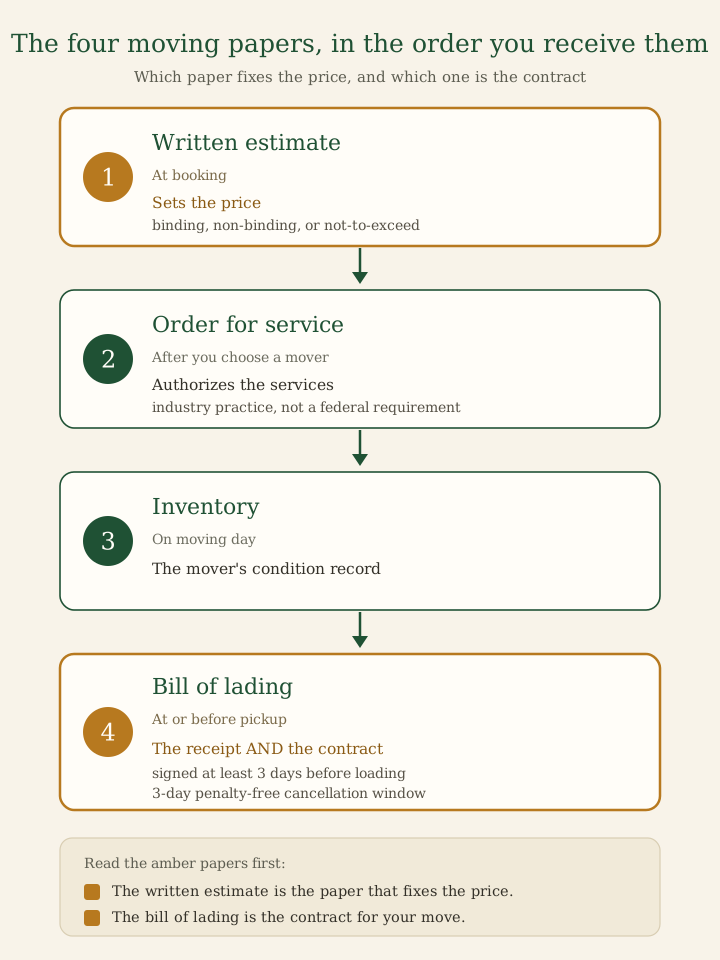
Read the amber papers closely: the written estimate is what sets your price, while the bill of lading is the contract that governs the shipment.
The written estimate comes first, at booking. It opens the set.
For a move across state lines, the estimate does not arrive alone. When your mover gives you the written estimate it must also furnish the federal consumer booklets, including Your Rights and Responsibilities When You Move, under the federal information rule (49 CFR 375.213). If a mover never mentions that booklet on an interstate job, ask for it.
After you accept an estimate and choose a mover, many companies issue an order for service. This paper authorizes the mover to perform the services listed and confirms the agreed dates. It is standard industry practice rather than a document the current federal rules require, and that distinction matters later: it is not the paper that sets your binding terms.
The bill of lading comes last. Under the federal bill-of-lading rule (49 CFR 375.505), the mover must prepare and issue it before it receives your shipment, and in practice you review and receive it around pickup, typically with the estimate and the inventory attached. It is the document that travels with your goods.
Keep the bill of lading with you and do not pack it. It is your receipt and your contract for the shipment, so you want it in hand, not in a box on the truck.
- Written estimate at booking, binding or non-binding, furnished with the Your Rights and Responsibilities booklet for interstate moves.
- Order for service as the authorization step many movers still issue.
- Inventory taken on moving day.
- Bill of lading issued at or before pickup, usually with the estimate and inventory attached, and kept with you.
Knowing the order also tells you when something is off: a paper that appears out of sequence, such as a bill of lading with no estimate behind it, is a prompt to stop and ask why before you sign.
Hold onto the names and the order. The depth of each document follows.
Estimate, order for service and bill of lading: who does what
The distinction that matters most is simple: one paper fixes the price, and one records and governs the shipment. Read each document with that question in mind.
The written estimate: the paper that sets the price
The written estimate states the total charges and says whether they are binding or non-binding. The federal estimate rule (49 CFR 375.401) requires the mover to give you that written estimate and indicate its binding or non-binding status before it executes your bill of lading, and it expects the estimate to be based on a physical survey of your goods, in person or by live or recorded video, unless you waive the survey in writing.
You and the mover both sign the estimate, and the mover must give you a signed, dated copy. Keep it: that copy is your proof of the price that was agreed.
For how a mover builds that estimate from a survey, what a valid one must show, and how to read each line, see how a moving estimate is made and what it must show.
The order for service: a record of what you agreed to
The order for service records the services you agreed to and the pickup and delivery dates, and it authorizes the mover to perform them. Because it is industry practice rather than a current federal requirement, it is not the document that sets your legally binding terms. The price-fixing role stays with the estimate, and the contract role stays with the bill of lading.
An order for service often looks a lot like the estimate, with similar line items and figures, so do not treat it as the paper that locks in your price. Match it against your signed estimate and keep both.
The bill of lading: receipt and contract in one
Federal law defines the bill of lading as both the receipt and the contract for transporting your household goods, under the definitions in 49 CFR 375.103, and the bill-of-lading rule requires it to contain the terms and conditions of the contract. It is the legal paperwork that lets the mover carry your belongings.
Because it is the contract, the bill of lading is the document that records and governs the shipment, and it carries the final pricing and the agreed delivery dates. If anything else on the page competes with it, the bill of lading is the one that controls the move.
Before you sign the bill of lading, confirm that it and the estimate agree on services, dates and dollar amounts. A mismatch between them is the single most useful thing to catch early.
For an interstate move, the Your Rights and Responsibilities When You Move booklet is your reference for your legal protections. It applies to moves that cross a state line and is not a universal feature of a local move, so treat it as the interstate reader's handbook.
Binding, non-binding or not-to-exceed in 30 seconds
Three estimate words decide how much you actually owe at delivery. Here is what each one means for the final bill.
A binding estimate is a fixed price for the items and services listed. Once your shipment is loaded, the federal binding-estimate rule (49 CFR 375.403) says the mover may not collect more than the original binding estimate at delivery, except for services you request after the bill of lading has been issued. Add items or services and the price can change; leave the list alone and the number holds.
A non-binding estimate is the mover's best projection, and the final bill follows the actual weight of your shipment, so it can land higher or lower than the quote.
The protection built into a non-binding estimate is a cap at delivery. Under the federal non-binding-estimate rule (49 CFR 375.405), you will not be required to pay more than 110 percent of the non-binding estimate at the time of delivery, with any remaining balance billed afterward rather than demanded on the spot.
A binding not-to-exceed estimate is a ceiling: you never pay more than the quoted amount, and you can pay less if your shipment weighs less than estimated.
| Estimate type | What it is | What you pay at delivery |
|---|---|---|
| Binding | A fixed price for the listed items and services | Not more than the original binding estimate, except for services you request after the bill of lading is issued |
| Non-binding | A projection; the final bill follows the actual weight and can be higher or lower | Not more than 110 percent of the estimate at delivery; any balance is billed afterward |
| Binding not-to-exceed | A ceiling price for the listed services | Never more than the quoted amount, and possibly less if the shipment weighs less |
The first thing to find on your own estimate is which of these three words it uses.
The full mechanics and worked examples belong on the estimate page.
Choose your situation
Find the situation that matches yours, read the short answer, and open the page that covers it in depth.
- Which document fixes the price and which just records the shipment? The estimate fixes the price; the bill of lading is the receipt and contract for the shipment. See the written-estimate and bill-of-lading pages for the detail.
- What do binding, non-binding and not-to-exceed mean for what I will pay? Binding is fixed, non-binding follows the weight up to 110 percent at delivery, and not-to-exceed is a ceiling. The estimate page walks through each with examples.
- What paperwork will I sign, and in what order? The estimate first, then usually an order for service, then the bill of lading at pickup.
- What should I check before I sign anything? Start with the checks below, then open the page for the document in front of you.
- I was given only an order form or a quote and no bill of lading at pickup. An interstate shipment must have a bill of lading. Ask for it before loading.
- I am asked for a large upfront deposit or full payment before the move. A deposit may be expected, but a large one is a warning sign, and payment terms belong on the signed documents.
The no-bill-of-lading situation changes what you should do. Because the bill of lading is the required receipt and contract for an interstate household move, a crew that loads your belongings with only an order form or a quote has skipped the one document that protects the shipment. Before anything goes on the truck, ask for the bill of lading and check that it matches your estimate, and treat a refusal to produce one as a reason to pause the move.
The deposit question calls for general, cautious guidance. Movers may ask for a deposit, but it should be modest rather than a large share of the total, and the payment terms, including any pickup-and-delivery split, should be written on the documents you sign rather than agreed by phone.
Follow the branch that matches your situation to the page that covers it.
What to check before you sign
Run these checks with a pen in hand before you sign any moving document. They apply to every mover.
First, confirm the estimate states its type, binding or non-binding, that both you and the mover sign it, and that you leave with a signed, dated copy. That copy is what you will measure everything else against.
Keep a copy of everything you sign.
Never sign a blank or incomplete document. The federal bill-of-lading rule (49 CFR 375.505) is explicit that a mover may not require you to sign a blank document, and everything on a signed estimate is treated as final once both sides sign. If anything changes before loading, it needs a fresh signature from you and the mover, not a verbal promise.
Before you sign the bill of lading, confirm that the services, the dates, the valuation or insurance coverage and the dollar amounts on it match your original estimate.
Read the entire contract, even with a well-known company.
Know the bill of lading's timing. Under the same rule, it must be provided to you, signed and dated at least 3 days before loading, and you have a 3-day window after signing to rescind it without penalty. Movers often review and hand over the signed bill of lading around pickup, so if the first time you see it is as the truck is loaded, slow down: you are meant to have it in advance, with time to read it and change your mind.
Treat a phone-only quote and a large upfront deposit as cautions. Because your price is meant to be based on a physical survey, in person or by video, a firm number quoted sight unseen deserves a second look. Make sure the payment terms, including any split between pickup and delivery, are written on the signed documents.
- The estimate states its type, both of you sign it, and you have a signed, dated copy.
- No blank or incomplete document is signed.
- Services, dates, valuation or insurance and dollar amounts on the bill of lading match the original estimate.
- You have read the whole contract, even with a known company.
- You understand the bill of lading's signing timing and the 3-day penalty-free cancellation window.
- Payment terms, including any pickup-and-delivery split, are in writing, and any deposit is small.
The deeper, document-by-document checks live on the child pages.
Where to go next
Each need below points to the page that answers it in depth.
For the full mechanics, go to the deep written-estimate page and the bill-of-lading page.
To weigh several competing quotes against each other, use the compare page, which this hub deliberately leaves out.
For the catalogue of accessorial and extra charges, see the hidden-fees page.
For the delivery-day final invoice and damage claims, see the claims, disputes and final-invoice area.
If you are not sure where to start, open the page for the document you were just handed.