Binding vs. Non-Binding Moving Estimates: Which One Protects You
Your moving paperwork says binding or non-binding, or a mover quotes a "guaranteed not-to-exceed" price, and you have to decide which one to request. The three types differ mainly in one way: how each ties your final bill to the figure written on the quote.
That single choice shapes what you pay at the door. This guide covers interstate household moves under the federal rules in 49 CFR Part 375, and a type only protects you once it is marked on the estimate in writing.
Regulatory text checked .
Short answer. On an interstate move you can request a binding, binding not-to-exceed, or non-binding estimate. A binding estimate fixes the price for the goods and services listed. A non-binding estimate is only an approximation, billed on the actual weight at the mover's tariff, so it can run higher or lower. A binding not-to-exceed price treats the quote as a ceiling you never exceed. For cost certainty, ask for a binding or not-to-exceed estimate built on a survey, and get the type written on the estimate.
The estimate types at a glance
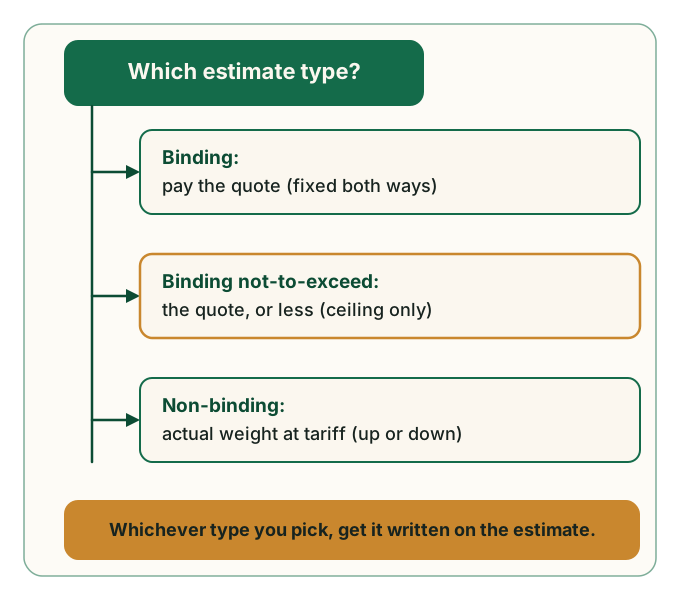
Interstate movers work with three estimate types: binding (a fixed price for the inventory and services listed), binding not-to-exceed (a ceiling that can only drop), and non-binding (an approximation later billed on actual weight and services). Place any estimate you already have in one of those three boxes before reading further.
The axis that separates them is your core decision: how each type links the quoted figure to the final charge.
| Estimate type | What you pay | Can the bill rise above the quote? | Can it come in lower? | Most the mover may collect at delivery |
|---|---|---|---|---|
| Binding | The agreed figure for the listed inventory and services | No, except services you request after the bill of lading and, where applicable, impracticable-operations charges | No; fixed even if the shipment weighs less | The exact binding estimate, plus post-bill-of-lading requested services and impracticable-operations charges (capped at 15 percent at delivery) |
| Binding not-to-exceed | The agreed figure, or less | No | Yes, if actual weight or services come in under the estimate | The estimate as a ceiling; less if the shipment weighs less |
| Non-binding | Actual weight and services at the mover's tariff | Yes | Yes | 110 percent of the non-binding estimate, plus any lawful added-service and impracticable-operations charges; remaining lawful balance billed later |
Read it one row at a time: you pay the quote (binding), the quote or less (not-to-exceed), or for actual weight and services, which can land above or below the quote (non-binding).
Of the three, a binding not-to-exceed estimate is the most shipper-friendly, and movers do not always put it on the table.
Whichever type you agree to has to be recorded in writing on the estimate to mean anything.
Binding estimate: a fixed price
A binding estimate fixes the total cost for the inventory and services listed before the move. If that inventory and those services do not change, the price holds even when the shipment ends up weighing less than expected. It trades away the chance of a lower bill for certainty: the figure on the page is the figure you pay.
That certainty is backed by the rules. On a binding estimate the mover may not collect more than the amount of the original binding estimate at delivery (49 CFR 375.403).
Can a binding price ever go up?
Only through two narrow openings. The first is services you request after the bill of lading is issued: if you add items or ask for work that was not on the original list, the mover can charge for it, and a change made after loading should be captured on a signed change order.
The second is impracticable operations, meaning conditions at pickup or delivery the estimate could not account for, such as a long carry or a shuttle. Where those apply, the amount collectible at delivery for impracticable operations is capped at 15 percent of all other charges due at delivery, and the rest is billed afterward (49 CFR 375.703). Both are additions on top of the binding figure, not a reopening of it.
For the guarantee to hold, the binding estimate must be in writing and attached to the bill of lading (49 CFR 375.403). Outside those two exceptions, the price does not drift with the shipment's actual weight.
Binding not-to-exceed: the price can only go down
A binding not-to-exceed price is a mover offering that works as a one-directional ceiling: the quoted figure is the most you can ever be asked to pay. It also keeps the upside of a non-binding quote, because if the shipment weighs less than estimated or needs fewer services, you pay the lower actual amount instead of the ceiling.
That is what sets it apart. A plain binding estimate is fixed in both directions, a non-binding estimate can rise with actual weight, but a not-to-exceed price can only move down. It is the shipper-friendly middle ground.
Because it favors you rather than the mover, it is not always volunteered. If you want this protection, ask for a "binding not-to-exceed" estimate using that exact name, and confirm it is written on the paperwork.
Non-binding estimate: why the final bill can differ
A non-binding estimate is an approximation based on the estimated weight or volume and the services expected. It does not guarantee the quoted figure.
Here is how the final charge is set. The mover weighs the truck before loading and again after your goods are aboard, and the difference is your shipment's actual weight. You are then billed for that weight and the services performed at the mover's published tariff, which is why the final charge can end up higher or lower than the quote. The estimate is a forecast; the weight ticket is the fact.
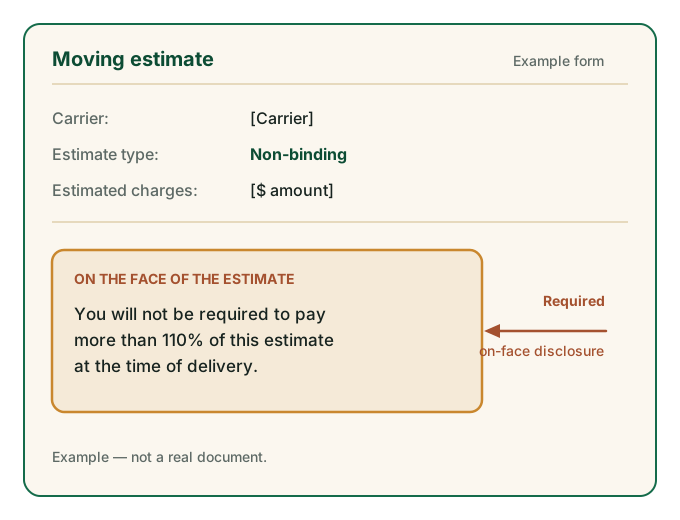
The rules put conditions on how it is given. A non-binding estimate must be furnished free of charge and in writing, and it must state on its face that the final charges will be the tariff charges based on the actual shipment and may exceed the estimate (49 CFR 375.405).
What makes a non-binding quote reliable?
A non-binding quote set too low invites a much larger final bill once the actual weight is on the ticket. What makes any estimate dependable is a careful survey, in person or by video, of everything being moved, so projected weight and services land near the quote.
No survey, no bill of lading.
The interstate collect-on-delivery limit at delivery
This is the moment that worries most people: the truck is at the curb and you want your things. On a non-binding estimate, the mover may collect at delivery no more than 110 percent of the non-binding estimate, meaning the estimate plus ten percent (49 CFR 375.405, 49 CFR 375.703). That is the ceiling on what you must hand over to get the shipment released.
On a binding estimate the counterpart is tighter: the most collectible at delivery is the exact binding figure, plus only the allowed additions already described, services requested after the bill of lading and impracticable-operations charges within the 15 percent cap (49 CFR 375.703).
Anything beyond that cap is handled later. On a collect-on-delivery shipment the mover must relinquish the goods once you pay up to 110 percent of the non-binding estimate plus any lawful added-service and impracticable-operations charges. Any remaining lawful charges are billed and collected afterward under the credit rules in subpart H, and if only part of the shipment is delivered, the amount due is prorated to what arrived (49 CFR 375.407). Pay up to the cap, and the goods are yours.
For this to work, the non-binding estimate must carry the disclosure: the 110 percent limit and the tariff basis for the final charges must appear on its face (49 CFR 375.405).
What if the crew asks for more before unloading?
Which type to request and how to confirm it in writing
Start from your tolerance for surprise. Weigh cost certainty, which a binding or not-to-exceed estimate gives you, against the possible savings of a non-binding estimate. If an unexpected several hundred dollars at delivery would be a real problem, prefer a binding or not-to-exceed estimate built on a real survey. If your inventory is modest and carefully surveyed, a non-binding estimate can come in lower, with the risk it comes in higher.
Is a phone quote enough?
Favor an in-home or video survey. A phone-only quote, given without anyone seeing what you own, is the weakest basis for any estimate, because the mover is guessing at the weight it will later charge you for. A phone call is not a survey.
On deposits, treat the size as a signal. A deposit may be expected, but an unusually large upfront demand before any service is a warning sign. There is no single federal dollar figure here, so judge it against the move's value and whether the rest of the paperwork is in order.
What exactly do I check before signing?
Before executing the bill of lading, the mover must indicate whether the estimate is binding or non-binding, and the estimate has to be based on a physical survey of the goods unless you sign a written waiver of it. A binding estimate must also be attached to the bill of lading (49 CFR 375.401, 49 CFR 375.403). Run through this before you sign:
- The estimate clearly marks which type it is: binding, binding not-to-exceed, or non-binding.
- It is based on an in-home or video survey, or you knowingly signed a written waiver.
- The type is indicated before the bill of lading is executed.
- A binding estimate is attached to the bill of lading.
- The estimate is signed and dated, and you keep your own copy.
A signed, dated estimate marked with the agreed type is what a mover can be held to later. A number spoken over the phone is not. Keep your copy.
Official rules used in this guide
For an interstate household-goods move, verify the estimate terms against the current federal rules:
- 49 CFR 375.401 — written estimates
- 49 CFR 375.403 — binding estimates
- 49 CFR 375.405 — non-binding estimates and collection at delivery
These federal rules apply to interstate moves. State-regulated moves may follow different requirements.