Moving Company Extra Charges: What to Check in Your Estimate
Connect each possible extra charge to the service, condition and written terms that would make it apply to your move.
Regulatory text checked .
Match an additional moving charge to its service, actual trigger, pricing method and timing in your paperwork. An unexpected amount alone does not establish that it was undisclosed, unauthorized or unlawful.
Choose your situation
- Before signing: access and optional services can affect the price. Compare your actual conditions with the estimate’s inclusions and pricing terms.
- Before loading: added items or services may require a different estimate. Resolve the written choice before loading starts.
- After the bill of lading is issued: identify whether you requested the work or the mover considers it necessary. The paperwork and payment rules differ.
- After receiving a bill: a listed rate does not show that its trigger occurred. Request the records and calculation for the exact unexpected line.
Distinguish additional, undisclosed and disputed charges
Choose the question your records leave unanswered. These working labels can overlap; they are not statutory classifications.
| Working label | What to check |
|---|---|
| Additional | A cost beyond transport or the scope you are comparing. Was this service already included? |
| Apparently undisclosed | A gap in prior explanations. Where and when were the service and pricing condition explained? |
| Disputed | A line you question. Is the gap its description, trigger, authorization, calculation or collection timing? |
A service can be listed while its quantity remains unexplained. Evidence that work occurred also leaves its inclusion and separate calculation to check.
A listed rate also leaves a question open: did the condition activating it actually occur?
Access conditions and services that may affect the bill
Can this shipment's vehicle reach both properties?
Describe stairs, elevators, parking distance, road access and delivery-time restrictions at both ends. Ask whether the proposed vehicle can reach the loading point safely and what would require a shuttle. Get that assessment in writing; thresholds and prices depend on the applicable terms.
Send the mover the building's written access restrictions alongside your description. If parking or the available loading window changes, identify the change specifically so the mover can address its effect on the proposed service.
Which packing and handling tasks are included?
Check packing, unpacking, supplies, furniture disassembly, appliance preparation and extra pickups individually. Establish which are included, optional or conditional, and who packs which items. A transport total does not answer those scope questions.
What starts waiting or storage charges?
For waiting, ask which event starts and stops the clock and which labor or equipment unit applies. For storage, distinguish the trip into storage, handling, the storage period and delivery out. Compare those terms with the work records.
Match each possible line to the evidence needed to calculate it.
| Possible line | What to establish |
|---|---|
| Waiting or overtime | Trigger, start and stop records, labor/equipment unit, existing inclusions. |
| Storage handling | Work covered by the one-time charge and any separately priced handling. |
| Storage period | Included period, charging unit and treatment of additional days. |
| Delivery out of storage | Included delivery work and the condition activating a separate charge. |
Check how possible charges appear in the estimate and agreement
Do the estimate, bill of lading and attachments match?
For interstate household-goods moves covered by these federal rules, 49 CFR 375.401(b) and (h) require a written total-charge estimate identifying binding or non-binding status before the bill of lading is executed. Both parties sign; you receive a dated copy when signed.
Under 375.505(b)(14)–(17), compare the special/accessorial service descriptions and attachments. Attachments are part of the contract; the estimate and inventory must be attached if not supplied elsewhere. The bill of lading incorporates estimate services by reference.
Applicable minimum weight/volume rates and charges belong on the bill of lading. If absent there, the tariff must explain computation of final charges using actual weight or volume.
Which payment fields should match?
Also compare the payment fields. Under the same bill-of-lading rule, they include payment terms, minimum-charge notices and, for collect-on-delivery shipments, the maximum demanded at delivery to obtain possession. The accepted payment method must match the estimate. Ask for a breakdown if the delivery demand combines the original amount with later services.
Follow one service across the documents
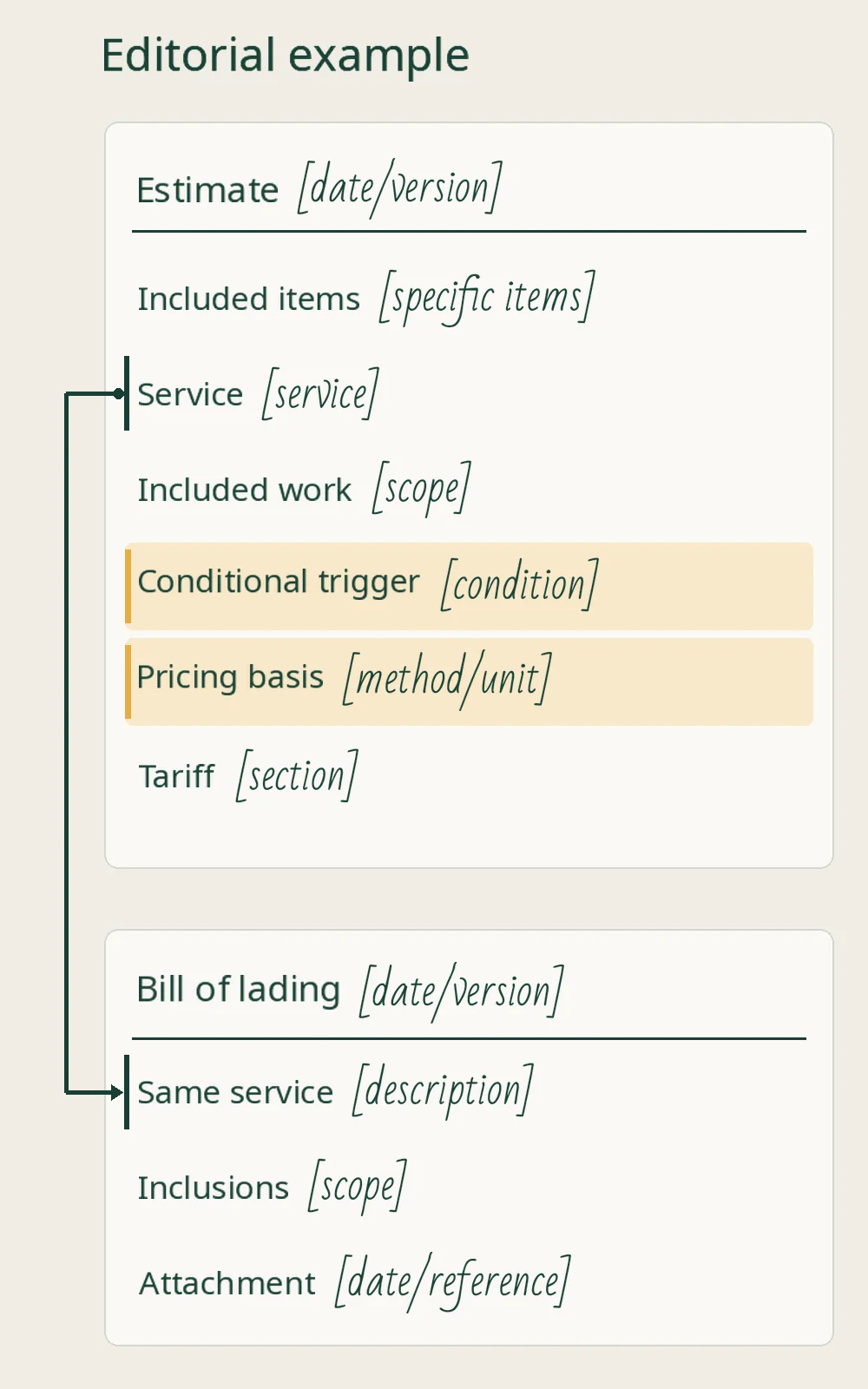
Follow the arrow from Service in the estimate to Same service in the bill of lading. Then compare the highlighted condition and pricing basis.
Copy the comparison fields
Estimate [date/version]
Included items [specific items]
Service [service]
Included work [scope]
Conditional trigger [condition]
Pricing basis [method/unit]
Tariff [section]

Bill of lading [date/version]
Same service [description]
Inclusions [scope]
Attachment [date/reference]
The arrow matches a service description; it does not match every condition automatically. Compare Included work with Inclusions, and carry any missing condition or pricing basis into your question.
If a trigger is missing, ask for it explicitly. 375.213(b)(2) requires notice that applicable tariff sections are available for inspection or copies on request. Request the particular provision supporting the line.
Use the moving estimates and contracts guide if you need to identify a document.
What information is missing before signature?
375.505(g) prohibits requiring your signature on a blank document. An incomplete document may be required before loading only with relevant shipping information included except genuinely undeterminable details, such as actual non-binding shipment weight or unforeseen transit charges. Ask what each missing field represents.
Questions to resolve before adding or changing services
Record when the bill of lading was issued, whether loading has occurred and who initiated the proposed work. Those facts select the applicable branch.
What changed before loading?
375.401(i) permits the mover and shipper to agree to amendments before loading. It tells the mover, “You may not amend the estimate after loading the shipment.” Later services follow the separate procedures below.
If additional goods or services change the shipment and the mover serves it, resolve the choice below before loading.
| Estimate type | Available choices |
|---|---|
| Binding | Under 375.403(a)(6), reaffirm the estimate; prepare a new binding estimate detailing the additions, signed by you; or agree in writing to treat the original as non-binding. |
| Non-binding | Under 375.405(b)(7), reaffirm it or prepare a detailed new non-binding estimate signed by you. Estimated charges also go on the bill of lading. |
Only the binding row offers a written agreement to treat the original as non-binding. With either type, unresolved price/service agreement can mean the mover need not serve the shipment.
Under 375.403(a)(7) and 375.405(b)(8), loading without a new estimate signifies reaffirmation of the original, subject to the later-service exceptions.
Before the mover accepts the shipment, a safety-related refusal has a separate consequence. Under 375.505(e), the mover must explain a special/accessorial service it reasonably expects is necessary for safe transport. If you refuse to purchase that service, it must refuse to accept the shipment and record the refusal.
Did you request services after the bill of lading was issued?
On a binding move, 375.403(a)(9) requires disclosure of extra charges, your agreement and a new binding estimate signed by you. Those requested-service charges plus 100 percent of the original binding amount may be collected at destination.
On a non-binding move, 375.405(b)(10) requires explanation of the extra charges. Requested-service charges may be collected with up to 110 percent of the original estimate. Partial delivery requires proration of the original-estimate collection amount under either type.
Delivery collection limits are not a final-price cap. See the binding versus non-binding estimate guide for the broader distinction.
Does the mover identify the later service as necessary?
Under 375.403(a)(8) and 375.405(b)(9), the mover explains necessary additional work before performing it and allows at least one hour for your decision.
- If you agree: the mover obtains your signature on a written attachment integral to the bill of lading and bills for the services after 30 days from delivery.
- If you decline: the carrier should perform only additional services required to complete delivery and bill after 30 days from delivery, subject to the exception below.
If you decline, the exception permits at-delivery collection for impracticable operations up to 15 percent of all other charges due at delivery. The customer-requested-service rules above also allow that collection when applicable. Ask for the tariff definition and calculation. This collection limit does not cap the final bill.
Does the crew's instruction match the agreed work?
Record the changed work, initiator, need, inclusions, price/method, timing, required document and unresolved decision. A generic change-order signature does not answer every branch.
Trace an unexpected charge through the paperwork
Start with one invoice line and the matching shipment and document versions. Compare:
- Original estimate/inventory, bill of lading and later attachments.
- Actual service or condition activating the charge.
- Quantity, unit, rate/calculation and applicable tariff provision.
- Requester, agreement and timing.
- Access/work records and the collection or later-billing branch.
For a shuttle, compare the earlier access assurance; for storage, check included versus conditional lines; for packing, compare responsibilities with dispatch instructions. Mark the evidence still missing.
Were accessorial charges missed before the bill of lading?
375.401(f) requires accessorial charges to be determined before preparing the bill of lading for either estimate type. If the mover both failed to ask about them and failed to determine them beforehand, it must deliver the goods and bill the additional charges after 30 days.
Delayed billing does not cancel the charge.
What should the written question ask?
Name the line and the discrepancy with a dated document. Replace the fields in this request with your records.
Subject: Explanation of [invoice line] for [shipment reference]

Please explain [line description and amount]. My [document and date]
describes [scope or condition]. The difference is [specific mismatch].

Please provide:
- The supporting document/attachment and applicable tariff section.
- The actual condition or work triggering the charge.
- The quantity, unit, rate/method and calculation.
- The supporting work or time record.
- Who requested or agreed to the service, and when.
- The basis for the payment or billing timing applied.

If unresolved, please send your customer complaint and inquiry procedure.
Check whether the reply explains the same service, condition, calculation and timing. A rate sheet alone may leave the trigger or performed work unanswered.
For a time-based line, compare start and stop records with the billed quantity. If the reply supplies a rate but omits recorded time, keep that specific question open.
Keep the request, reply and supporting records.
If the line remains unexplained, use or request the mover's complaint and inquiry procedure required under 375.213(b)(4), identifying exactly which part of the question remains unresolved.