Moving Company Estimates: How They're Made and How to Read Yours
Regulatory text checked .
Quick answer: A moving estimate is your mover's written projection of what the move will cost, built from a survey of your goods and labeled binding or non-binding. A price produced with no survey, or one that never gets put in writing, is not something you can rely on yet.
What a moving estimate actually is
A moving estimate is the written projection of the total charges for your move, which your mover must give you and mark binding or non-binding before the bill of lading is executed (49 CFR 375.401(b)). That document, not a number said over the phone, is the thing you can actually check.
Once you and the mover sign it, the estimate becomes part of your contract, so both what it states and what it leaves out matter.
That is the line between a documented estimate tied to your shipment and a casual verbal quote. A figure someone rattles off before seeing your goods commits no one; the signed written estimate is what governs the price.
The type is a field you will see on the page. A binding estimate guarantees the total for the items and services listed on it, so the figure does not move as long as the inventory and the services stay the same.
A non-binding estimate is only an approximation of the cost. Which type to request is a decision we cover on the binding vs non-binding page; here you only need to read the label and know which one you are holding.
This is also why a bare phone or emailed number is not yet a reliable estimate: it skips the survey the price is supposed to be built from, which is the next thing to understand.
No survey, no estimate you can trust yet.
How movers produce one: in-home vs virtual vs phone
For an interstate household move, the mover must conduct a physical survey of your household goods and base the written estimate on that survey (49 CFR 375.401(a)). You can waive the survey, but only in writing, signed before the shipment is loaded.
That waiver condition is the part to hold onto. Because the survey is the foundation of the number, a sight-unseen phone price only becomes your official estimate if you have signed a written waiver first. If no one asks you to sign one, a phone figure has quietly skipped the step the rule is built around. Do not let a number stand in for a survey you never waived in writing.
In-home visit or live video survey
In an in-home visit, a surveyor walks through your home and inventories what is actually moving, room by room. A live video survey does the same thing remotely: you walk the surveyor through every room, and the attic, on camera so nothing is missed and the price stays realistic.
Either way, someone has actually seen what is moving.
A survey-based estimate tends to be more accurate than a sight-unseen quote because it rests on a real inventory. An incomplete survey is exactly what lets a low number climb once the goods are on the truck.
What a phone-only number really is
A phone-only number rests on a survey waiver and usually has nothing complete behind it. The mover is working from whatever you happened to list out loud, not from a look at your home.
That is why it is worth insisting on an in-person or live video assessment before you trust a price. If a company will only quote over the phone, treat that as the start of the conversation, not the estimate.
Don't accept a firm price for goods nobody has seen.
What a valid written estimate must include
A valid written estimate has to carry a set of specific regulated fields. These federal requirements cover interstate, across-state-lines household moves; a purely local or in-state move follows your state's rules instead. Use the fields below as a checklist against your own document.
| Required field | What it must say | Governing rule |
|---|---|---|
| In writing, binding or non-binding label | A written estimate of the total charges, marked binding or non-binding, given before the bill of lading is executed | 49 CFR 375.401(b) |
| Description of shipment and services | A clear description of the shipment and all services the mover provides | 49 CFR 375.403(a)(5) for binding estimates; 49 CFR 375.405(b)(6) for non-binding estimates |
| Form of payment at delivery | The forms of payment the mover and its agent will honor at delivery | 49 CFR 375.401(c) |
| Valuation (liability) election notice | The liability election notice from the STB released rates order | 49 CFR 375.401(g) |
| 110 percent statement (non-binding only) | Charges are approximate; you will not pay more than 110 percent of the estimate at delivery | 49 CFR 375.405(b)(5) |
| Accessorials set before the bill of lading | Elevators, long carries and the like determined beforehand; otherwise the mover delivers and bills after 30 days | 49 CFR 375.401(f) |
A few of these fields deserve a closer read. The estimate must be in writing and marked binding or non-binding, and you must receive it before the bill of lading is executed (49 CFR 375.401(b)). If what you are holding is not in writing, you do not yet have an estimate.
It must clearly describe the shipment and all the services the mover is providing (49 CFR 375.403(a)(5) for a binding estimate, 49 CFR 375.405(b)(6) for a non-binding one), so read the description and confirm it matches the move you actually asked for.
It must specify the forms of payment the mover and its agent will honor at delivery (49 CFR 375.401(c)). Reading this field now is how you avoid a surprise cash-only demand on delivery day.
Settle the payment method before delivery day, not on it.
It must include the liability, or valuation, election notice from the Surface Transportation Board's released rates order (49 CFR 375.401(g)), which is where you record how much coverage you chose for your goods.
If your estimate is non-binding, it must state on its face that the charges are approximate and that you will not be required to pay more than 110 percent of the estimate at delivery (49 CFR 375.405(b)(5)). That 110 percent figure is a ceiling you can hold the mover to.
Accessorial charges such as elevators and long carries must be determined before the bill of lading is prepared; if the mover fails to ask about and set them, it must deliver your goods and bill the balance after 30 days (49 CFR 375.401(f)). Here these matter only as a field to check, and the full fee catalog lives on the hidden-fees page.
Then there is the signing rule. You and the mover both sign the estimate, and the mover must hand you a dated copy when you do (49 CFR 375.401(h)); it can be amended before loading if you both agree, but not after the shipment is loaded (49 CFR 375.401(i)). So never sign a blank or incomplete estimate. Once signed, the contents are final, and any change beforehand needs another read and another signature.
A blank estimate is never safe to sign.
Reading your estimate line by line
Now read the lines that actually appear on your own estimate.
Your price breaks into parts, and a complete estimate shows them:
- Transportation
- Packing and unpacking
- Storage
- Any deposit
- Taxes and fees
- The binding or non-binding label
- The valuation coverage you selected
Ask the mover to break the quoted price into those parts rather than hand you a single lump sum; a lump sum hides what you are actually paying for. If there is a deposit line, it should be a modest amount written on the estimate, not an open-ended prepayment you hand over before anything is moved.
Checking it on moving day
On moving day the mover inventories and loads your goods, then hands you the bill of lading. That document sits at the end of a short paper trail, and the diagram below shows how the pieces connect.
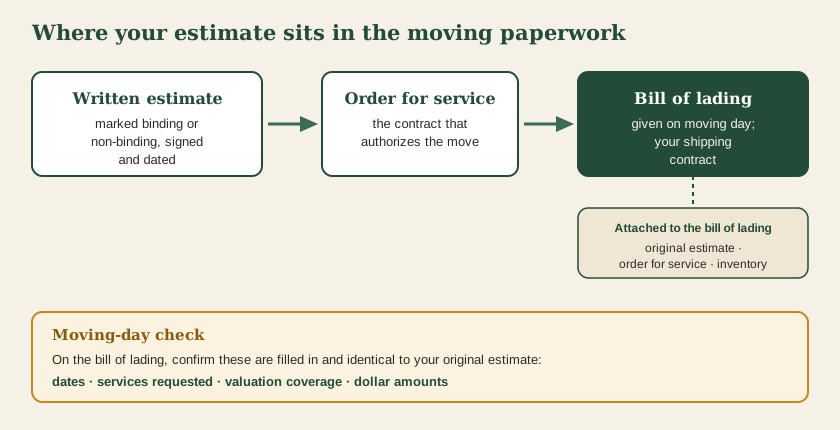
Your original estimate, the order for service and the inventory all attach to the bill of lading, so go through it line by line and confirm the dates, services requested, valuation coverage and dollar amounts are filled in and identical to the estimate you signed. On a non-binding estimate, the 110 percent cap is the ceiling the delivery total is measured against, not an open figure, so check the line totals against it before you pay.
Match it line for line, because blanks are where disputes start.
Red flags in how an estimate was prepared
These are signs an estimate was prepared or handled badly. Spotting them early lets you act before loading day, when fixing a vague agreement gets much harder.
- A price quoted with no survey, or over the phone only
- A demand for a large upfront deposit
- A price that switches after you agree
- Full payment taken in advance
- Independent or subcontracted crews that will not unload without more money
- Charges added mid-pack, or warnings that a long carry or no parking will cost extra
A price given with no survey at all, or over the phone only, has no complete inventory behind it, so the figure can climb once the truck is loaded, which ties straight back to the survey-waiver rule.
Price switching after you have agreed is another signal. A mover promises half at pickup and half at delivery, and then the figure moves. Treat any mid-stream change to a settled price as a reason to stop and check the paperwork.
Paying in full in advance can leave you exposed. A different crew can arrive at delivery and demand more money, backing down only when you produce the original paperwork. That is exactly why the signed estimate and the bill of lading matter.
Independent or subcontracted crews that refuse to unload without extra payment are a sign the booked arrangement was not what the estimate implied. A move booked with one company can arrive with crews from another, leaving you to negotiate with people you never hired.
Charges added mid-pack, such as a fee for the correct packaging, or warnings that a long carry or no parking will add to the bill, are accessorials that were never settled on the estimate. Recognize them here as red flags; the full fee catalog stays on the hidden-fees page.
If the price moves, go back to the paperwork.
Next: which type of estimate should you ask for?
You can now read a single estimate document and judge whether it was produced and written properly. The natural next question is which type to request, so you can choose a binding or non-binding estimate and see how the choice changes what you can be charged.
For the bigger picture, the hub overview shows how the estimate fits with the order for service and the bill of lading, so you can see where this one document sits in the whole paperwork trail without re-reading each piece here.