Moving Contracts and the Order for Service: What to Check Before Signing
Regulatory text checked .
Before signing, identify the issuer and compare the agreement with your accepted estimate. Read the incorporated terms, check the move and payment details, and obtain a written correction for any unexplained material difference.
Choose your situation
- Unclear document roles? Check the parties and attachment references to identify what your signature accepts.
- An order for service? Identify its function; Part 375 no longer requires the former separate carrier form.
- A different company or move? Compare the transporter, services, locations and pickup/delivery windows; request reconciliation.
- Unclear payment or cancellation terms? Identify the recipient, actual policy and change approval process. Broker booking terms and carrier bill-of-lading rights concern different agreements.
- Blanks or a replacement? Separate missing known terms from genuine unknowns, request correction, and keep the accepted version.
On this page
- Identify the agreement and the documents it incorporates
- Understand references to an order for service
- Check the parties, services, dates and locations
- Review payment, cancellation and change terms
- Resolve blanks and inconsistencies before signing
- Keep the agreed version and follow later document changes
Identify the agreement and the documents it incorporates
Put the accepted, dated estimate beside the proposed agreement.
For a household arranging its own interstate move, check whether the transporter is a household-goods motor carrier. Part 375 applies to interstate motor transport for individual shippers. The definitions cover owners identified on the bill of lading who pay their own transport charges, and carriers offering services such as inventorying, packing or residential loading. Entirely customer-loaded and unloaded container/trailer transport is excluded from that carrier definition. Local, commercial and government moves require their own applicability check.
Read the issuer, parties and operative terms together. Which commitment does this document ask you to accept?
| Paperwork | Its job in your review |
|---|---|
| Estimate | Identifies the charge basis, goods and services being priced. |
| Booking agreement or confirmation | Sets out its issuer's offered booking terms. Its title alone does not establish that it replaces the transport contract. |
| Bill of lading | Serves as the receipt and transportation contract for the interstate household shipment. |
The bill-of-lading attachment rules make each attachment integral to the contract. The estimate and inventory must be attached if not provided elsewhere; the bill of lading also incorporates the estimate's services. Follow each reference to additional terms.
Obtain those terms before accepting them.
A binding estimate guarantees the cost for the listed quantities and services. A non-binding estimate is approximate, with final charges based on actual weight and applicable tariff provisions. Under §375.401(b) and (h), the written estimate precedes the bill of lading, identifies its type, and is signed by both parties; you receive a dated copy at signing.
Use that copy to compare price, payment, scope, schedule and valuation—the carrier-liability choice for your goods. If document labels overlap, use the moving paperwork overview to identify each paper's purpose.
Understand references to an order for service
An order for service is a label historically used for paperwork authorizing the agreed moving services.
The separate federal carrier requirement in Part 375 was removed effective June 27, 2022, leaving §375.501 reserved. The 2023 correction confirms that the bill of lading replaced it. Review the carrier's bill of lading rather than demanding the former separate federal form.
A company can still use that title. Ask which parties it binds, what booking or service commitment it records, and how it connects to the bill of lading. The label alone establishes neither completeness nor invalidity.
The phrase also survives in §371.117(a), concerning household-goods brokers' cancellation, deposit and refund disclosures. That broker context differs from the removed carrier requirement. Check the actual policy under cancellation terms.
Check the parties, services, dates and locations
Compare the booking issuer with the transporter. Check your own name, addresses and contact details too.
Under §375.505(b)(1)–(3), the bill of lading identifies the carrier's registered legal/trade name and physical address, plus participating carriers' names, contacts, addresses and USDOT numbers when known. A broker's written estimate represents an authorized carrier under a signed carrier-broker agreement and uses that carrier's published tariff—its rates and service rules. Ask which carrier and tariff it represents.
Use the actual documents to make this comparison:
| Check | Compare across the estimate, booking terms and bill of lading |
|---|---|
| Company and role | Booking issuer, transporter and known participants; explain any different name. |
| Move and services | Goods, packing or other ordered work, pickup address, destination and applicable minimums. |
| Schedule | Pickup and delivery dates/windows; guaranteed-service wording. |
| Charges and protection | Estimate type, payment stages/method, delivery payment ceiling and selected valuation. |
| Terms and versions | Document dates, attachments, cancellation notice route and approval of changes. |
For the services row, check what packing and other extra work you ordered. Where minimum weight/volume pricing applies, §375.505(b)(14) requires the minimum rates and charges; if omitted, the tariff must explain calculation using actual weight or volume.
Check valuation separately from independent insurance. A changed selection needs clarification, even if the transport price appears unchanged.
Which pickup and delivery dates are agreed?
For non-guaranteed service, compare the agreed pickup and delivery dates or windows. For guaranteed service, check the tariff-based dates and any stated penalty or per-day entitlement under §375.505(b)(6)–(7). Confirm the contact route for schedule changes.
Review payment, cancellation and change terms
What will you pay, to whom and how?
Locate payment stages, recipients, minimum charges and the maximum demanded at delivery to release a collect-on-delivery shipment. §375.505(b)(4), (10) and (11) also require the delivery payment method to match the estimate. Resolve any change before accepting it.
Identify who holds a broker deposit and how it relates to carrier charges. Ask for an explanation if the allocation is unclear.
Which cancellation terms apply?
Find the notice address or channel, deadline and refund conditions in the actual agreement. Household-goods brokers must prominently disclose cancellation, deposit and deposited-funds refund policies on their websites and in prospective-shipper agreements for cancellation before scheduled pickup.
Disclosure supplies no particular refund outcome. Ask what happens to your specific payment under those terms.
When do you sign the carrier's bill of lading?
Under §375.505(h), you must receive, sign and date the bill of lading at least three days before scheduled loading, with a penalty-free three-day opportunity to rescind after signing. This carrier-contract right does not establish a universal broker-booking refund rule.
Under paragraph (f), both parties sign before loading; signatures are required at origin and destination. You receive a dated copy at signing.
The narrow exception: additional items or services on moving day that produce a new estimate under §375.403(a)(6)(ii) or §375.405(b)(7)(ii) allow corresponding bill-of-lading changes without a new three-day period. A generic replacement document does not establish that exception.
What must change before loading?
Compare the proposed quantities, services and rates with the signed estimate. Mutual estimate amendments must occur before loading; the carrier cannot amend the estimate after loading.
If additional goods or services appear and the carrier proceeds, the binding and non-binding procedures offer these choices before loading:
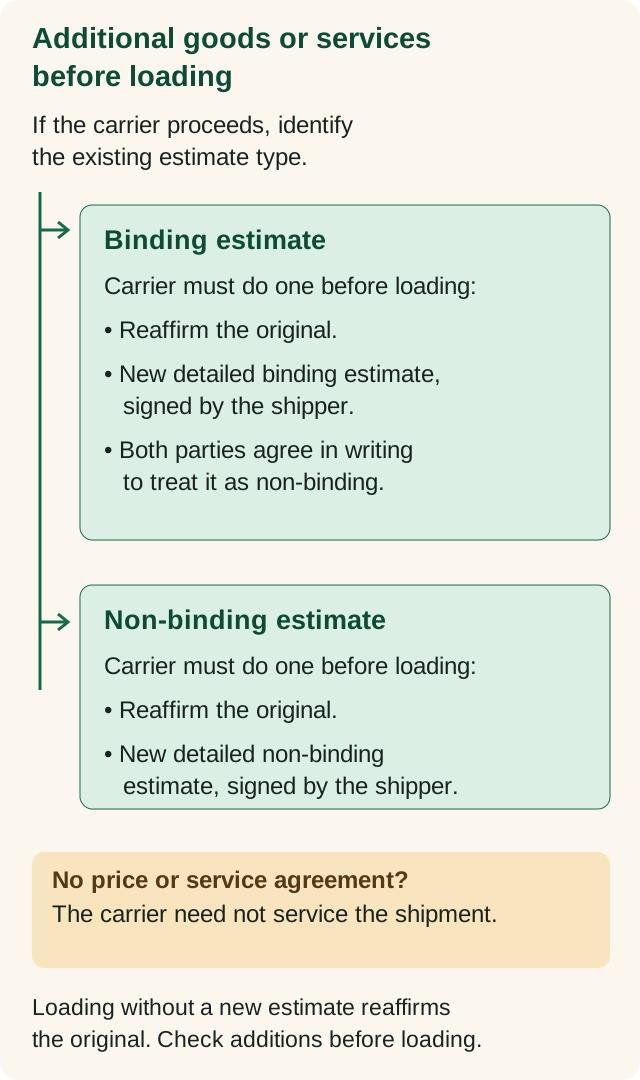
The binding path includes a written conversion to non-binding pricing. That changes the price basis you accept; inspect it as a substantive decision. If the carrier loads without a new estimate, the binding rule and non-binding rule treat the original as reaffirmed.
Who requested a later service?
Bill-of-lading issuance and loading are different events. Identify the requester and timing of an addition before accepting its paperwork.
For carrier-identified necessary services after issuance, §375.403(a)(8) and §375.405(b)(9) require explanation before performance and at least one hour to decide. Agreement to pay requires your signed written attachment. If you decline, the carrier should perform only services needed to complete delivery.
For services you request after issuance, check the added-charge notice. The binding procedure requires agreement to charges and a signed new binding estimate; the non-binding procedure has separate charge treatment. Requested-service charges may be collected at destination. Ask how the addition is recorded and when payable; these provisions do not authorize rewriting the original estimate after loading.
Resolve blanks and inconsistencies before signing
Is the field genuinely undeterminable?
A carrier may provide blank or incomplete paperwork. §375.505(g)(3) tells the carrier:
“You may not require an individual shipper to sign a blank document.”
For a required incomplete preloading document, paragraph (g)(2) permits omitting only information that cannot be determined before loading; all relevant known shipping information must be present.
Actual shipment weight for a non-binding move or unforeseen transit charges can remain unknown. A known missing company, service or payment term needs correction now.
Ask for a dated correction
Name the exact mismatch, the proposed document's date and the accepted reference. Send the question to the issuing carrier or broker, including any missing incorporated attachments.
This editorial paper example shows a packing mismatch between an accepted estimate and a proposed bill of lading.
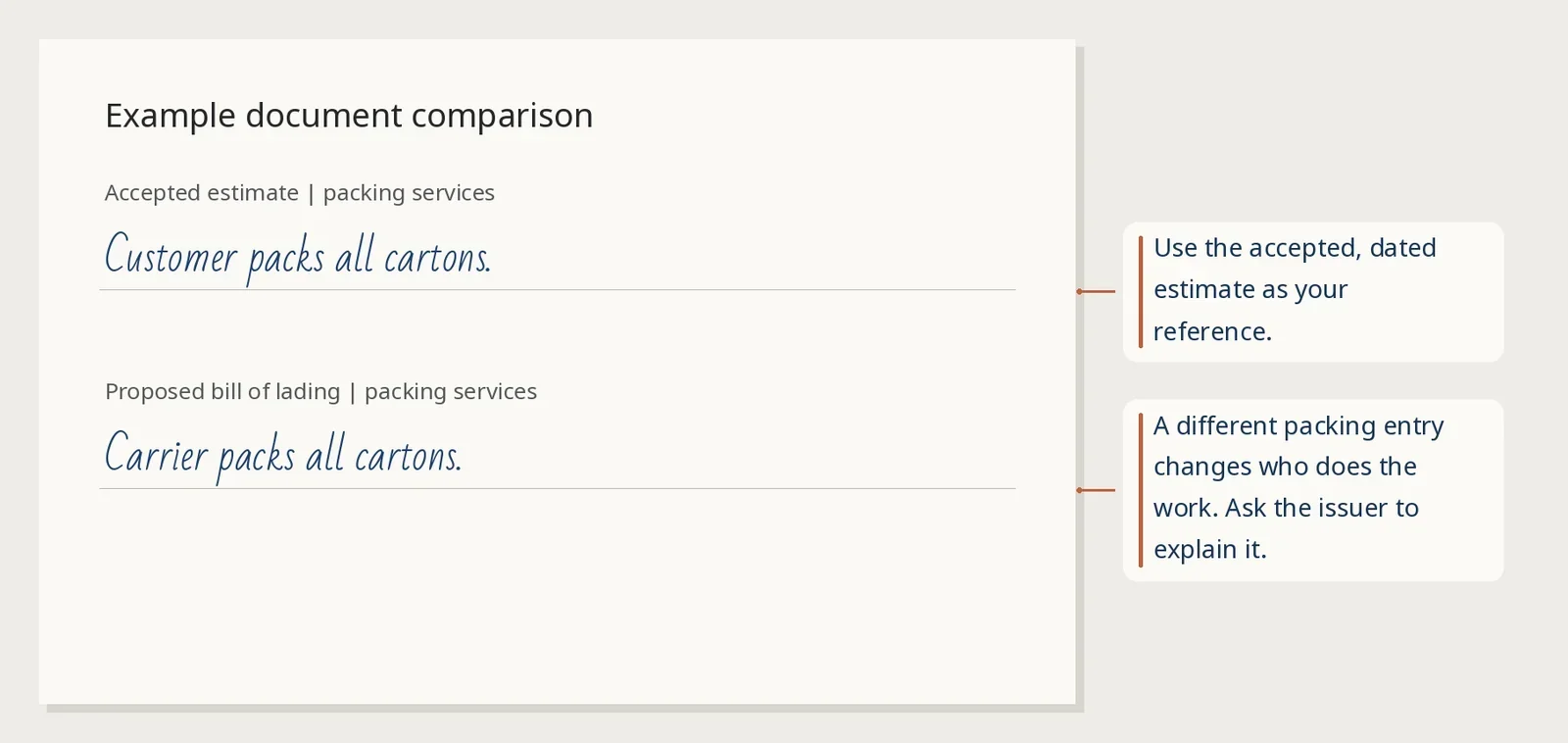
The changed packing entry assigns the work to the carrier. Ask whether you ordered that service and how it affects the estimate; a matching total alone would leave that question unanswered.
Adapt this clarification request to your documents:
Shipment: [shipment reference]
In [document name and date], [field] differs from
[accepted estimate/agreement and date]: [describe difference].
Please explain what changed and why, and send the corrected,
dated version with its incorporated attachments before I accept it.
Check the returned field, date and attachments against your reference. A reply that leaves the difference unanswered has not resolved it.
Use this check on the response:
- The field: does the returned document actually contain the agreed wording, or does the email merely say the issue has been handled?
- The scope: if goods or services changed, does the new estimate describe those additions in detail rather than showing only a different total?
- The attachments: can you open the terms the agreement references and identify which version you are accepting?
Keep any unanswered item on your comparison list. If an explanation reveals a new service request or a change from binding to non-binding pricing, return to the corresponding approval procedure above before accepting the replacement.
Defer accepting the unexplained known term.
Keep the agreed version and follow later document changes
Keep the signed, dated estimate and bill of lading, booking agreement, incorporated terms, inventory, other supplied attachments, written clarifications and accepted changes together.
Retain the previous version beside its replacement.
When the paperwork includes a bill of lading, understand the moving bill of lading before interpreting its entries or acknowledgments.
A practical file label can combine the document name, its date and whether it is proposed or accepted. Keep the written clarification with the document it concerns, so a later replacement can be compared with both. This is a household filing method; the carrier's legal record-retention duties are separate.
Compare each replacement for company, scope, schedule, price basis, payment method and selected valuation. Identify the approved change and any unanswered difference; apply the preloading procedures and narrow timing exception above.
Before signing, check that you can identify the accepted dated version, retrieve its attachments and locate the written answer to each material discrepancy.