The Moving Bill of Lading: What It Means and What to Check
Read your moving bill of lading alongside the estimate and inventory. Check who is carrying the shipment, what services are recorded, and what each requested signature acknowledges.
Regulatory text checked .
A household-goods bill of lading contains the transportation contract terms. For a covered interstate move, compare the complete packet before signing, resolve conflicting entries in writing, and obtain dated copies of the signed pages.
Choose your situation
- The bill arrived just before pickup or has unclear fields. Request the missing carrier, date or valuation information and a corrected or explained copy. Check omissions and timing.
- The estimate or service page disagrees with the bill. Ask for written reconciliation; a zero balance does not explain an unfinished charge elsewhere. Compare the related pages.
- You are asked to sign two different bills. Examine each issuer, terms and valuation election. A later bill does not explain the earlier signature. Check both documents.
- You are acknowledging delivery. Compare items with the inventory, record missing or damaged articles and get a copy. Read the receipt wording.
What a household-goods bill of lading does
The carrier must prepare and issue the bill before receiving your household shipment. Under 49 CFR 375.505(a), it contains the contract terms and conditions.
The federal requirements here apply to household-goods motor carriers transporting for individual shippers by motor vehicle in interstate commerce. Section 375.101 defines that scope; these requirements do not establish the rules for every local move.
A balance answers a payment question. The inventory answers item-level questions. Read the bill together with its referenced pages.
How it relates to the estimate, inventory and agreement
Start with the question you need answered. Each part of the packet has a different reading job.
| Document | What to examine | What to compare or obtain |
|---|---|---|
| Bill of lading | Contract terms and shipment entries | Carrier, dates, services, payment, valuation and attachments |
| Estimate | Estimated services and pricing/payment wording | Services incorporated into the bill; any conflicting wording |
| Inventory | Item identity and condition | Complete signed copy and written delivery exceptions |
| Related service or terms page | The referenced service or condition | Its charge entry and relationship to the bill |
Under § 375.505(b)(15) and (17), attachments are integral to the contract. The estimate and inventory must be attached if not provided elsewhere to you. The bill must also incorporate all estimate services by reference.
Locate those pages and compare the versions actually supplied. A service-page entry still needs attention when the front-page total looks settled.
Match a referenced attachment to its title and date, then find the actual service or term it supplies. If the bill points to a page you do not have, request that page. An unexplained reference leaves part of the reading task unfinished.
For incorporated terms beyond this shipment document, review the wider moving agreement. Compare dates, services, payment wording and valuation across the packet.
If a separate order for service appears in your packet, read its contents and follow its references alongside the bill.
Locate the shipment, service and payment information
Which shipment and carrier do these pages identify?
Match the carrier’s FMCSA-registered legal or trade name and physical address with the packet. Check your name, address, available telephone number and any assigned shipment reference.
The required identity entries in § 375.505(b) also include participating carriers’ names, telephone numbers, addresses and USDOT numbers when known, plus the carrier identification number of the vehicle or vehicles used. Ask which carrier an unfamiliar entry identifies.
Are the dates agreed, guaranteed or actual?
For non-guaranteed service, find the agreed pickup date or period and delivery date or period. For guaranteed service, § 375.505(b)(6)–(8) requires pickup and delivery dates and any contractual penalty or per diem entitlements, subject to tariff provisions.
In this original training fragment for non-guaranteed service, locate the agreed delivery period and the separate actual pickup entry.
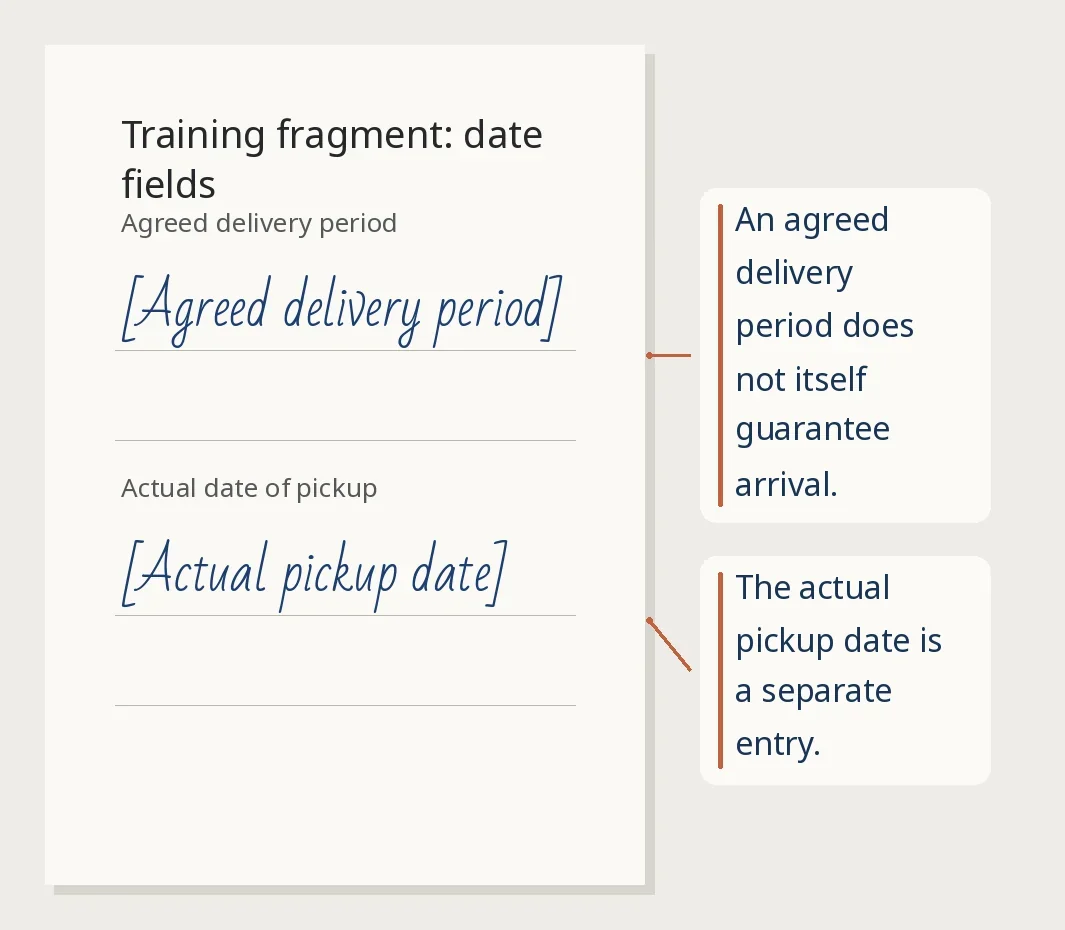
The actual pickup date is a separate entry. A completed pickup entry does not fill an empty delivery entry. Compare each label with the selected service. An agreed delivery period does not itself guarantee arrival.
What do the payment and service entries say?
Compare the accepted delivery payment method with the estimate. Find the payment terms, minimum-charge notice and ordered special or accessorial services required by § 375.505(b)(4), (10) and (14).
For collect-on-delivery transportation, locate the charge-notification contact’s name and address, plus any furnished contact details. Separately identify the maximum amount demanded at delivery to obtain possession under § 375.505(b)(11). The notification contact and maximum-demand entry answer different questions.
When rates use a minimum weight or volume, the bill must indicate the applicable minimum rates and charges. If they are not indicated, § 375.505(b)(14) requires the tariff to explain final-charge computation using actual weight or volume. Ask for that basis; an empty field is no reassurance about cost.
Which protection election is recorded?
Locate the Surface Transportation Board valuation statement. Section 375.505(b)(12)–(13) distinguishes choosing Full Value Protection for carrier liability from waiving it in writing in favor of released rates. After a waiver, check any charges for optional valuation coverage other than Full Value Protection.
Evidence of insurance sold or procured from an independent insurer, including its premium, is separate. Ask what each entry records: the carrier-liability election or an independent insurance policy.
A prechecked box alone does not establish your election.
Understand signatures and acknowledgments in context
When must the bill be provided and signed?
For the covered interstate move, § 375.505(h) requires the bill to be provided to you, signed and dated at least three days before scheduled loading. The carrier must give you an opportunity to rescind without penalty for three days after signing.
A narrow exception applies when additional items or services on move day result in a new binding estimate under § 375.403(a)(6)(ii) or non-binding estimate under § 375.405(b)(7)(ii). Corresponding bill changes do not require a new three-day period.
Compare the signing and scheduled-loading dates. These provisions do not make every cancellation penalty-free.
Both mover and shipper must sign before loading; the bill must be signed at origin and destination. Under § 375.505(f), the carrier provides a dated copy when signing.
Read the words above each signature.
What does the delivery acknowledgment record?
Section 375.701 permits acknowledgment of apparent good condition except as noted. It prohibits delivery-receipt or shipping-document language purporting to release or discharge the carrier or its agents from liability.
Read receipt and release wording separately. If release language appears, identify it to the carrier and request a corrected receipt; do not assume a signature alone eliminates every claim right.
Under § 375.503(d), you must have an opportunity to observe the delivered articles and condition, write missing-item and damaged or destroyed-item notations, and receive a copy. Compare inventory identifiers as items arrive.
Keep those written exceptions with your copy. For an unexplained omission, use the incomplete-document distinction below.
Handle missing or inconsistent information
Which missing information can be determined before loading?
Section 375.505(g) allows carriers to provide blank or incomplete documents, but says: “You may not require an individual shipper to sign a blank document.”
A required incomplete document before loading must contain relevant shipping information. Omissions are limited to information that cannot yet be determined, such as actual weight under a non-binding estimate or unforeseen charges incurred in transit.
Ask exactly what is missing and why it cannot be known yet. Read each path in the diagram separately.
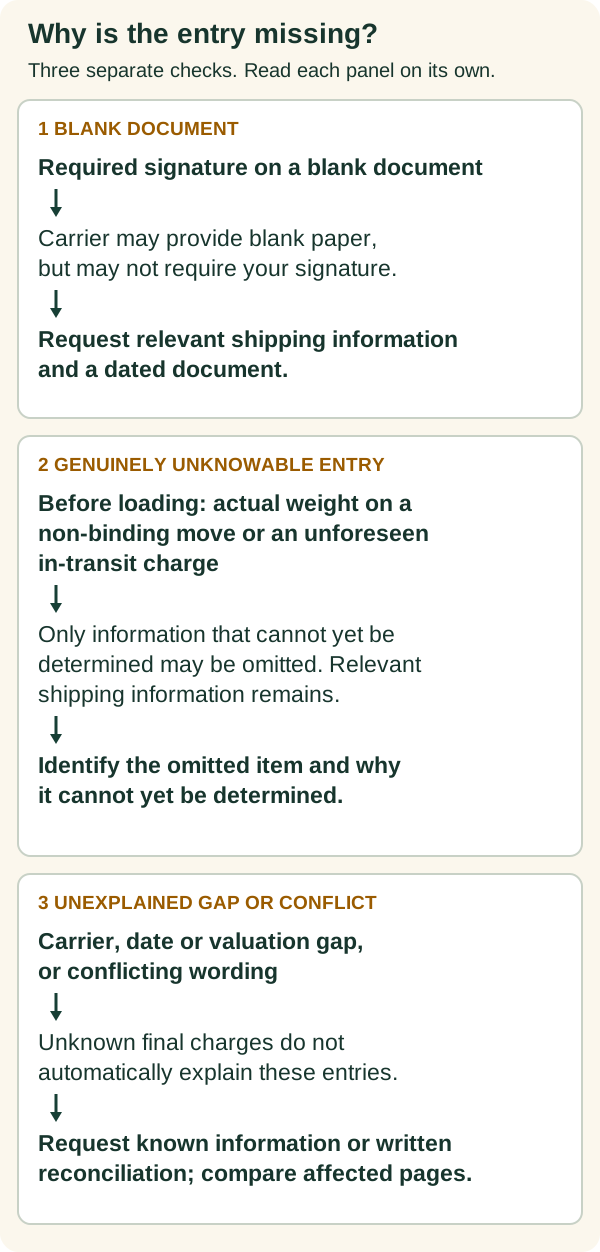
The key distinction is why the entry is missing. Unknown final weight does not explain an omitted agreed delivery period or an unclear valuation choice. Ask for the known information or a specific written explanation.
How do you request and check a correction?
Identify the document date or version and exact field. Put the conflicting estimate or service-page wording beside it. Send the issuing carrier or identified mover contact a focused request:
Please clarify [field/term] on the bill of lading dated [date]
for shipment [reference]. It shows [wording or blank entry],
while [related page and date] shows [different wording].

Please send a corrected dated copy or a written explanation
showing how these entries fit together, including any affected
service, payment or valuation page.
Check the reply against the named entries. Compare all affected revised pages and keep the explanation. If they still conflict, preserve the issue and response and ask the carrier to resolve that discrepancy before relying on the packet as coherent.
A useful response identifies the entry you questioned and explains which wording applies. If it changes a service or valuation selection, compare the affected page as well as the bill. Save the earlier version so the change remains traceable.
Keep the document with the rest of your moving records
Keep your usable packet outside the shipment, accessible at loading and delivery.
Under § 375.503(a)–(c), the carrier prepares an itemized inventory before or at loading, identifying every carton and uncartoned item with corresponding identification numbers. You can request to observe and verify its accuracy. The complete inventory, signed by both parties, must be supplied with the bill before or at loading.
Section 375.505(c)–(d) requires a bill copy to accompany the shipment and be with the driver before departure from origin. The carrier retains the bill for at least one year after creation and, under § 375.503(e), inventories for at least one year after preparation. These are carrier duties, not your discard date.
Before putting the packet away, check that you can retrieve:
- Dated signed bill copies and revisions, with versions identifiable.
- The estimate and all referenced terms or service pages.
- The complete inventory signed by mover and shipper.
- Written reconciliation of conflicting entries.
- Copies of written delivery exceptions for missing or damaged items.