The 110% Rule for Non-Binding Moving Estimates
For a collect-on-delivery interstate household-goods move under a non-binding estimate, the federal 110% rule generally limits what the mover may require as a condition of delivery to 110% of the applicable estimate for the services and quantities listed there. Specific permitted additions can increase what is due at delivery.
The 110% limit controls a payment moment. It does not, by itself, cap the final lawful bill.
Rule text checked October 26, 2026. The eCFR displayed Title 49 as current through October 22, 2026.
By MoversHere editorial team

Choose your situation
Start with the point in the move where the amount changed.
- Before signing: Confirm that the written estimate is labeled non-binding, shows the shipment and services being estimated, and states that no more than 110% of the non-binding estimate will be required at delivery. The estimate is still an approximation, not a guaranteed final price. Check when the federal rule applies.
- The price increased before loading: Keep the original estimate. Check whether you and the mover mutually agreed to a change before loading, and whether the mover reaffirmed the original estimate or prepared a new signed non-binding estimate. Review the change record.
- The mover is demanding payment at delivery: Identify the applicable non-binding estimate, then separate its 110% amount from the limited categories that may be added at delivery. Subtract payments already made. Check the delivery demand.
- A bill arrived later: A later invoice is separate from the amount the mover could require to release the shipment. Match each charge to its service, document, tariff basis, and invoice date. Check later charges.
A later invoice does not retroactively change the delivery limit. Use the records you received, not a remembered quote.
When the federal 110% rule applies
First confirm the federal scope. 49 CFR 375.101 applies Part 375 to a household-goods motor carrier serving an individual shipper when it transports household goods by motor vehicle in interstate commerce.
An intrastate-only move falls outside that federal Part 375 frame. State or local requirements may differ, so do not apply the federal percentage automatically.
What makes an estimate non-binding
A non-binding estimate is the mover's written approximation of total cost. Under 49 CFR 375.401 and 49 CFR 375.405, it is based on the estimated weight or volume, requested accessorial services, and the required survey. Final charges may exceed the estimate because they are based on actual weight and applicable tariff provisions.
Look for the label “non-binding,” the estimated amount, shipment and service description, date, both parties' signatures, accepted payment forms, and the 110% delivery statement. Layouts vary, so follow the wording rather than expecting every form to place these items in the same box.
For the broader distinction, see Binding vs. Non-Binding Moving Estimates.
Use this rule only when the interstate scope, covered carrier relationship, and written non-binding estimate all line up.
Calculate the delivery amount without confusing it with the final bill
Start with the applicable signed non-binding estimate. Multiply that amount by 1.10. Then examine, separately, whether the mover is claiming charges for services you requested after the bill of lading was issued or for tariff-defined impracticable operations. Do not simply calculate 110% of the mover's new total.
Here is an illustrative calculation. It is not a quote and does not decide whether any particular charge is valid.
| Calculation line | Illustrative amount | What to verify |
|---|---|---|
| Applicable signed non-binding estimate | $4,000 | Confirm the estimate type, scope, signatures, date, and any valid pre-loading revision. |
| 110% of that estimate | $4,400 | $4,000 × 1.10. This is the starting delivery-release amount for the estimated services, not a new estimate. |
| Service requested after the bill of lading was issued | $250 | Find the dated written request or attachment and the charge basis. |
| Illustrative amount that may be requested at delivery | $4,650 | This assumes the $250 service was actually requested and is separately permitted. Other categories require their own check. |
| Final tariff-based bill shown later | $5,200 | Ask for the weight, services, rates, credits, and supporting records behind every line. |
In this example, the difference between $4,650 and $5,200 does not automatically disappear. It also does not automatically become valid. It belongs in the later invoice review, where each charge can be matched to the shipment records and the applicable billing rule.
What can be required at delivery and what may come later
Find the applicable estimate first. Then separate charges for what that estimate covers from other categories the regulation treats differently.
Start with the applicable estimate
The base is the non-binding estimate for the services and quantities shown on it. Under 49 CFR 375.703(b), the maximum collect-on-delivery amount is generally 110% of that estimate, subject to specified additions. A written revision may be the relevant estimate if both parties agreed to it before loading.
Timing matters. 49 CFR 375.401(i) says an estimate may not be amended after loading begins. When extra goods or services appear before loading under a non-binding estimate, section 375.405(b)(7) and (8) requires the mover that proceeds to reaffirm the estimate or prepare a new signed non-binding estimate. If the parties cannot agree, the mover is not required to service the shipment.
The regulation also permits specific additions at delivery. The mover may collect full charges for services you requested after the bill of lading was issued. It may also collect tariff-defined charges for impracticable operations up to 15% of all other charges due at delivery, as described in 49 CFR 375.407 and 375.703(b).
Unexpected charges are not automatically collectible at delivery. Carrier-initiated services considered necessary under section 375.405(b)(9) have their own notice, decision, written-attachment, and later-billing conditions.
If you offer the amount allowed by section 375.407, the mover must relinquish the shipment. The mover must accept the payment form agreed to in the estimate unless you agree in writing to change it. For a partial delivery, the permitted amount is prorated by the delivered portion's weight rather than applied in full.
Why 110% is not the final-bill ceiling
A non-binding estimate can produce final charges above the estimate. The 110% rule limits specified collection as a condition of delivery; it does not declare every later charge valid.
For a collect-on-delivery balance, 49 CFR 375.805 and 375.807 require the mover to present an invoice within 15 days of delivery, excluding weekends and federal holidays. A 7-day credit period follows, with an automatic extension to 30 calendar days if unpaid. By contrast, mover-initiated necessary additional services under section 375.405(b)(9) are billed after 30 days from delivery.
That distinction matters. A blanket statement that every remaining charge can first be billed only after 30 days does not reflect the current provisions. Identify the category and date relied on for each amount.
Your documents can expose questions about amount, timing, service, and tariff basis. They cannot decide whether a particular final charge is lawful.
How to check your estimate and moving documents
Read the records as a chain. One headline number will not show revisions, delivery additions, earlier payments, and later billing.
| Record actually received | What to find | What to compare and preserve |
|---|---|---|
| Written estimate | Type, amount, pricing basis, shipment and services, date, signatures, payment form, survey or waiver context, and 110% wording | Compare the type and amount with the delivery calculation. Keep every version. |
| Order for service, if provided | Services, dates, charges, and references to the estimate | Compare it with the estimate and bill of lading. Keep it as a practical record. |
| Bill of lading | Parties, shipment ID, payment terms, COD maximum, special services, attachments, signatures, and dates | Compare its terms and attachments with the estimate and delivery demand. |
| Revision or change record | Timing, reason, changed goods or services, amount, and signatures | Check whether it was completed before loading. Keep it with the original. |
| Delivery paperwork and invoice | Demand, prior payments, cited services, dates, terms, and receipts | Separate the delivery amount from later charges. Preserve proof of payment and communications. |
Written estimate
The estimate should be written, dated, signed by both parties, and clearly labeled binding or non-binding. Check the shipment and services described, the estimated amount and basis, accepted payment forms, survey or waiver information, and the 110% delivery notice required for a non-binding estimate under 49 CFR 375.405.
Preserve every version. Note mismatches between the label, amount, services, signatures, payment method, and figure later used at delivery.
Order for service if you received one
An order for service may describe the requested work and timing. Current 49 CFR 375.501 is reserved, so a separate order for service should not be treated as a universal current Part 375 requirement. If you received one, compare its services, dates, charges, and estimate references with your other records.
Bill of lading
The bill of lading is the shipment contract. 49 CFR 375.505 requires information that includes carrier and shipper identity, participating carriers, accepted payment form, delivery dates, payment terms, the maximum due at delivery for a COD shipment, special services, shipment identifier, signatures, and dates.
Check whether the estimate, inventory, and service details are incorporated or attached. Some information that cannot be known before loading may remain incomplete as the section allows, but the mover may not require you to sign a blank bill of lading.
Revised estimate or change record
Check when the change was presented, whether loading had begun, what goods or services changed, and who agreed. For a non-binding estimate, confirm whether the original was reaffirmed or a new signed estimate was prepared before loading.
Keep the original beside the revision.
Delivery paperwork, invoice, and payment records
Across the forms you actually received, compare the demanded amount, prior payments, cited service or condition, receipt details, invoice date, and payment terms. Flag inconsistent estimate types, amounts, dates, services, signatures, or mover identities as questions to clarify, not automatic proof of fraud or invalidity.
If a charge first appears on the later invoice, ask which documented service, tariff provision, and timing rule supports it.
Check the weight tickets and request a reweigh when it applies
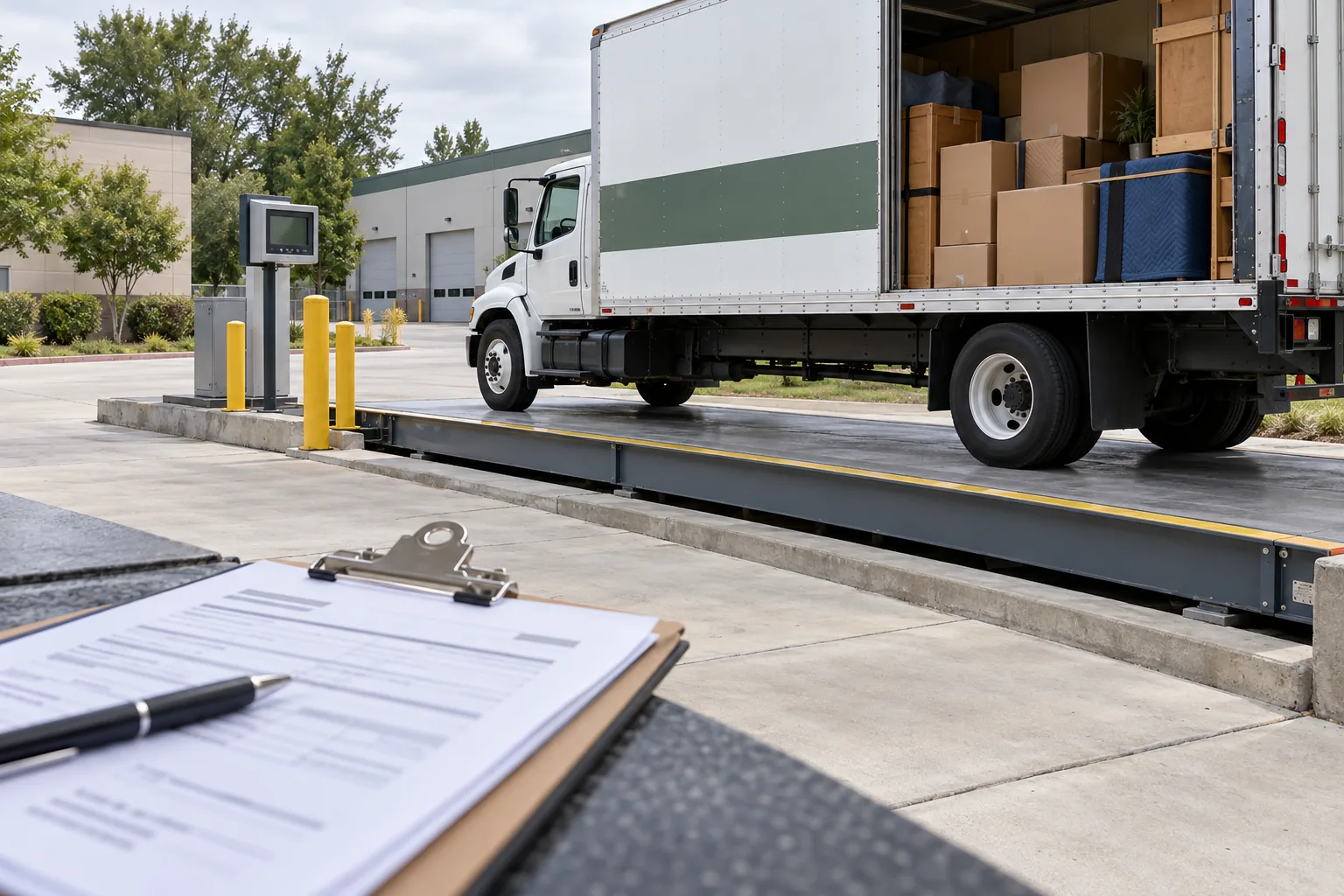
Public moving discussions repeatedly turn into arguments about whether the shipment really weighed what the mover says it weighed. A verbal total or a photograph of one number does not let you reconstruct the calculation. For a weight-based interstate shipment, read the weight records alongside the estimate and freight bill.
Under 49 CFR 375.519, required weight tickets identify the scale and date, label the weight entries, identify the vehicle, show the shipper's last name, and include the shipment registration or bill-of-lading number. The mover must retain the originals and provide true copies with the freight bill.
How to read the weight calculation
- Tare weight: the truck or trailer weight used as the empty-side measurement for your shipment.
- Gross weight: the corresponding loaded-side measurement.
- Net shipment weight: gross weight minus tare weight.
Compare the vehicle identification, scale location, dates, shipment number, and whether the same equipment conditions were used for the paired measurements. Then compare the resulting net weight with the weight and rate used on the invoice. A discrepancy is a question to document and raise; it is not, by itself, proof of fraud.
If the shipment was weighed at origin, 49 CFR 375.517 permits the individual shipper to demand a reweigh after the mover communicates the billing weight and total charges and before unloading begins. The freight bill must then be based on the reweigh weight. Make the request promptly and preserve the written request and the resulting ticket.
The reweigh right is not a general reason to delay every delivery. Use it when the shipment is weight-rated, the timing condition is met, and the reported weight appears inconsistent with the records you have.
What to do if the amount changes at the door
The goal is to create a clear record while keeping the discussion tied to the documents. Avoid relying on a remembered sales call when the estimate, bill of lading, attachments, payment terms, and invoice can be read directly.
- Identify the estimate. State whether it is binding or non-binding and identify any signed revision made before loading.
- Ask for the written calculation. Request the estimated-services amount, each asserted addition, prior-payment credits, and the total being required before release.
- Compare payment terms. Check the accepted payment form written into the estimate and bill of lading.
- State the amount you are offering. If the federal rule applies, explain which estimate you used, show the 110% arithmetic, identify any additions you accept, and ask the mover to identify the basis for the rest.
- Document the response. Save the demand, invoice, names, date, time, truck information, payment proof, and any written refusal to release the shipment.
- Use the official channel when necessary. FMCSA says that an interstate mover that will not deliver after the required amount is paid violates the household-goods consumer regulations. Its consumer answer on refused delivery points to the federal complaint process and hotline.
Calling an amount disputed does not settle it, and filing a complaint does not guarantee reimbursement or immediate delivery. The practical value of this sequence is that it shows which document, amount, and response are actually in dispute.
Questions people actually ask about the 110% rule
These questions recur in public moving discussions and videos. The answers below are checked against the cited federal sources rather than against forum replies or video claims.
Is a non-binding estimate automatically a scam?
No. It means the estimate is an approximation and the final charges can depend on actual shipment weight, performed services, and the applicable tariff. The useful checks are whether the estimate is written and reasonably accurate, whether the inventory and services are complete, whether the survey reflects the shipment, and whether the carrier and pricing basis are identifiable. A suspiciously incomplete or low estimate may be a warning sign, but the label alone does not establish fraud.
Can the final price go down on a non-binding estimate?
It can. The final amount is not an automatic 10% surcharge. If actual weight or chargeable services are lower than estimated, the lawful final charges may also be lower. Ask for the weight tickets and itemized invoice so the result can be checked instead of assuming the estimate is a minimum or maximum.
Which number do I multiply by 110%?
Use the applicable signed non-binding estimate for the services and quantities shown there. If a new estimate was mutually agreed and signed before loading, inspect whether that is now the applicable estimate. A new demand created after loading is not automatically the base merely because it is the latest number the mover presented.
Does 110% mean I never owe more than that?
No. The rule governs what can generally be required to obtain delivery of a collect-on-delivery shipment under a non-binding estimate, subject to specified additions. It does not erase a later lawful balance. Review the later invoice separately rather than treating either the estimate or the delivery demand as the final answer.
What if the mover says I added more items?
Ask which items or services were missing from the original scope and when the change was raised. Before loading, the mover that proceeds must reaffirm the original non-binding estimate or prepare a new signed non-binding estimate under 49 CFR 375.405. Preserve the original and the revision so the timing and changed scope remain visible.
What if the weight seems impossible?
Request the true copies of the weight tickets, reconstruct gross minus tare, and compare the vehicle and shipment identifiers. If the shipment was weighed at origin and unloading has not started, determine whether the reweigh procedure in section 375.517 applies. Do not accept or reject the amount solely from an estimate of what a room “should” weigh.
Does the rule apply if I booked through a broker?
First identify the actual motor carrier transporting the shipment and the estimate being used. 49 CFR 375.409 sets conditions for a household-goods broker to provide estimates on behalf of an authorized carrier. Compare the names and identifiers on the broker paperwork, estimate, and bill of lading; do not assume the company that sold the move is the carrier holding the shipment.
Does the federal rule cover a move within one state?
Not automatically. Part 375 applies to covered interstate household-goods transportation. A move that remains entirely within one state requires a separate check of that state's rules and regulator. Do not import the federal percentage into a local dispute without first confirming jurisdiction.
Your document check and records to keep
Complete this check while the estimate, revision, delivery demand, and invoice can be read together.
- Confirm the move is interstate and the estimate is non-binding.
- Identify the original estimate and any signed pre-loading revision.
- Record the delivery demand and every prior payment.
- Match additional services or conditions to dated documents.
- Separate the delivery demand from the later invoice and identify its charge category.
- Save every relevant document, attachment, receipt, and dated communication.
Keep the records that show what changed
Keep every signed estimate and revision, the bill of lading and attachments, inventory or service records when relevant, delivery paperwork, invoices, receipts, payment proof, and dated communications. Federal rules require the mover to retain the non-binding estimate and bill of lading for at least one year under sections 375.405(d) and 375.505(d). Keeping your own broader file is a practical safeguard, not a claim that federal law requires you to retain every item listed here.
Dated messages can connect a requested service or disputed change to a document. Preserve dates and attachments when saving them.
Choose the next check
If you want to organize these fields in one place, use MoversHere Estimate Check as a document-checking next step. Bring the estimate, any revision, bill of lading, delivery demand, prior-payment proof, and later invoice. It is not a legal review or a guarantee about price, recovery, or outcome.
For adjacent document questions, use the Moving Estimates and Contracts hub. For an unresolved issue with an interstate moving company, the FMCSA Complaint Center accepts complaints and supporting documents, but filing does not guarantee recovery or resolution.
Preserve the record chain, identify the disputed amount and category, then choose document review or official clarification.