Moving timeline: a week-by-week countdown to moving day
Regulatory text checked .
Start about eight weeks ahead when you can. Secure transport and access first, pack progressively, and confirm service appointments before arrival. Keep separate dates for pickup, your arrival and delivery whenever those events differ.
Choose your situation
- Eight weeks or more: choose the moving method and establish responsibilities before reserving dependent arrangements. Start with booking.
- Four weeks or fewer: confirm transport, keys and service appointments while assessing unfinished packing. Set your immediate priorities.
- Apartment appointment: compare written building requirements with the mover’s actual arrangement. Both must fit. Check access.
- Long-distance delivery window: carry necessities for the gap between your arrival and the shipment. Separate the calendars.
How far ahead to start planning
Use eight weeks as a planning runway when available. The week labels below are practical targets. Use the final column to identify what still needs confirmation.
| Planning point | Main action | Confirmation to keep |
|---|---|---|
| About 8 weeks | Choose method and reserve transport | Services, responsibilities and pickup arrangements |
| Around 6 weeks | Gather supplies, request time off, arrange records; pack low-use items | Help and records arranged; daily necessities accessible |
| Around 4 weeks | Coordinate services and address changes | Effective dates and activation appointments |
| Around 2 weeks | Recheck dates, inventory, access and help | Updated arrangements still fit |
| Final week | Finish packing; separate essentials | Loading readiness, access and documents |
| Pickup and delivery | Track items, record condition, complete handover | Inventory, document copies and unresolved issues |
| First week after arrival | Set up essential rooms and follow up | Usable services and remaining tasks recorded |
A service appointment may need booking ahead of its week label. Keep its confirmation with the task before relying on that date.
If you expect to move next year, use the extra time for decisions and gradual decluttering. Keep everyday belongings usable.
What comes first with four weeks or fewer?
Confirm transport or available help, keys and loading access first. Contact services needing appointments while assessing the actual packing workload. Keep necessities separate as you work.
If help, capacity or appointments remain unresolved, ask the responsible mover, rental provider, building or service provider for a workable alternative.
8 weeks out: research and book
Compare full-service moving, transport with separately arranged labor, and a rental truck against your budget. Include packing, supplies, travel and any storage needs. Confirm who packs, loads, drives and unloads before relying on the reservation.
Keep estimates, confirmations and receipts together.
Compare estimates against the same inventory and requested services. Check whether packing materials, loading help and storage are included or need separate arrangements. If you change what you intend to move, tell the provider before treating the earlier estimate as the basis for the booking.
Which estimate and access details should be settled?
For an individual shipper’s interstate household-goods move, 49 CFR 375.401(b) says “Before you execute a bill of lading” the mover must provide a written total-charge estimate stating whether it is binding or non-binding. Binding charges apply to the stated quantities and services; a non-binding estimate leaves final charges based on actual shipment weight and applicable tariff provisions.
Paragraph (f) requires accessorial charges, including elevators and long carries, to be determined “before preparing the bill of lading”. Describe those access conditions and check the service scope; later charges are not automatically waived.
Around six weeks, what can move forward?
Gather supplies suited to your belongings, request time off and begin relevant school or medical-record arrangements. Pack seasonal clothing, books and other possessions you will not need before departure. Leave daily-use items available.
4 weeks out: notify, transfer, confirm
Coordinate utilities at both homes, important address updates, requested records and the move reservation. Check lease and provider requirements. Record service end dates, activation dates and any appointment or access conditions.
Update banks, insurers and subscriptions directly, alongside arranging mail forwarding. For records being transferred, identify the receiving school or provider and complete any requested release paperwork. Keep outstanding requests on the same list so a submitted form does not get mistaken for a completed transfer.
Use this request for the service you are transferring:
Please confirm the service end date for [old home]
and activation date for [new home]. I expect to arrive
on [date]. Please specify any appointment, access or
setup requirement, anything still required from me,
and the agreed dates in writing.
Check the reply for both homes’ dates and a booked activation where needed. An account request alone leaves that appointment unresolved.
Put each confirmed date and outstanding action on the calendar. If activation requires someone to be present, check that the person has access for the appointment before closing the transfer task.
Two weeks out, do the arrangements still fit?
Reconfirm addresses, dates and arrival arrangements with the mover or rental provider. Report changed inventory, parking or building requirements and obtain the updated arrangement. Arrange help for children or pets where needed.
Keep incompatible dates open until the provider or building confirms an available arrangement.
1 week out: pack, confirm access, final readings
What is actually ready to load?
Finish most packing, leaving daily necessities accessible. Mark destination rooms and contents clearly. Photograph cable connections before disconnecting them, and keep furniture parts in labeled bags with reassembly references.
What must stay with you before delivery?
Carry important documents, medication, chargers, clothes and daily necessities for the actual travel and delivery gap. A first-use box on the truck remains unavailable until delivery.
Set aside identifiable bedding, towels, toilet paper, hand soap and basic meal supplies.
Choose the branch by the first time you need the item.
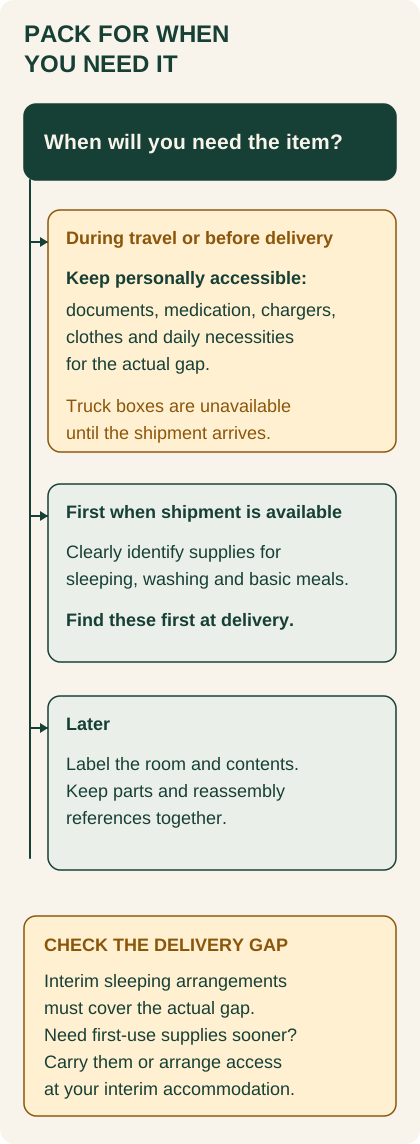
Bedding needed before delivery belongs in the accessible group. Carry it or arrange access at your interim accommodation; a first-use shipment box cannot cover that night.
Do keys and loading access line up?
Confirm key availability, parking and loading instructions, and written building requirements, including an elevator reservation when applicable. Compare them with the mover’s pickup or delivery arrangement.
If a slot and delivery window differ, ask both parties what they can accommodate. Use the long-distance access steps below.
Is the interstate bill of lading ready in time?
For an individual shipper’s interstate household-goods move, 49 CFR 375.505(h) requires the bill of lading to be provided to, signed and dated by the shipper “at least 3 days before the shipment is scheduled to be loaded”. It also requires an opportunity to rescind without penalty for three days after signing. Check the document and loading dates now.
The paragraph has a specific exception: additional items or services requested on move day that result in a new binding estimate under 375.403(a)(6)(ii) or non-binding estimate under 375.405(b)(7)(ii), and corresponding bill-of-lading changes, do not restart that three-day period.
Compare scheduled loading with the document date separately from personal departure or key collection. Keep the signed copy with the estimate so the date, estimate type and services can be checked together. If the document or timing is unresolved, contact the mover before loading.
What can you prepare for handover?
Clean areas as they empty. Arrange final meter readings and condition records where your provider or tenancy process uses them. Use the moving-out checklist for detailed leaving tasks.
Moving day
Pickup and departure
Track belongings against the inventory during loading. Note visible condition, photograph problems promptly and retain moving-document copies. After loading, search closets, cabinets and drawers and complete the applicable handover records.
Keep your personal essentials out of the shipment.
Delivery and personal arrival
At delivery, compare items with the inventory, note visible problems and contact the mover about specific discrepancies. Keep the observations, photographs and documents together.
Stacking can hide a single-side label. Put room names and contents where they remain readable, or use an accessible contents lookup, so first-use boxes can be found.
At your own arrival, check essential services and establish sleeping, washing and basic meals. If delivery is later, use your carried necessities and interim sleeping arrangements.
The first week after the move
Work toward a usable home in stages: services and carried necessities first, then beds, toiletries and a basic kitchen. Inspect and unpack priority rooms as belongings arrive, then finish remaining account updates.
How do you find and sort what remains?
Room names and box numbers linked to a contents note provide a useful lookup when stacked labels disappear. Look up the needed item, identify its box number, and open that box before disturbing the rest.
Keep one list of missing or damaged items, pending delivery and unresolved service or access arrangements, alongside document copies and provider contacts. For each follow-up, record what you observed, whom you contacted and the reply. Check any new appointment against your calendar before closing the task.
How to adjust the timeline for a long-distance move
Keep four calendar entries: shipment pickup, personal travel and key access, the agreed delivery period, and building access. Plan necessities and somewhere to sleep through the actual gap. Follow the comparison between entries 03 and 04 below.

An unconfirmed elevator match stays in coordination. The separate delay route starts when a bill-of-lading pickup or delivery period will be missed; revised expectations then feed back into travel, access and service plans.
What does the agreed delivery period tell you?
For non-guaranteed interstate household-goods service for an individual shipper, 375.505(b)(6) requires the “agreed date or period of time” for both pickup and delivery in the bill of lading. Compare both entries with travel and access plans. A delivery period does not establish an exact elevator appointment.
What changes when an agreed period will be missed?
For an individual shipper’s interstate household-goods move, 375.605(a) requires the mover to notify you at its expense “as soon as the delay becomes apparent” when it cannot meet the bill-of-lading pickup or delivery dates or periods. Under paragraph (b), it must advise expected replacement dates or periods, considering your needs.
Ask for that revised expectation, retain the communication, and recheck travel, access and service plans. Confirm what can now be accommodated before relying on a new appointment.