Moving to another state checklist
Regulatory text checked .
Build your interstate moving checklist around housing access, personal travel, shipment pickup and delivery. Before committing, check the mover’s documents, destination record requirements, utility activation and each household member’s coverage dates.
Choose your situation
- Comparing an estimate? Match its type, listed goods and services, and contract terms before signing. Check the paperwork.
- Arriving before your belongings? Compare home access with the agreed delivery period. Arrange accommodation if home access also lags, and keep essentials with you. Plan the gap.
- Bills are in your roommate’s name? Ask the requesting agency or insurer which address evidence it accepts. Prepare your documents.
- Coverage dates do not meet? Obtain written end and start dates for each affected person. Check the transition.
- Flying while belongings travel separately? Confirm who collects, loads, transports and receives them, including help at both ends. Assign the responsibilities.
What changes when you move to another state
Crossing state lines adds destination-record tasks. Distance adds travel, handoff and arrival dependencies. A long journey within one state and a short move across a state border can therefore need different plans.
Who travels and who handles the goods?
Compare transport options against your budget, time, storage needs, amount of belongings and comfort driving a large truck. Identify who supplies loading and unloading help. A rental truck, a transported container and a full-service move assign different work to you.
Confirm who receives the shipment at the destination.
What must be confirmed before committing?
Check your federal interstate moving paperwork
The Part 375 consumer rules apply to household-goods motor carriers serving individual shippers through interstate motor-vehicle transportation. Mileage alone does not establish coverage. Do not automatically apply these requirements to a DIY rental or parcel shipment.
What does the estimate actually cover?
Under 49 CFR 375.401, the mover provides a written estimate before executing the bill of lading and identifies whether it is binding or non-binding. Both parties sign; you receive a dated copy when the estimate is signed.
The mover must conduct a physical survey unless you elect to waive it. That waiver must be written and signed by you before loading. The mover retains it as an attachment to the bill of lading. Ask how the survey or waiver is documented.
Compare the same goods and services before comparing totals.
| Estimate type | Meaning of the total | Estimate fee |
|---|---|---|
| Binding | Guarantees the total for the quantities and services listed in the estimate. | The mover may charge for providing it. |
| Non-binding | Does not cap final charges, which use actual shipment weight and applicable tariff provisions. | The mover may not charge for providing it. |
A binding total is useful only alongside its scope. Check the inventory, packing services and access arrangements rather than assuming every task is included.
What happens if the goods or services change?
Section 375.401(i) permits a mutually agreed estimate amendment before loading and prohibits amending the estimate after loading the shipment. Keep that rule distinct from calculating final charges under a non-binding estimate.
Which dates and signatures belong in the contract?
The bill of lading requirements in 49 CFR 375.505 include agreed pickup and delivery dates or periods for non-guaranteed service. Guaranteed service lists dates and any contractual penalty or per diem entitlements, subject to tariff provisions.
A delivery period is not one promised arrival day.
You and the mover sign before loading; signatures are required at origin and destination. Obtain your dated copy when signing.
The bill must be provided to you, and you must sign and date it at least three days before scheduled loading. You also receive a three-day opportunity after signing to rescind without penalty. Corresponding bill changes for additional move-day items or services producing a new estimate under 375.403(a)(6)(ii) or 375.405(b)(7)(ii) do not require another three-day period.
What must be complete before signing?
Addressing the mover, section 375.505(g)(3) states: “You may not require an individual shipper to sign a blank document.” A permissibly incomplete document still contains relevant shipping information. Only information that cannot yet be determined may be omitted, such as actual weight for a non-binding shipment or unforeseen in-transit charges.
Ask the mover to explain a missing known term.
What protection did you elect?
Read the valuation statement for Full Value Protection or your written waiver in favor of released rates. Check applicable optional valuation charges. This records the mover’s liability choice; independent-insurer coverage sold or procured for you, including its premium, is recorded separately under 375.505(b)(12)–(13).
Locate the Delivery, Valuation and Independent insurance entries in this editorial field guide, then compare the corresponding fields in your own document set:
- Pickup and delivery dates or periods matching the agreement.
- Valuation election or waiver and any separate insurance premium.
- Shipping information, inventory, estimate, signatures and dated copies.
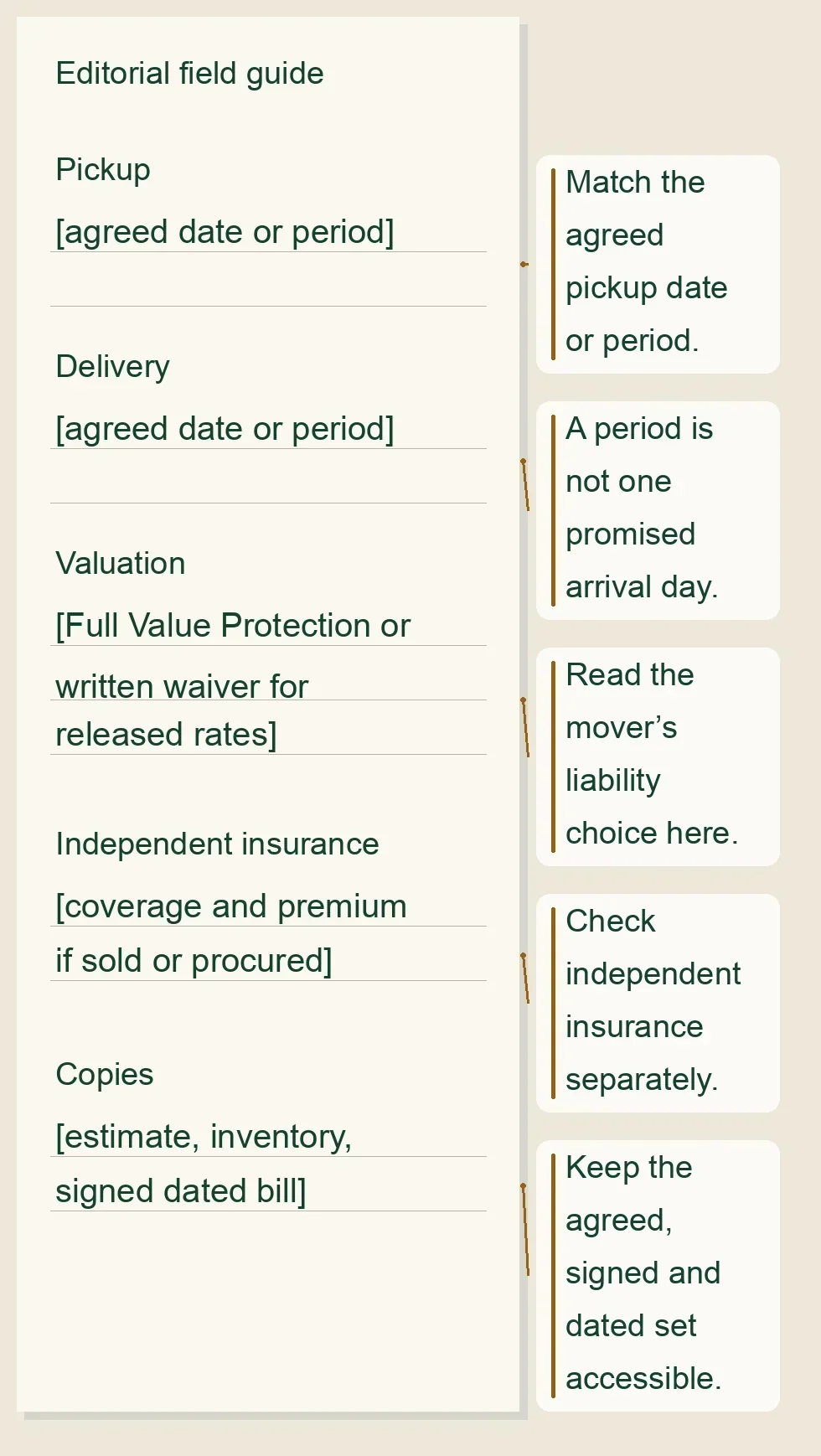
The Delivery line allows a date or a period; use the whole agreed period in your plan. Read Independent insurance separately from the Valuation election. Keep the agreed, signed and dated document set accessible during travel.
Prepare your license, vehicle and voter registration updates
Which office and deadline apply?
Find your destination motor-vehicle agency through USAGov’s government address-update routes. Track your driver’s license and vehicle registration separately. Record each applicable deadline, prerequisites, accepted documents, appointment process and completion confirmation.
Vehicle tags can be overlooked even when the license is on your list.
Use a separate line for each task so one completed appointment does not hide another requirement:
| Task | Record before the appointment | Keep afterward |
|---|---|---|
| Driver’s license | Destination deadline, identity and address evidence, prerequisites and appointment instructions. | The office’s completion confirmation or stated next step. |
| Vehicle registration | Destination deadline, vehicle documents and insurance requirements. | Registration confirmation and any remaining task identified by the office. |
For voter registration, select your state or territory at vote.gov, note its registration deadline and follow its completion or status-check instructions. Treat this as a direct records task, separate from postal forwarding.
Will your address evidence be accepted?
If documents and appointment availability do not align, contact that office or insurer before the appointment or stated policy date. Keep its response and accepted next step with your records.
Add unresolved evidence requirements to the schedule.
Confirm address changes, utilities and access to essential records
Arrange postal forwarding and directly update essential agencies and accounts. Forwarding does not complete their separate records changes.
Use the complete checklist to update your address and records for USPS, direct notifications and utility stop/start confirmations.
Will utilities work when you arrive?
Confirm activation or transfer dates with each provider. Ask whether access or an appointment is needed, and obtain confirmation of when service will be usable. Match that date to your arrival and housing access.
Keep old-home disconnection and new-home activation as separate requests. If activation requires someone to provide access, assign that person before confirming your arrival arrangements. An account confirmation and a service appointment may describe different steps; ask which still needs completion.
What must stay with the household?
Carry identity and move documents, agency instructions, contacts and confirmations where you can reach them during your actual travel method. Keep readable backups. A folder inside the shipment cannot help while the shipment is still traveling.
Arrange relevant household care-record transfers and identify destination provider contacts before leaving. Keep transfer requests and contact details accessible alongside your other records.
If your bank has no destination branch, confirm access to the services you actually use before deciding whether another account is useful.
Check taxes, insurance and benefit transition dates
Which tax records need direct attention?
Follow the IRS address-notification instructions: use your new address on a return filed after the change, or its appropriate Form 8822, written-notice or phone method. Notify your preparer too. Postal forwarding alone may not deliver government checks.
Identify the relevant state tax agencies and obtain instructions for your circumstances. An address update does not determine your tax residency or filing obligations.
When do your coverage periods end and begin?
Send a focused inquiry to the administrator:
Please confirm [person]’s coverage end date under [current plan]
and effective start date under [new plan].
For [person] moving to or remaining in [location], which
instructions and documents apply?
If there is a gap, who can confirm the applicable options,
application steps and effective dates?
Moving day and a job start date do not establish coverage.
For vehicle and other insurance, confirm destination details, required evidence and effective dates with the insurer, coordinating with actual motor-vehicle instructions. Obtain the applicable sequence before changing or canceling policies.
Update relevant benefits-agency records directly and retain confirmations. Ask your employer what relocation support includes and excludes before counting it in your moving budget.
Build your long-distance moving timeline
Which dates depend on which confirmations?
Keep five separate entries: old-home exit, new-home access, personal travel, shipment pickup and contractual delivery. Add agency appointments, utility activation and coverage dates. Follow each confirmation to its affected entry in the diagram; attach unresolved requirements to that entry.
For each entry, write the date or period, who confirmed it, the contact to use if it changes and any prerequisite still open. Check your old lease’s notice and exit terms before choosing a departure date. If housing depends on sale proceeds or another closing, discuss that dependency with the people handling the transactions before treating access as firm.
Budget for the arrangements this calendar actually creates: travel, loading help, storage, accommodation, housing deposits and any overlap between homes. Compare those items with confirmed employer support. A shipment quote alone will not describe the household’s entire relocation expense.
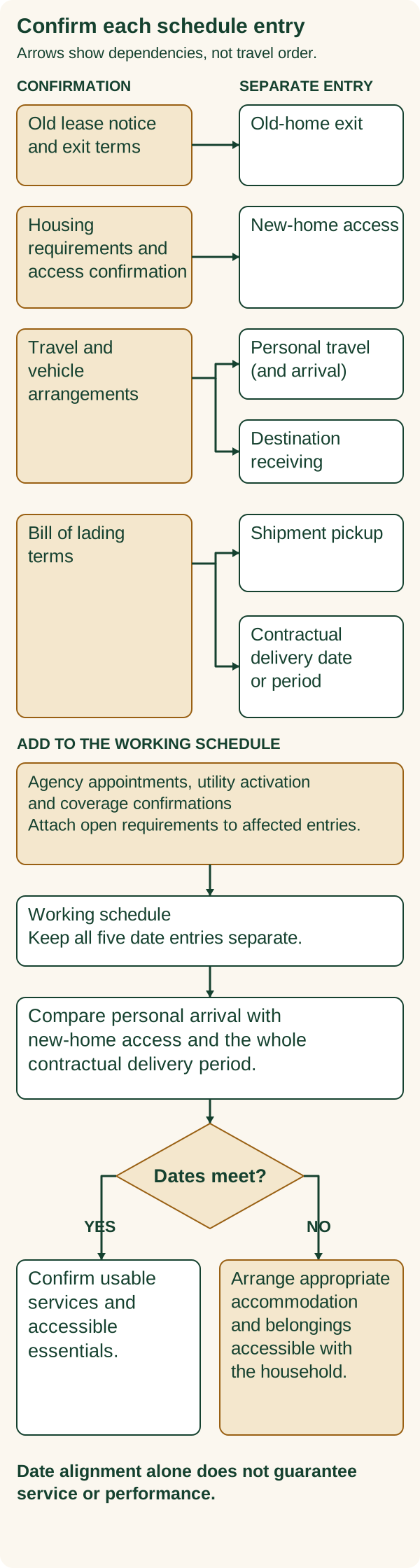
Travel arrangements feed both Personal travel and Destination receiving; the bill’s terms feed Shipment pickup and Contractual delivery. If the dates do not meet, follow the No branch to arrange accommodation as needed and keep essential belongings with you.
What happens between departure and delivery?
If you arrive before home access, arrange accommodation. If you can enter the home before the shipment arrives, arrange sleeping and everyday essentials independently. Use the whole agreed delivery period when checking these arrangements.
Keep sheets, towels, toiletries, toilet paper and eating supplies accessible with the household, scaled to your travel and arrival gap.
- Before departure: reconfirm mover arrival time, pickup and destination addresses, contact details, housing access and utility activation. Keep records and essentials within reach.
- After arrival: check actual service access, complete destination-record tasks under the responsible offices’ instructions and retain confirmations.
Leave unresolved dates, documents and coverage questions on the working checklist.