New house move-in checklist: first things to do as a homeowner
Secure the house, confirm essential services for its first use, check alarms and locate the main controls. Record unresolved problems and owner account details before turning to decorating and other improvements.
Choose your situation
- Moving in now? Prioritize access, working services and safety before sleeping there. Open your inspection report and start with the first arrival checks.
- Keys before moving day? Arrange services for the first cleaning or trade visit while keeping old-home services separate. Check your provider confirmations against the service dates.
- Inherited locks or codes? Inventory entry points, contact a locksmith and find the installed systems’ instructions. Begin the physical and digital access review.
- Moving into a new build? Collect the builder’s handover and warranty instructions, record condition and check installed safety systems. Use those documents for the new-build checks.
- Joining an HOA? Find the manager in your property records. Confirm owner contacts, account access and the actual dues calendar through the HOA setup checks.
Full contents
- Choose your situation
- First things to do in a new house
- Cleaning starts before move-in
- Security: locks, codes and alarms
- A window starts to fog
- Which codes and accounts still allow entry?
- Utilities, services and HOA setup
- What if both homes are still in use?
- Keys arrive while the old home is still in use
- What should you confirm with the HOA?
- Safety checks and documenting condition
- Where are the controls, and are the labels clear?
- Are smoke and CO alarms ready?
- What belongs in the condition record?
- Which new-build coverage and checks apply?
- A later inspection raises a new-build issue
- Address changes and records
- What goes in a simple home file?
- Settling-in tasks for the first weeks
- How do you build a routine with unknown service history?
First things to do in a new house
Use the inspection report to separate unresolved safety and functional problems from improvements. Before the first night, give attention to exterior access, essential services, alarm readiness and the locations of important controls. A room needing paint can wait while you arrange help for a door that will not lock.
If the house will stay empty, confirm water and electricity before cleaners or trades arrive. Furniture delivery may be later than the first visit.
Check off a result you can identify.
- Access: retained keys operate the intended locks; an unresolved fault has a repair contact.
- Service: the provider has confirmed the new-address start, with any remaining step recorded.
- Controls: the water shutoff and electrical panel locations are recorded.
- Condition: each urgent inspection item has a next action and contact.
These are suggested priorities for a usable starting point. Move decorating and nonurgent upgrades to your first-weeks list; use the detailed checks below to resolve access, services and safety questions.
Security: locks, codes and alarms
List exterior doors and the keys handed over. Ask a locksmith whether the installed locks can be rekeyed or need replacement. Having the keys does not tell you who else retains a copy.
Check that doors and windows close and their locks engage. Record the exact location of anything that sticks or fails.
Check physical access and installed digital access separately:
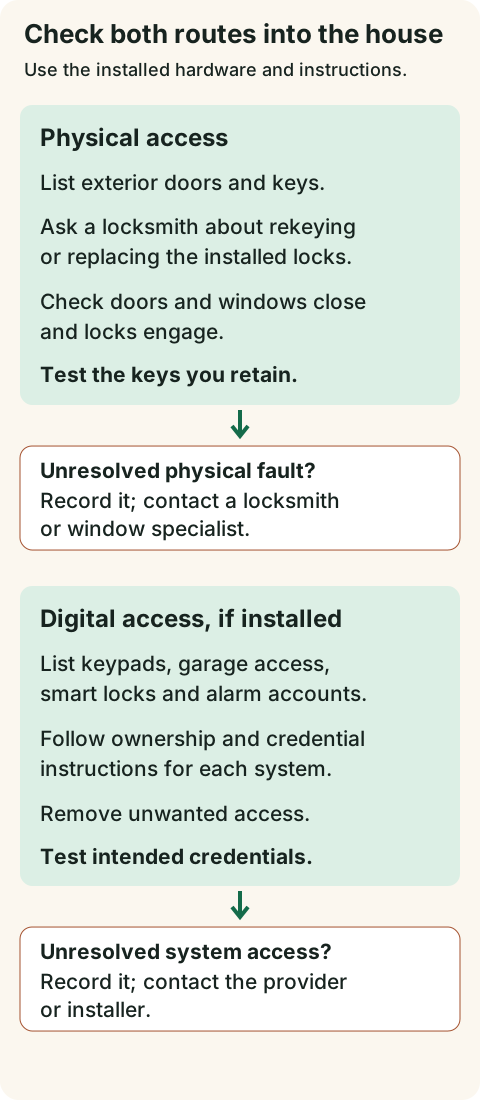
A working key leaves the digital route open. Review each installed system before marking access complete.
Which codes and accounts still allow entry?
Review installed keypads, garage access, smart locks and the security alarm where present. Find each system’s instructions and contact its provider or installer about ownership and access changes. Remove unwanted guest credentials through the supported procedure; do not assume changing one keypad code updates every account or device.
Keep unresolved access faults on the repair list with the appropriate locksmith, installer or window specialist as the next contact.
Test the keys and credentials you intend to retain, and confirm the removal of unwanted access. Smoke and carbon monoxide alarm readiness needs a separate check in the safety section.
Utilities, services and HOA setup
Confirm electricity, water, gas if present, trash collection and internet with the providers serving the property. Record the account contact, agreed start date, confirmation reference and any outstanding activation step.
A running tap does not confirm your owner account.
What if both homes are still in use?
Include any cleaning or contractor visit before moving day. Ask the provider to confirm its required documents, deposits and activation arrangements for your addresses.
Keep the dates you need beside the dates the provider confirms:
| Record | New home | Old home |
|---|---|---|
| Your need | [first-use date, including cleaning] | [last-use date] |
| Provider confirmation | [confirmed start] | [confirmed end] |
| Follow-through | [account/contact, reference, remaining step] | [account/contact, reference, remaining step] |
A first-use date in the top row still needs a confirmed start beneath it. Keep a requested date open until the provider responds, and check that starting the new service has not unintentionally ended one you still need.
What should you confirm with the HOA?
If the property belongs to a homeowners association, confirm your name, mailing address, email and manager contact. Request account access, the governing documents, actual dues calendar and payment instructions. Save the response with your property records.
If no welcome packet or bill arrives, contact the association or manager listed in those records. Silence leaves the setup unconfirmed.
For a later statement with an unexplained prior balance, request an itemized account record and explanation. Keep the statement and manager’s reply together for follow-up.
Safety checks and documenting condition
Where are the controls, and are the labels clear?
Locate the main water shutoff and electrical panel. Record their locations clearly enough for another household member to find them. Ask qualified help to explain unfamiliar controls and verify uncertain labels.
A printed label alone does not establish accuracy.
Leave panel opening, electrical repair and gas disconnection to appropriate professionals. Keep access to the identified controls clear as boxes arrive.
Are smoke and CO alarms ready?
The U.S. Fire Administration recommends smoke alarms in bedrooms, outside separate sleeping areas and on every level, including the basement. Compare their locations with the rooms you will actually use for sleeping.
Test smoke alarms using their instructions and review manufacture and replacement information. USFA recommends monthly testing and replacement ten years after manufacture. Check the device’s specific care instructions too.
USFA recommends replacing 9-volt smoke alarm batteries and hardwired smoke alarm backup batteries at least annually. Sealed long-life models have nonreplaceable batteries; replace the whole alarm according to its instructions. Use a qualified electrician for hardwired installation.
USFA recommends CO alarms near separate sleeping areas and on each level. Follow the installed model’s testing and replacement instructions; do not apply the smoke alarm replacement age automatically to a CO device.
What belongs in the condition record?
Review unresolved inspection items alongside current observations. Keep immediate safety and functional needs separate from improvements. Record what you see before assigning a cause, deciding coverage or choosing a repair.
Copy this blank entry for each issue:
| Field | Your entry |
|---|---|
| Date and location | [date observed; room/component] |
| Observed symptom | [what you saw or what failed to operate] |
| Supporting record | [photo filename or inspection report reference] |
| Contact | [assessment contact; warranty reporting contact if applicable] |
| Request and response | [date sent; confirmation; reply] |
| Next action | [follow-up or assessment to arrange] |
Here is a hypothetical filled entry for window fogging. Keep the visible symptom separate from the assessment you request.
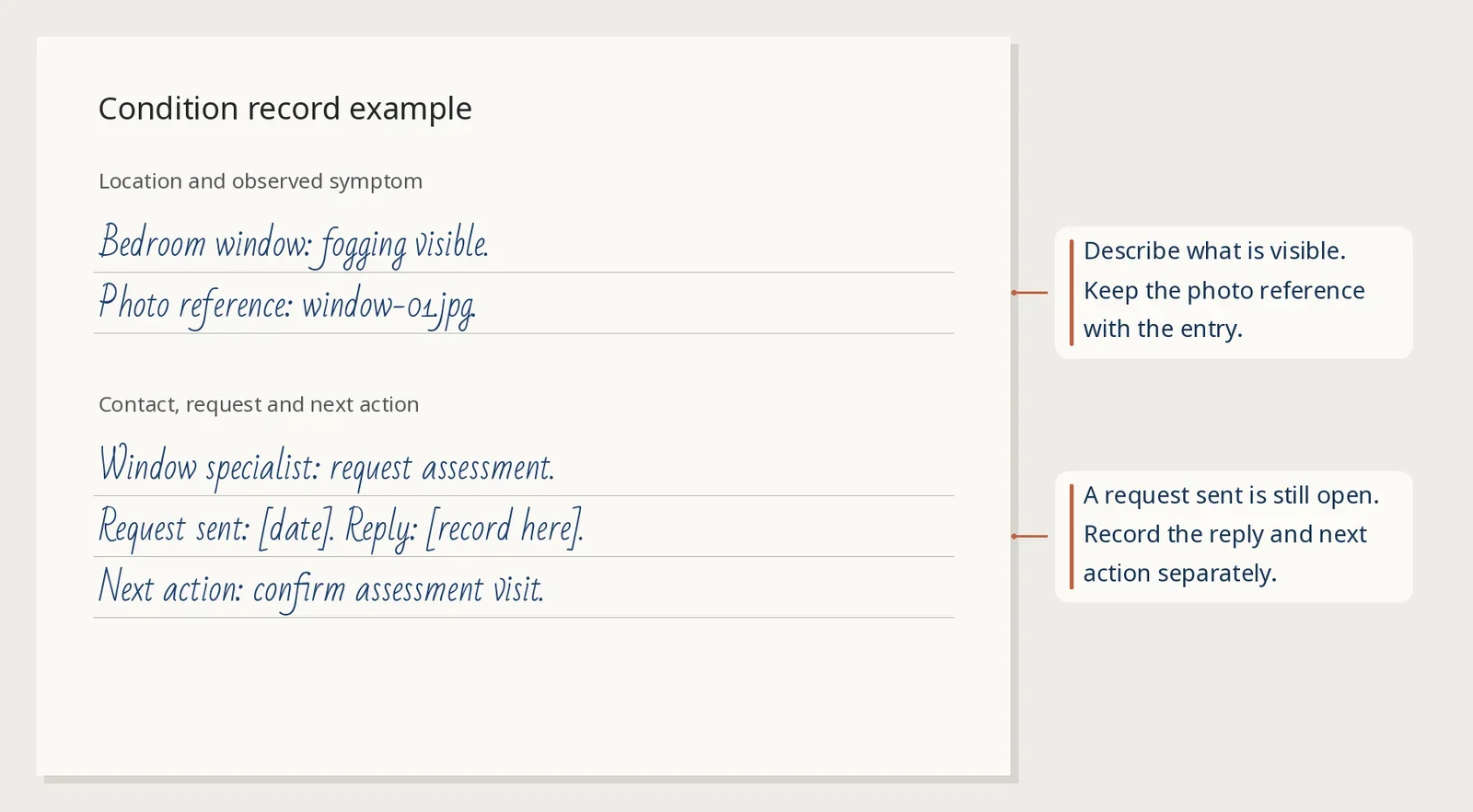
The reply field is still open. Add the assessment and any coverage decision when received, rather than recording them as part of the original observation.
An earlier inspection does not close later observations.
Which new-build coverage and checks apply?
Keep the builder warranty, any paid home service contract and appliance manufacturer coverage distinct. The FTC’s new-home warranty guidance explains these differences. In your actual documents, find the relevant component, exclusions, coverage end date and reporting route.
Follow the warranty’s claim instructions and put the repair request in writing, retaining copies and replies. Follow up with the named builder or warranty contact if receipt or the next action is unclear.
If your new build has a passive radon system, EPA recommends testing immediately after moving in. Follow the test provider’s or state radon program’s instructions. The installed pipe does not tell you the test result.
Address changes and records
If you need forwarding, submit an official USPS change-of-address request, complete identity verification and retain the confirmation. USPS changes its mailing record; some mail will not be forwarded.
Forwarding does not update your accounts.
Update your lender or servicer if financed, insurer, financial accounts, employer and other important senders directly. Use each organization’s process and confirm the saved address. Check relevant state and local agencies directly for applicable record updates and their timing.
If the house is financed, locate the actual first-payment instructions. Verify the payee and due date through the lender or servicer contact already in your records, and keep the instructions with your account confirmation.
What goes in a simple home file?
A folder or binder can use these divisions:
- Closing and insurance papers.
- Inspection reports and dated condition records.
- Provider and HOA confirmations.
- Builder and manufacturer coverage with reporting instructions.
- Manuals and service contacts.
- Maintenance log and next checks.
Keep a backup you can retrieve when an issue arises. Add later service records to the same index rather than leaving them in separate message threads.
Settling-in tasks for the first weeks
Clean accessible kitchen and bathroom surfaces and empty cupboards before filling them where possible. If you have already moved in, work through one usable zone at a time instead of waiting until every room can be emptied.
Carry unresolved functional problems into a working list with a next contact. Keep decorating and other nonurgent improvements separate from current safety or service issues.
Assign unfamiliar work to qualified help.
How do you build a routine with unknown service history?
Start with the installed alarm, filter and appliance manuals and any known service records. Enter the next checks in your home log using those instructions. Where history is missing, ask the appropriate service professional what assessment is needed before choosing a maintenance date.
For each completed task, record the component, work date, instruction or service reference, next check and contact. The pre-purchase inspection gives you a starting record; add what you learn as you live in the house.
For a separate room-by-room buying list, use the new-home essentials to buy guide once your immediate setup tasks are addressed.